

(To subscribe to this newsletter, please send email to theNerve@symbolicsound.com with Subscribe as the subject)
FREE Psychedelic trance party this Saturday May 24 (same location as last weekend). Kyma Sounds by gragglasport at an undisclosed location in the general vicinity of New Jersey. (Bring camping gear and life support.)
On Thursday, May 29, William Meadows will be performing in Brent Fariss' composition Shining White Air for vibraphone, wind sextet, and live electronics in Austin, Texas. Meadows will be using Kyma to process the acoustical instruments, using resonators, ring modulators, granulators, and live sample capture and playback. The work will open a program which includes a performance of Pauline Oliveros's Four Meditations with the composer in attendance.
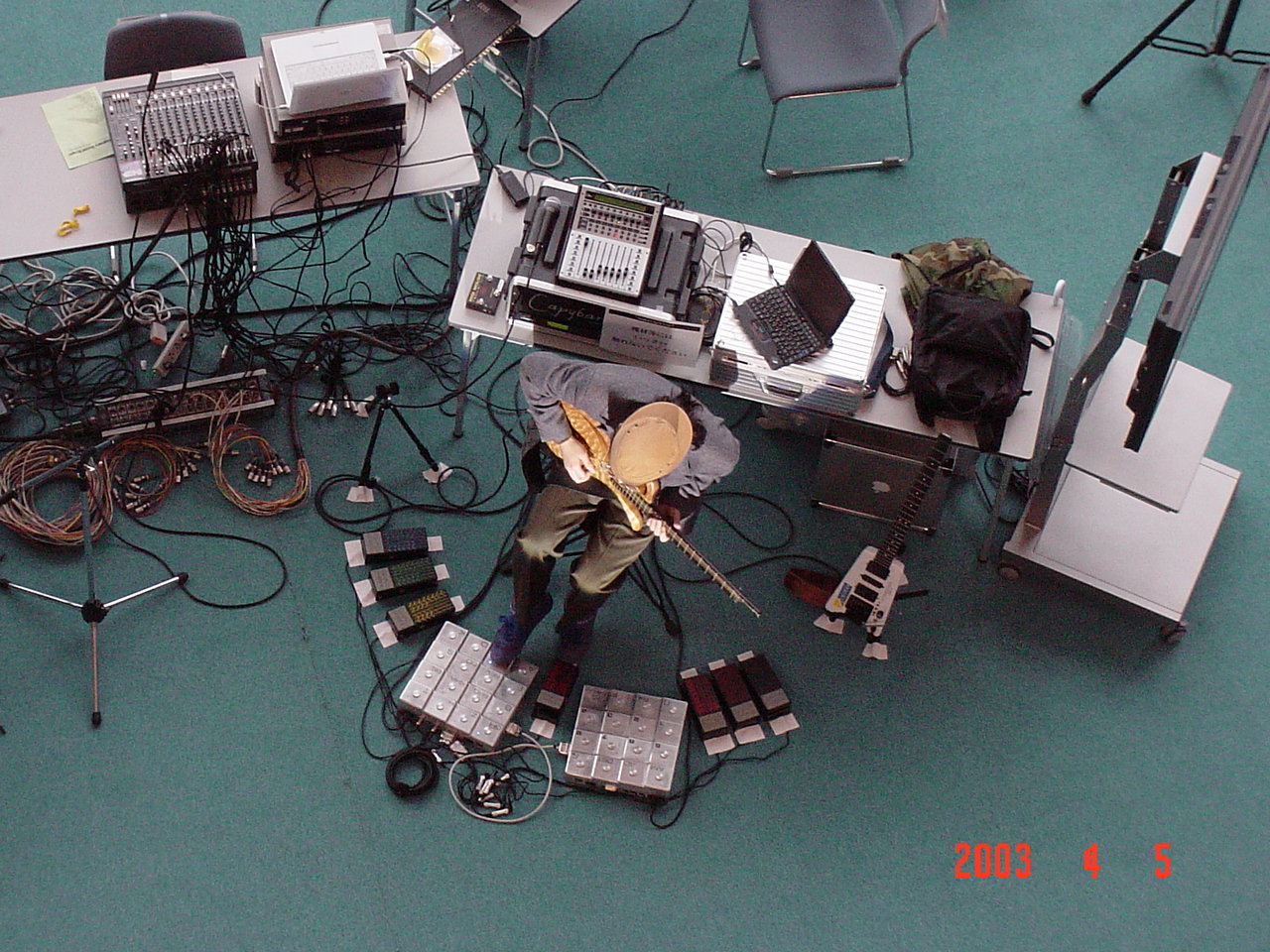
Yasushi Yoshida performs seated in the center of the audience and surrounded by live multichannel Kyma processing (giving new meaning to the term "surround sound"). For an overhead view of his setup (including a dual, multilevel foot switch control of his own design), see http://www.eonet.ne.jp/~channel-d/media/perform.JPG
Electronic Music Foundation (http://www.emf.org) is producing a series of concerts on June 3, 4 and 5 at the Chelsea Art Museum, W 22nd Street and 11th Avenue (http://www.arts-electric.org/specialpages/030515emf.html). Words & Music, on Tuesday, June 3 at 8 pm, features Chris Mann's Plato Songs, Kenneth Goldsmith's 73 Poems (performed by Joan La Barbara), and Joel Chadabe's Many Times Chris. Mann reads and Chadabe uses Kyma to electronically multiply and transform Mann's voice, sending it around the room, left, right, up, down, everywhere, creating a complex verbal and musical fabric.
http://www.apple.com/pro/music/devine/index3.html
A Kyma user who, for various reasons prefers to remain anonymous, will be generating the sounds for Reflected Moment Masher: a Psychedelic trance party under the gurgling cosmic splinter field this Saturday May 17. If you come, be prepared to camp, and bring along any necessities like food, water, (and electric generators?, ed). For driving directions, email gragglasport.
On Monday, May 19th at 7 pm, composer Tamami Tono will present a live concert performance in the offices of the Japan Society on East 47th Street in New York. Tono is the recipient of the second Siemens' "Artist-In-Residence" award and is working in the U.S. in conjunction with Yo Yo Ma's Silk Road program.
Claudio Lugo (http://www.rubicondor.it/lug.htm) provided interactively surround-processed sounds for A Stars' Collier for Cathy — a special production at Teatro Ariosto on Tuesday 13 May 2003 dedicated to Cathy Berberian and featuring pyrotechnic vocalist Cristina Zavalloni (http://www.cristinazavalloni.it). In several movements, each named for celebrated female performer, the piece featured special sound objects for each artist: diamonds in a tin box (Marilyn Monroe), kitchen set for eggs' recipe "à la Marlene" (Marlene Dietrich), hairbrush (Julliette Gréco), great archaic iron maracas (Maria Callas - Medea), great plastic paper white flower (Billie Holiday).
The 2003 International Conference on New Interfaces for Musical Expression—NIME-03 will be hosted by McGill University in Montreal from 22-24 May 2003. The conference will be a three day event including research papers, demos and performances presenting the state-of-the-art in new interfaces for musical expression. Joel Chadabe will be using a new performance interface of his own design to control Kyma in live performance on the 24th (Saturday). Also featured in concerts and installations are Yoichi Nagashima and Garth Paine. For more details see http://www.nime.org.
On Thursday 11th of September 2003 in Ealing (London), Modular2003 will feature presentations and installations by Kyma artists Garth Paine and Robert Jarvis (http://www.modular2003.com).
On Monday April 28 at 8 pm, Joel Chadabe's composition class at the Manhattan School of Music is putting on a concert of live electronic music using Kyma in Greenfield Hall. The Manhattan School of Music is located at the corner of Broadway and 122nd Street on the upper west side. (See directions at http://www.msmnyc.edu/about/directions/). The concert is free and open to the public.
For centuries, explorers have reported that crescent-shaped sand dunes can emit low sounds like that of a turbo-prop airplane (giving rise to a legend involving the ghost of a buried dinosaur). Apparently the best way to experience the effect is to climb to the top of a dune and then slide down the steep slip face (causing a small avalanche). A news item in the 4 April issue of Science (page 47), describes how a team headed by Stephane Douady was able to replicate this sound by slowly turning 72 kg of Moroccan sand in a 2 meter doughnut shaped container. Douady believes that this phenomenon can be explained by something called the Reynolds dilatency—a vibration created by the dilation and compression of air as grains separate and come together. (http://www.lorentz.leidenuniv.nl/~mvhecke/Workshop/granular_workshop.html).
For more links and sound recordings of "singing sand" see
http://www-personal.engin.umich.edu/~nori/booming_sand.html
http://www.desertusa.com/magjan98/dunes/jan_dune1.html
http://www.bigai.ne.jp/~miwa/sand/index.html
http://www.schweich.com/sbdA.html
Edmund Eagan is seeking submissions of Kyma sound art for a DVD-A compilation disk. Sound art, sound design, and all musical genres will be considered (http://www.twelfthroot.com/12_html/ra01.html). Each work will be presented in three formats: stereo, DTS encoded surround, and full 5 discrete 24/48kHz channels. Submissions have already started to come in, and the deadline is the end of next month, so it's the perfect time and incentive to finish off that project you've been working on and get it out for the world to hear!
With Spectrality, Disney animator Marcus Hobbs continues his use of Kyma to create microtonal melodies using ancient scales against a backdrop of acid techno beats. For more of Marcus' music visit http://artists.mp3s.com/artists/537/perfect_buzz.html
Lorenzo Brusci announces an MP3 version of a timet compilation called COMPILATIONE classicism meets the beat: an electronic tuscan scene now available on http://www.timet.org. (Kyma was used on two of the pieces). You may freely use this music under a EFF legal licence. To support the timet project, order their CDs!
On April 18, Chris Guest (of This is Spinal Tap fame) is set to release his new film, this one centered on the folk music groups of the early 60s. A Mighty Wind (http://www.rottentomatoes.com/m/AMightyWind-10002036/preview.php) is based on the premise of a memorial concert celebrating the life of a folk music promoter by reuniting some of his most famous acts (some of whom haven't performed together for 30 years). Sound designer Hamilton Sterling used Kyma to do a manually-controlled decode of the MS stereo production recordings that were made during the number of impromptu rehearsal scenes leading up to the final concert. This allowed him to cross-fade from stereo music to mono dialogue within a shot without a jarring change in perspective (helped along by some stereo backgrounds). Sterling also used Kyma to record all the crowds in quad and 5.0. For the backstage scenes, he played back the concert material through various sources and re-recorded it in the original dressing rooms and backstage areas for a you-are-there verisimilitude. Kyma was also used to create the rapid on-board car bys and car idle bys during the scenes of travelling through New York.
TransParrot, an Internet sound installation by Glen Sparer, is running all this week at the San Jose State University Art Studio Space. The installation consists of a bird cage with an iMac inside (where the iMac is receiving streaming images and audio of/from Glen's parrot in his home in Oakland, California). Next to the bird cage is a podium with Charles Darwin's book on human behavior (a lesser known and earlier work than Origin of Species). A microphone attached to the podium feeds into the Capybara Input 1 and the audio from the iMac in the bird cage (the parrot sounds) feeds into Capybara Input 2. The Capybara-processed output is played live in the studio space and also transmitted back to Glen's house via the Internet for his parrot to hear. The parrot occasionally decides to comment on the commotion, and this sound then comes back to SJSU and back into the Capybara. Gallery participants are invited to read any passages from the Darwin book at any time. Glen designed a 90-minute TimeLine for processing the two inputs. No birds were harmed during the production of this installation (the parrot declined to be interviewed). Sparer is a graduate student of Brian Belet at SJSU.
Lorenzo Brusci's CD set, Zarathustra, the last animal —timet2002, is reviewed by Ken Hollings in the April issue of The Wire #230 (http://www.thewire.co.uk/).
A concert to be held on May 9th at Centro Tempo Reale in Florence as part of the 14th Colloquium on Musical Informatics will feature a performance of Agostino Di Scipio's "Ecosistemico Audibile n.1" 2002 (solo live electronics) with Di Scipio and Alvise Vidolin at the controls. This piece explores the relationship between an acoustic space and feedback controlling the parameters of several Kyma Sounds (which are then fed back into that space).
On May 16th at the Conservatory of Naples Stravinski Hall at 19:00, Di Scipio's "6 studi dalla muta distesa delle cose" (1998) for piano + interactive signal processing will be performed by Ivano Morrone, piano.
Two Di Scipio tape pieces were included on an April 3rd concert at the Ukrainian Institute of Modern Art in Chicago: "Paesaggio Scalare n.1 (Rome, Cantor Set)," 1998 and "Paesaggio Scalare n.2 (Berlin, bad sampling)," 2000.
An international festival of contemporary music in Croatia, the 22nd MUSIC BIENNALE ZAGREB (http://www.biennale-zagreb.hr), will take a place from 4-12 April 2003. According to the artistic director: The central point of the MBZ 2003 will be an extensive exhibition on SOUND and TECHNOLOGY, open-air performances given by various artists, workshops, play-rooms and toys (for everybody!), afternoon, evening and night concerts.... For this occasion, Zlatko Tanodi has written an interactive composition—mo-RE for string quartet and Kyma--which is scheduled for performance during the Electronic afternoon on the 8th of April.
Yasushi Yoshida (jazz guitarist) and Fumitaka Nakamura (University of Tokyo) are taking part in a concert called Imaginary Soundscape: Sound and music with digital technology on 5 April 2003 at 18:30. The venue for the concert is the National Museum of Emerging Science and Innovation in Tokyo. For further information on how to get tickets or how to watch the concert streamed live over the Internet, visit http://iss.nc.u-tokyo.ac.jp/index-e.html
James Paul Sain is the organizer of the Twelfth Annual Florida Electroacoustic Music Festival (http://emu.music.ufl.edu/femf/fest12prg.html). This year's concerts include works by several Kyma artists including: Eclipse by Robert Scott Thompson, The Insectivora Honor Their Dead by Robert Dickow, Lyra by Brian Belet, Second Thoughts by Dennis Miller, TV Scherzo by Sung-Ho Hwang, Klangschatten III for percussion and tape by Seong-Joon Moon, Simple Matter by Lawrence Fritts, The Leaking Noise by Jeffrey Stolet, and Scattered Voices by James Paul Sain.
Dennis Miller's Vis á Vis is the winner of this year's New England Film and Video Festival Best Animation Award. His work was presented as part of the festival on March 27th at 7 p.m. at the Brattle Theatre in Cambridge, MA (http://www.bfvf.org/festival/
Warner Bros. Dreamcatcher opened in theatres March 21, 2003, but most of the buzz seems to be centered on the 9-minute animated "short" that will be paired with it. The Final Flight of Osiris, a fusion of CG animation and Japanese anime serves as a link between the Wachowski brothers' The Matrix and its much anticipated sequel The Matrix Reloaded (scheduled for May release). Included on the soundtrack is music by Ben Watkins and his Kyma-ite collaborator Greg Hunter (aka Juno Reactor). Listen for Kyma-generated granular feedback, vowel filters and surround effects courtesy of Greg and his transatlantic Capybara. (http://www.intothematrix.com).
Dennis Leas will present a demo of his Looper Construction Kit (http://www.greenteasoftware.com), a large collection of custom Kyma plug-ins for live looping, at Loopstock 2003 on April 5. Loopstock, an international gathering of looping aficionados, will be held Saturday and Sunday, April 5th and 6th at Chumash Auditorium, located upstairs in the Julian McPhee University Union on the campus of Cal Poly State University, San Luis Obispo, California U.S.A. In addition to several live performances, the event will provide an opportunity for looper software/hardware manufacturers to present their products. For an ongoing discussion of live, loop-based music, see http://www.loopersdelight.com/loop.html.
Brian Belet's Lyra for violin processed live through Kyma was performed in St. Paul Minnesota as part of the SCI-Region V Conference at Macalester College on Friday, March 7, at 1 pm, with Minneapolis violinist Zack Kline performing. Belet's (Disturbed) Radiance, for live piano processed through Kyma, was premiered in San Jose California on March 12 by pianist Janis Mercer.
Agostino Di Scipio's ESSAI DU VIDE. SCHWEIGEN (1993) for 2 digital tracks and Fred Szymanski's DUE REMIX (2001) were played on a concert at Galleria Toledo in Naples on 14 March 2003.
Some of the evil sounds designed by Mathis B. Nitschke (http://audionomio.de/) for the film Resident Evil are to be included on a new 7 CD set available from Hollywood Edge (release date: March 3, 2003). The Evil FX sound library includes such all-time favorites as: 59 KYMA ZOMBIES 1-10, 56 PROCESSED BEAST 1, 86 KYMA HELICOPTER, 88 KYMA SCANNER, 89 KYMA MONK STORM, 91 KYMA RADIO DEATH, and more. For details check out http://www.hollywoodedge.com.
Jonathan Sager got a credit for "additional sound design with Kyma" on John Wilson's second Pig in a Can album: You Can't Poison a Pig (Fedora FCD 8002). Sager also shot the photos used on the album. Described variously as "the future of Nu-Blues, Nu-Blooze, Techno-Blues, and Avant-pop," this collection of "De-mixes" pairs blues legend Harmonica Slim (http://iowablues.tripod.com/harmonicaslim.htm) with Meat Beat Manifesto's John Wilson on a journey through speech rhythms, blues, trip-hop beats and inside tips on how to kill a pig and which parts taste the best (the eyeballs). Each track begins with the voice of Harmonica Slim telling a story from his childhood on the farm or life on the road. Wilson picks up the rhythms of his speech, transforming it into an almost-rap. For a review of the first Pig in a Can album, see http://pulse.towerrecords.com/contentStory.asp?contentId=636.
Columbia University's Philosophy Hall is the venue for the Loops and Resonances concert, scheduled for Saturday March 8 at 6 pm. Joel Chadabe is using Kyma as the diffusion system for Jean-Claude Risset's Resonant Sound Space for surround-sound electronics. Also on the program is Philippe Manoury's 'En echo' with Juliana Snapper (soprano) and Miller Puckette (electronics).
"When Antonio Politano first invited me to write for recorder and electronics, in 1995," confesses Agostino Di Scipio, "I could hardly imagine that I would develop such a 'special interest' for such instrument(s). Curiously enough, my works for recorders and electronics seem to have attracted special attention these days." After its Lausanne premiere, DUE DI UNO (sopranino recorder, violin and Kyma) was played in Bologna (where the audience demanded an encore). An older work called THREE (1997), for voice (reading a short Gregory Corso poem), doublebass recorder and Kyma-generated tape will be played in Wien's EchoRaum on 8 March at 9:00 pm in a festival called "In Potenzia" (with vocalist Agnes Heiginger and recordist Angelica Castello). Also forthcoming are more performances of 4 VARIATIONS ON THE RHYTHM OF THE WIND (1995) for doublebass recorder and Kyma-generated tape: first in Naples (Fondazione Morra, on Sunday 2 March with Tommaso Rossi on recorder), then twice in Austria in Karnten (23 May) and Wien (Amman Studio, 24 May). The Austrian performances will be played by Angelica Castello featuring Susanna Boesch as a guest recordist (they will play 2 variations each). On the Bologna concert, Politano also played music written for his C-doublebass recorder and for his brand new (and huge) sub-doublebass recorder which has the same range as the string doublebass(!)
On Friday March 7, Carla Scaletti has been invited to present a 90 minute talk/demonstration on Kyma for music technology students followed by a discussion of careers in sound and music and a visit to the Arp 2600 mentioned in her online bio. The talk is part of the opening celebration for a new interdisciplinary College of Visual and Performing Arts at Texas Tech University (http://www.vpa.ttu.edu/).
Fred Szymanski (Laminar) was recently interviewed in the Italian e-zine ExibArt http://www.exibart.com/notizia.asp?IDNotizia=6646&IDCategoria=211 in connection with his participation in the ninth edition of the Sonic Acts festival in Paradiso and De Balie. The central theme of the festival is the fascination held by artists for the creative possibilities offered by giving musical form to light and space (http://www.sonicacts.com).
Claudio Lugo will be performing saxophone, mouth sounds, and other objects (like small stones in aluminum pans) with live Kyma processing and surround diffusion for the radical dance company PRIMA MATERIA's performance at the new Teatro del Lido di Ostia (Rome). ACTS-Sine Nomine is one of the first acts of the opening season for the new theatre and will run from February 28 through March 2, 2003 at 21.30.
Brian Belet will be performing live bass processed through Kyma on the NOW Music Festival in Pleasant Hill (San Francisco) California. His piece Still Harmless [BASS]ically will be on the first set starting at 7 pm, Saturday, February 22, 2003 (http://www.music.org/activities/reg/pc/pccurrnt.html)
David Mooney's work Perfect Grooming has been selected for performance at the 2003 SEAMUS conference at Arizona State University. The piece was extracted from a compositional matrix constructed with the Kyma timeline. The matrix consists of 30 minute layers of musical material that can shifted incrementally in either direction—structure remains constant while content changes. The beginning of each layer equals its end so that they can be looped. In this way compositions of any length can be extracted by choosing the starting point for each layer and recording/playing/performing for any desired length of time. For conference info, see (http://isa.hc.asu.edu/seamus/). For info on Mooney's matrix, see (http://www.city-net.com/~moko/aceg.html).
NEW WORLD RECORDS (http://www.newworldrecords.org) announces the release of Eric Chasalow's Left to His Own Devices (CATALOG # 80601-2), featuring seven of his electro-acoustic works. Two in particular, Left to His Own Devices and Suspicious Motives, pay homage to his Columbia-Princeton mentors; the former is built from vocal samples of Milton Babbitt and the sound of the RCA synthesizer while the latter incorporates two motives from Mario Davidovsky's music—primarily the opening to Synchronisms #6. Chasalow writes, "In spite of my long history with electronic music, the technology is not my focus." Of related interest: 80440-2 Eric Chasalow - Over the Edge.
Joel Chadabe used the CCMIX Kyma system to do a live realization of John Cage's Birdcage on Thursday night the 30th of January in Paris as part of an Hommage à John Cage at the Fondation Cartier pour l'art contemporain / 261 Boulevard Raspail / 75014 Paris. Starting at 8:30 pm and running until at least 11:30 pm, the evening included a selection of audio and video documents including sound installations and conversations with leading figures from the worlds of art and music, together with the texts of Cage's poems and recordings of him reading them. For more info, go to http://www.fondation.cartier.fr/, click on Ce qui arrive, then on Soirees Nomades, then scroll down to the picture of Cage. Birdcage is a live stochastically mixed collage of the sounds including birds in aviaries, recordings of Cage singing his 'Mureau' and ambient sounds. While working in the studio and listening to tapes of himself singing Mureau, he commented, "It makes the birds seem less ridiculous." The live mix is intended to be played back in a space in which, as Cage put it, "people are free to move and birds to fly" (http://www.emfmedia.org/catalog/em113/).
On Monday night (1/27/03) Chadabe did a performance of his Many Times David with cellist David Gibson processed live through Kyma at Rensselaer Polytechnic Institute in upstate New York.
Robert Jarvis used Kyma on his latest project Europhonix which takes the form of a travelling installation underneath the sea between Calais and Folkestone. On February 19th, an audience of two hundred will travel on specially adapted Eurostar train carriages listening to atmospheric compositions created by Robert Jarvis in collaboration with students from three local secondary schools. The music will also be broadcast on the Eurostar radio station for all other passengers travelling that day. An article describing the event will appear in the Sunday Times that week and also the Times Educational Supplement. Originally, Jarvis had intended for the journey to be lights-out all the way, but one can just imagine the meeting of the safety and security committee reviewing that particular aspect of the proposal...
Cliff White used the mastering Sound posted to the Kyma Forum by David McClain as part of the mastering process on Deovolente's latest CD, Vision Quest (http://www.commiepinkorecords.com/musicframeset.html). Powerful and uncompromising in their lyrics, Deovolente's musical style could be described as a form of heavy metal, progressive rock, experimental electronic, new wave alternative rock.
Kyma can be heard in the vocal effects for Twilight, in the "devil dog" middle section of Goodwilling, and as the underlying basis for Hanged Man. In Looking you can hear Kyma coming in over the last part of the song and floating above it. In Metamorphosis, after the drums, bass, and guitar come in, there's a depth charge and a morphing into the water sound followed by another Kyma Sound dubbed "the parasite sound" by one of Cliff's colleagues and Kyma vocoding on one of the voices towards the end. Cliff recommends listening to the "parasite sound" over headphones, saying "it causes you to open your jaw real wide like you are clearing your ears." The last two songs, Circles and Providential, use the Kyma Sound called Watery Vox for vocal effects. Other electronic sounds on the album were generated using Propellerhead's Reason softsynth and guitar tracks with feedback.
Cliff has also been using Kyma in Deovolente's live performances, controlling it from an electronic bass drum (tempo calculations for amp mod), and a Behringer FCB1010 MIDI foot pedal controller for triggering samples and sounds for switching between songs in his compiled sound grid. The band is doing a lot of playing in the Austin, Texas area. Check their calendar at http://www.commiepinkorecords.com.
Brian Belet's Lyra for violin soloist processed live through Kyma is scheduled for performance on the National Conference of the Society for Electro-Acoustic Music in the United States (SEAMUS) "Sum/Difference" conference to be held March 13-15, 2003 at Arizona State University in Tempe, Arizona (http://isa.hc.asu.edu/seamus/info.html).
At the Bologna, Conservatorio di Musica on 21 February, you can hear a performance of Agostino Di Scipio's DUE DI UNO for piccolo recorder (Antonio Politano) and violin (Haesung Choe) processed live through Kyma. (http://space.tin.it/musica/adiscipi/forthsounds.htm)
Composer and Kyma-user Diane Thome's album Bright Air/Brilliant Fire is reviewed in the current issue of Computer Music Journal (Winter 2002).
Lowell Pickett will be performing electric cello processed through Kyma in Unfashionable Music, an assortment of original music by Lenny Pickett scheduled for Friday January 31st in New York City (http://www.lotusarts.com/calendar.htm). It's part of the Warmer By the Stove Concert Series (featuring innovative music, intermedia, and free hot liquids) at Lotus Music & Dance / 109 W. 27th Street / 8th Floor / NYC. Lowell will be using Kyma for live processing and pre-programmed sounds on a piece featuring Lenny on the Lyricon (wind controller for voltage controlled analog synthesizer) and Lowell on 6 string electric cello. Other compositions feature Lenny playing woodwinds along with Leroy Clauden (drums), James Genus (bass), Will Holshouser (accordian) and Giancarlo Vulcano (guitar & banjo).
Peter Comley and Tawm Perkowski used Kyma for the sound design on the new XBox game, MechAssault (http://www.xbox.com/mechassault). As one might expect from an action game centered on 40-foot-tall robots, explosions are large and frequent. The game is a near-constant barrage of debris, dirt, and flames being cast about with extreme force. Most of these sounds were created with Foley and recorded sound elements. However, to convey the advanced technology behind the weapons found in the Battletech universe (and the sheer chaos of the explosions) Peter and Tom wanted lots of unusual synthetic elements...so naturally they turned to Kyma. Outrageous zaps, drones, and sub-bass sounds were integrated with the more traditional sound design and Foley elements to create some intense, cutting-edge audio effects that don't lose their impact even after being heard thousands of times. Filtering, pitch enveloping, granulation and waveshaping/distortion were key elements of the Kyma sounds which were used in processing field recordings and generating textures. Nearly every sound utilizes a carefully crafted low frequency element generated by Kyma to fill out the bottom end of explosions, building collapses and weapon-firing sounds. The game has been getting great reviews for the sound effects (e.g. from XBox Addict's Gamer Reviews: "This is mastered in Dolby 5.1 and it sounds like your right in the middle of the action. I use my surround system and it kicks freakin !&%$@#* like no tomorrow.")
SUPER SUCKER (from Purple Rose Films) opens in selected theaters this weekend January 24, 2003. Starring the "homemaker's little helper," a vacuum cleaner attachment whose voice was created by Joel Newport entirely in Kyma (with the help of a feather duster and a spinning bicycle wheel), the film was voted best comedy of the year by audiences at the HBO Comedy Film Festival in Aspen Colorado. Rumor has it that the Homemaker's Little Helper *may* be in the running for an Oscar nomination in the 'best supporting household appliance' category—the first time in the academy's history that this award would be awarded to a mechanical device. For more details on the cast, crew, story line and where you can see the movie, check out http://supersuckerthemovie.com.
Three compositions by Agostino Di Scipio will be performed by the Chamber Music Ensemble of Lausanne Conservatoire (Antonio Politano on recorder and Haesung Choe on violin) on the 4th of February 2003 at the Lausanne Conservatoire de Musique:
For a full schedule of Di Scipio's upcoming performances see http://space.tin.it/musica/adiscipi/forthsounds.htm.
Bob Dickow's recent almost-entirely-Kyma piece The Insectivora Honor Their Dead will be performed at the 12th Annual Florida Electronic Music Festival in Gainesville (April 3-5). The following week it will be performed at the Society of Composer's Region VIII meeting in Ellensburg, Washington (April 11-12). Dickow is an Associate Professor of Composition and Horn at the University of Idaho's Lionel Hampton School of Music where he uses Kyma both in his courses and in his home studio.
Jeff Stolet's extended media work for mezzo soprano, Yamaha Disklavier, computer-generated sound and computer animation (by media artist Ying Tan), Caminos Terrible, Desiertos Crueles (created using Kyma and Max) is scheduled for performance at the Florida 12th Annual Electroacoustic Music Festival in April and at the 2003 SEAMUS conference in Arizona. Previous presentations of excerpts from Caminos Terrible, Desiertos Crueles include presentations at the Boston Cyberarts Festival; D.art 99; dLux media arts, Sydney, Australia; Dream Centenary Computer Graphics Grand Prix, Aizu, Japan; transmediale 99 International Media Art Festival, Berlin; IV2001 Art Exhibition, Brunei Gallery, London; IV2001 Computer Animation Festival, London; C.P.U. Concert Series, Eugene, OR; Digital Arts Concerts Series, Bowling Green State University; New American Music Festival, Sacramento, CA; SIGGRAPH 2002; Digital Arts Concert Series, Bowling Green State College; Electronic Music Midwest, Kansas City, March; Florida Electroacoustic Music Festival, March, 2002; San Jose State University Electroacoustic Music Artist Concert Series; and the University of Wisconsin-Milwaukee Computer Music Artist Concert Series.
Larry Fritts' Pre-images for bassoon and tape will be played at the SEAMUS conference March 13-15 2003 (http://isa.hc.asu.edu/seamus). The work features pre-recorded Kyma-processed sounds of a bassoon recorded in an anechoic chamber.
Fritts will also be presenting a paper at SEAMUS on the Iowa Musical Instrument Samples (MIS) database, now featuring 15 orchestral instruments recorded in an anechoic chamber as mono 16-bit AIFF files. These samples are freely available online at: http://theremin.music.uiowa.edu.
Read what the inventors of Kyma, SuperCollider, Max, cmusic, and Csound had to say in answer to the following questions:
In a special issue of Computer Music Journal entitled Language Inventors on the Future of Music Software (http://mitpress2.mit.edu/e-journals/Computer-Music-Journal/), Carla Scaletti, Miller Puckette, David Zicarelli, James McCartney, Max Mathews, and Barry Vercoe talk about their work and speculate on what the future holds. The issue also includes a panel discussion transcribed from the Dartmouth Symposium on the Future of Computer Music Software organized by Eric Lyon.
The complete issue of Computer Music Journal is available at most bookstores (if not, ask them to special-order a copy of the Winter 2002 issue, Volume 26, Number 4 from MIT Press). Subscribers to CMJ can access the issue on line at http://rudolfo.ingentaselect.com/vl=9371171/cl=35/nw=1/rpsv/catchword/mitpress/01489267/v26n4/contp1-1.htm, and some libraries also have it available online at http://muse.jhu.edu/journals/computer_music_journal/toc/cmj26.4.html.
L'Ultimo Animale, Sullo Zarathustra, Prima Parte, the new open-source composition by the Timet collective, will be featured on RAI Radio 3 just after midnight tonight in Italy (23:15 in Greenwich), and on the Internet at http://www.radio.rai.it/radio3/ on FONORAMA, Nicola Catalano's showcase for new electronic ultra-pop. Timet describes the CD as "metacomposed music...a territory made of musical elements in multiple relationships, providing words and construction prototypes that can be applied in thousands of analog free states" (Read more of Timet's Open Object manifesto at http://www.timet.org/main.html).
The Timet CDs Carne Capitata and Zarathustra are exquisitely packaged (the Zarathustra box looks as if it could have been carved out of marble and topped with frosted glass) and that same degree of attention to detail and aesthetics is manifest in the music inside. The performers, the engineering and the sound design (by Lorenzo Brusci) are both professional and subtle. They've also managed to meld disparate musical styles in a way that makes perfect musical sense. Not too surprisingly given the Timet manifesto, Zarathustra takes on an Ivesian-multiple-things-at-once quality at times but is always held together by the commonality of the speaking and singing voice. In fact, this veering in and out of disoriented and peaceful states makes the CD the perfect sound track for travelling through airports and train stations—highly recommended for personal headphone listening in stressful crowded situations.
The Leaky Noise of Skin that Falls by Jeffrey Stolet http://darkwing.uoregon.edu/~fmo/stolet.html is scheduled for presentation at the upcoming Cycle de concerts de Musique par ordinateur series in Paris (St. Denis) on 23 January 2003. For more information on times and venues see http://margaux.ipt.univ-paris8.fr/~mmary/cycle.html.
The Computer Music Journal Sound Anthology, Volume 26, 2002, has just been issued and includes a live performance of Agostino Di Scipio's NATURA ALLO SPECCHIO, in which he uses Kyma both for functional iteration synthesis and the realtime processing of two percussions by means of granular time-stretching, with the time shift ratio and density dependant on aspects of the percussion performance. (http://mitpress.mit.edu/CMJ/discs)
Composer Steve Everett's Blow Back for trumpet and Kyma won First Prize in the 2002 International Trumpet Guild Composition Competition and was premiered at the Royal Northern College of Music in Manchester, England by FSU trumpet professor, Bryan Goff.
Other recent Everett performances and lectures include:
* In December 2002, performances and workshops on his interactive compositions using Kyma at INA-GRM Studio in Paris and at the Conservatoire de Musique de Genève (Switzerland) and the Conservatoire Populaire de Genève
* In Fall 2002, performance of music-video "Opaque Silhouette" at ICMC2002 in Sweden
* In Fall 2001, performance of a music-video "Opaque Silhouette" at the CIRCUS Art and Technology Conference at the University of Glasgow.
In October 2003, Everett has been invited to give a two-day workshop and masterclass on his interactive compositions using Kyma at Le Conservatoire National Supérieur de Musique de Paris.
For more info, see http://www.emory.edu/MUSIC/COMPUTER/Steven_Everett.html.
2002
Joel Chadabe's composition classes at Manhattan School of Music and New York University presented end of semester concerts in New York City: The MSM concert, featuring all interactive Kyma pieces, was last week, and the NYU concert was on December 18 at NYU, and included a Kyma piece by Greg Rippen entitled Deaf, Dumb, and Blind.
Oded Streigold, physiotherapy student, musician, and former computer programmer living in Haifa, Israel has just released a new album called flat. Two tracks, 'Breathing' and 'Untitled,' use Kyma to generate synthesized sounds based on the pitch and amplitude of a vocal input. You can hear the utterly bleak (he says it's the saddest song on the album) 'Breathing' on his website http://www.sadglad.com. The web site also contains a beta version of his Super-Eel, the free VST plugin he wrote.
Kelly Fitz and Lippold Haken's paper "On the Use of Time-Frequency Reassignment in Additive Sound Modelling" has just appeared in The Journal of the Audio Engineering Society. In it, they discuss their approach to getting around the temporal smearing problem inherent in spectral analysis. In addition to using their Loris Class Library, Fitz and Haken used Kyma to resynthesize some of the results in real time under the control of Haken's Continuum keyboard.
L'Associazione Nuove Forme Sonore featured Walter Prati's Opus Orchestra in concert on Saturday 14 December at Sala Casella on Piazzale della Marina, 24 in Rome. Opus Orchestra is an ensemble of composer/performers formed under the artistic direction of Walter Prati in 2002 for the purpose of exploring unconventional sounds, using electronic instruments, making music together, collective research, confronting issues in musical aesthetics and improvisation. Their first performance was 6 months ago in Barcelona as part of the the Festival of Experimental Music sponsored by the Mir Foundation.
Interested in the idea of mapping data to sound? Check out the Sonification Lab website at Georgia Tech (http://sonify.psych.gatech.edu). You can read about research projects, check out the sonification tools they've developed, or apply for graduate school! There are research assistantships available, and students can enroll for the PhD in Psychology, PhD in Computer Science, or the Masters in Human-Computer Interaction.
If an array of detectors in the ocean pick up the signal from a distant sonar ping, the signal will be smeared out by propagation delays and each detector will receive a slightly different signal. Since the high frequencies arrive first, followed by the mid and low frequencies, the result is a kind of chirp or downwards glissando. Mathias Fink at the University of Paris VII realized that if you took these chirp signals recorded at all the detectors, played through them backwards and amplified, you could generate signals that would converge at the original source, but all in the same phase at the same time and amplified. Such a technique could have potential medical applications in focusing ultrasound energy to, for example, break up kidney stones without damaging surrounding tissue. For details, see page 1355 of Science Vol 298 15 November 2002 (http://www.sciencemag.org)
Narc, a brutal story of undercover narcotics cops and the relativity of truth choreographed to avant-garde musical score, will be opening in theaters December 17 (http://www.narcmovie.com). Cliff Martinez composed the score assisted by Tobias Enhus who created the musical atmospheres. Tobias used Kyma and CSound to create every sound in the score by processing struck-metal source material: turbines, metal sheets, steel drums, and even the suspended back end of a fork lift. Starting from these nonharmonic sources, Tobias used the spectrum editor and tuned filter banks to create atmospheres that match the key of the Martinez's musical score. He also used the Kyma timeline to do the surround scoring. The film, premiered at Sundance and picked up by Paramount for wider distribution, is striking audiences in a particularly haunting way, with many reviewers giving special mention to the effectiveness of the sounds and the score. For an early review ("The film literally rattled me for hours after the screening, the imagery and sound hanging with me for days"), see http://hollywoodbitchslap.com/review.php?movie=6186.
Greg Hunter (http://www.melt2000.com/artists/hunter_intro.html), former member of The Orb whose most recent credits include the score for Mark of Kri (http://www.ps2.digitalfan.com/reviews/review54/) and remixes for DJ Xavier Morel, will be using Kyma on several upcoming gigs in Tokyo featuring music from his soon-to-be-released solo album. Dates include:
December 13th live gig at Aoyoma cay 11pm -6am
December 14th DJ at Liquid rooms 11pm - 6am
December 22nd live gig at Roppongi Think Zone (not confirmed)
Greg will also be doing a live show with Yasushi Yoshida in Kyoto (see below).
Music tells us who we are and it can change us ... To me, the most powerful music moves me to a new understanding, it's something that I could not imagine. — pd
Paul Doornbusch creates extraordinary and unusual sounds for instruments, computers, and electronics in his new album Corrosion, released on Joel Chadabe's EMF Media label. In "Continuity 3" for percussion and computer, for example, a china cymbal, a circular metal plate, and a tam-tam are transformed electronically into decisive gestures of sound that seem to float in a musical space, or swing through it like powerful birds of sound, or explode spontaneously. In "Continuity 2" for recorder quartet and electronics, the sounds of a recorder are translated into thin, floating strands of sound, articulated by sudden movements. Each composition has its own distinct drama. The CD also includes "act5" for bassoon and electronics; "g4", electronic sounds; and "strepidus somnus" for voices and electronics. You can order the album from CDEMusic at http://www.cdemusic.org/artists/doornbusch.html.
Yasuski + Greg do the shopping mall
On December 20th in Kyoto at Shinpu-kan, Yasushi Yoshida (Yasuski) and Greg Hunter will be teaming up with live video artist Yuko Shimazaki as Kesaran & Pasaran to create 6.5 hours of live ambient atmospheres sure to calm the spirits of last minute Christmas shoppers and audience members alike. For more information (including a map), see the online flyer at:
http://www.iamas.ac.jp/~yaski99/upComingEvents/flyer1220Front.jpg
http://www.iamas.ac.jp/~yaski99/upComingEvents/flyer1220Back.jpg
Yasuski and Greg will be using Kyma for live capturing, looping, chopping, filtering, distortion, etc of both acoustic and electronically generated sounds. This will also be the debut performance for Yasuski's elegant new foot switch array. For an overhead view of what the stage is going to look like (including a soldering iron at the upper left!), see http://ns05.iamas.ac.jp/~yaski99/equipment/pictures/newSetOver01.JPG. And for a closer look at the switches, see http://ns05.iamas.ac.jp/~yaski99/equipment/pictures/newSetSide.JPG.
Tobias Enhus presented a guest lecture at the Berklee School of Music on "Using Kyma and CSound for Film" on November 27. Despite the fact that it was the day before Thanksgiving, Enhus drew an overflow crowd in the large auditorium at Berklee. As an alumnus of the school, working in Hollywood using the tools he learned about in Richard Boulanger's synthesis courses at Berklee, his advice held a particular validity for current Berklee students as he gave them the inside info on surround sound, the sometimes capricious but always final word of the director, and the importance of learning the fundamentals of sound synthesis in Kyma and CSound—fundamentals that can then be applied in any context, on any piece of equipment, in any software utility.
Researchers at Los Alamos National Laboratories are investigating the use of sound waves to do heating and cooling. A sound wave consists of oscillations in pressure, temperature, and displacement. Although the temperature oscillations are small, research during the past two decades suggests that this "thermoacoustic" effect can be harnessed to produce powerful, reasonably efficient heat engines, including heat pumps, and refrigerators. Thermoacoustic engines need now moving parts (except for a loudspeaker) and no sliding seals. Thus, these engines have the potential to be both simple and reliable. See http://www.er.doe.gov/feature_articles_2001/June/Decades/25.html for a photo and further links.
In memory of the imaginative and lively composer Salvatore Martirano (http://www.symbolicsound.com/eighth-memoriam.html), the 2003 Salvatore Martirano Memorial Composition Award is open to any composer, regardless of age or nationality and features a cash award of $1000 plus a performance by the University of Illinois New Music Ensemble in September of 2003. (http://www.voxnovus.com/information/Contests.htm#Martirano_Composition_Award)
Green Tea Software (http://www.green-teasoftware.com) has just released the Looper Construction Kit (LCK) as a plug-in for Kyma. The LCK is a collection of 50 new Kyma modules specifically designed for constructing live capture and looping patches. High-level models are included, and you can also design your own ideal looper by copying and modifying the supplied examples. See their website for details and examples.
Visit Sunao Inami's website, http://www.cavestudio.com, for news on his live Internet broadcast on December 1, 2002. Entitled "Pigmon Last Stand Gaiden" the broadcast featured Helmut Schafer (Austria), PheromonsterDISK (Osaka & Amagasaki), and Sunao Inami (Kobe). You can download a flyer from: http://www.cavestudio.org/cue/live_from_far_east/flyer/1201_ver9.jpg
Gerard Pape, director of CCMIX (http://www.ccmix.com), is presenting a series of concerts in Paris 2-5 December 2002 at the ADAC Auditorium Multimédia (http://www.adacparis.com/). The concerts feature several world premieres of music for live performers and electronics, all with 8 channel diffusion in the beautiful ADAC concert hall. For a complete listing of the program(s), see http://www.ccmix.com/news.shtml
Anyone who has ever tried to do show control from foot switches on stage can appreciate the dilemma faced by Yasushi Yoshida (aka "Yasuski"). When Yasuski performs live with Kyma, he's been using MIDI foot switches to trigger loop capture and playback, change parameter settings, and move between presets. But that ends up requiring a *lot* of foot switches, and the switches themselves can make a distracting amount of noise when you activate them during a performance. So Yasuski designed his own, three-dimensional photo-sensitive bank of foot switches (complete with blue LEDs to match his Capybara!) You can check out photos of his prototypes at his web site, or see it in action at an upcoming gig in Osaka featuring Yasuski, Greg Hunter, and live video-processing artist Yuko Shimazaki (details to be announced in the next Eighth Nerve)
http://www.iamas.ac.jp/~yaski99/equipment/pictures/newSystem04.JPG
http://www.iamas.ac.jp/~yaski99/equipment/pictures/newSystem03.JPG
http://www.iamas.ac.jp/~yaski99/equipment/pictures/newSystem02.JPG
http://www.iamas.ac.jp/~yaski99/equipment/pictures/newSystem01.JPG
Want to hear some mysterious unidentified sounds from under the sea? The Pacific Marine Environmental Laboratory (PMEL) carries out interdisciplinary scientific investigations in oceanography and atmospheric science, focusing on open ocean observations in support of long-term monitoring and prediction of the ocean environment on time scales from hours to decades. Their Acoustic Monitoring Project has performed continuous monitoring of ocean noise since August, 1991 using autonomous, roving, underwater hydrophones. In the course of their acoustic surveys, they have come across some USOs (Unidentified Sonic Objects), and they have put both the sounds and their spectra up on the web for you to take a stab at identifying: http://www.pmel.noaa.gov/vents/acoustics/sounds_mystery.html
Agostino Di Scipio has published a paper on his iterated nonlinear function synthesis technique in a special issue of the Journal of New Music Research. Di Scipio's article, "The Synthesis of Environmental Sound Textures by Iterated NonLinear Functions, and its Ecological Relevance to Perceptual Modeling" is in an issue dedicated to "Musical Implications of Digital Audio Effects" edited by Daniel Arfib (http://www.swets.nl/jnmr/vol31_2.html#discipio31.2)
Brian Belet will be performing Still Harmless [Bass]ically (for electric bass processed live through Kyma) as part of the Electronic Music Midwest Festival (http://www.electronicmusicmidwest.org/) in Romeoville, Illinois (near Chicago) December 5-7, 2002. One of the festival concerts is a special Salvatore Martirano Memorial that starts off with a short (and typically humorous) work entitled SATBehind, one of the earliest pieces of music created in Kyma. Other Kyma artists included on the festival include Larry Fritts and James Sain.
Robert Thompson's Pulse Field (http://cara.gsu.edu/pulsefield/ ) is an exploration of contemporary and historic approaches to sound art. In the School of Art & Design Galleries at Georgia State University, a spectrum of works by international artists will be featured in two sound art environments, a surround soundscape and an archive designed as a bibliotheque/café intended as a center to inform and educate the audience. Concurrent with the GSU show, the nonprofit artspace, Eyedrum Music and Art Gallery, will present L'Objet Sonore, an interactive display of sound art objects.
The heart of the project will be a three-week residency of the French sound art collective, Ouie Dire. Featured Kyma sound artists include Dennis Miller, Norbert L. Oldani, James Paul Sain, and Brian Belet.
Greg Hunter (http://www.melt2000.com/artists/hunter_intro.html) will be using Kyma for live berimbau processing Thursday night (21 November) from 8 pm to 1 am at Canalot Studio / 222 Kensal Road / London W10. Greg promises "a night of eastern tranquility and dusty beats" with all proceeds to be donated to WIMSA (http://www.san.org.za/) a grass roots organization set up and run by the San bushmen of southern Africa. How often do you get a chance to see Greg Hunter performing live, support a good cause, hear some live Kyma processing, and on top of all that get *free* mint tea and baclava as part of the deal? For more info, visit http://www.twisted.co.uk/ and click on "Live info" (Tickets are £5).
During the month of November, as part of the Wien Modern Festival in Vienna's TONart Gallery, you can experience a revolutionary development—a new form of art work created by composer Bruno Liberda called Pictophonics: Unresolved Mysterious Occurrences (or Mozart's last manuscript)... Traditionally, composers have presented their music in concert venues, the musical notation being seen only by the musicians who "implement" or "realize" the score. With "Pictophonics," Liberda has invented a new genre of artistic work-a synthesis of the audible and visible representations of music. Each audio piece is integrated with its own graphical score (etched on plexiglass cubes or on silvery blue computer-generated plates). Instead of presenting music as an ephemeral public event (concert), Liberda presents us with visual/audible objects—pieces of art that, like a painting, can be individually experienced in a gallery or even individually owned (like a limited edition print or a painting). At the gallery, you can listen and view over 50 such pieces (representing in total over three hours music—all of which was generated in Kyma!) For sounds, pictures, and interviews with the composer, visit http://kultur.orf.at//021106-9933/index.html
The Center for Research in Electro-Acoustic Music presents Electric Pacific, a concert of electro-acoustic music, Friday, November 22, 2003, 7:30 pm, in the Music Concert Hall on the San Jose State University campus (presented in conjunction with the SEAMUS annual Electro-Acoustic Music Month celebration). The concert features the premiere of Sonora #1, co-composed by Brian Belet and Daniel Wyman, for string trio and Kyma. Concert admission is $10, with tickets available at the door. Parking is available at the 7th Street Parking Garage on campus. For additional information, please contact: Brian Belet (mailto:bbelet@email.sjsu.edu) or tel: +1-408-924-4632. For directions to SJSU, see http://www.sjsu.edu/directions.html.
Garth Paine's Kyma+MAX powered interactive installation Gestation (http://www.activatedspace.com.au) is featured in the current issue of Leonardo (http://mitpress2.mit.edu/e-journals/Leonardo/whatsnew.html) and is part of a current exhibition in Florida entitled Design X (http://art.fsu.edu/designx/). Design X is the artistic component of a mini-conference on scientific visualization held at Florida State University in Tallahassee called Information Visualization // projects + designers + scientists. The purpose of the conference was to bring together researchers, practitioners, designers, and artists to discuss the enhancement of visual methods for disseminating and understanding information.
Blanche, a new film by Bernie Bonvoisin starring Lou Doillon, Gérard Depardieu, José Garcia, Antoine Decaunes, Carole Bouquet, and Jean Rochefort features some skin-crawling Kyma vocal treatments by Fred Attal (studio DIEZE). Set in the 17th century but with amusingly anachronistic use of slang and references to current global politics, the film opens with shocking scenes of a young girl, Blanche De Perronne, witnessing the savage murder of her parents by Captain KKK, the man in charge of the "Death Squads," a private militia of Cardinal Mazarin. Jump to fifteen years later and a grown up Blanche who is determined to avenge the death of her parents. She discovers two invaluable items that are highly coveted by his Eminence the Cardinal: a substance called "powder of the Devil" and a coded letter that only Bonange, a spy in the employ of Mazarin, is able to decipher. When Blanche finally gets her chance at hand-to-hand combat with Mazarin, Attal uses Kyma to create a chilling, dream-haunting, animalistic scream. In another powerful scene, Mazarin's voice betrays his true nature when, processed through Kyma, it becomes the voice of the devil. (http://www.commeaucinema.com/news.php3?nominfos=5346&cinenews=1)
Weltklang Electronic Music presents: Electronic Street Music and Moving Electronics at T-U-B-E (http://www.t-u-b-e.de) on December 5, 2002 at 20:00 in Munich. Weltklang (Richard Aicher & Andreas Merz) along with special guest Dieter Doepfer will be performing at the Max Weber Platz U-Bahn station in München, using a 26-channel sound system, Aibo robot dogs, a Doepfer Modular and "lots of crazy vocoder and grain-freezed sounds" produced by Merz's Kyma System. For more info, visit Weltklang's website http://www.weltklang-music.de.
Eric Chasalow's four instrument and tape piece, Suspicious Motives (produced with "the intelligent assistance of Kyma") had its New York premiere on November 7th by the Chamber Music Society of Lincoln Center. (http://www.chambermusicsociety.org/events/performance_detail.php?id=61). The work was performed as part of the Double Exposure series of contemporary music concerts in which you can hear each new work played twice, followed by a chat with the composers and performers over a glass of wine.
Italian metacomposer and sound-designer Lorenzo Brusci has launched a new website for the concept group TIMET (which he founded in 1993). The primary focus of the group is the development of nonlinear compositional techniques for interactive music and multimedia. Their "Open Objects" project is an environment for collective composition. The idea is that TIMET is making some compositional source material freely available on the web as an invitation to others to interact with them or to use and manipulate the sources — in other words to "co-compose" with the TIMET artists. Check out their beautifully designed web site and CDs of their music at http://www.timet.org.
Brusci will also be performing live with Kyma on November 29th in a duo with New Yorker David Shea at the Musicus Concentus in Florence. Shea and Brusci will present an electronic musical homage to the legacy of Italian neorealistic cinema (http://www.mega.it/musicus/emscsho.htm).
Understanding Virtual Reality: Interface, Application, and Design, a new book by William Sherman and Alan Craig published by Morgan Kaufmann, features a discussion of Kyma in the chapter called Aural Representation in VR:
For VR experience developers interested in creating very complex sounds in real time, hardware devices like the Capybara are an option. The Capybara is programmed using the Kyma language. Kyma is a general-purpose sound creation language. Kyma provides a visual programming language interface that allows a programmer to combine modules into a network that renders (in real time) a sound on a general-purpose audio engine (much like OpenGL produces commands to render on a graphics rendering engine). Because the samples are created in real time, any aspect of the sound can be controlled by any data stream...
You can order the book online through the publisher at http://www.elsevier.com/ or through Amazon.com at http://www.amazon.com/.
Kyma figures prominently in the soundscape for a current artists' exhibition in Ottawa, Canada. Visual artist Kevin Benson's 20 year retrospective "The Language of Colour" will be showing at the Gallery in Ottawa City Hall from 7 November 2002 to 5 January 2003. The soundscape accompanying the exhibition was composed by Edmund Eagan and features, as he puts it, several "Kyma-born sonic pleasantries." Check out Eagan's beautiful web site and get your creative juices flowing with your own personal oblique strategy of the day at http://www.twelfthroot.com/.
Number19 continues to "seduce your spinal column with it continuing electro-mantic ministrations." They've just finished a live show on the 8th of November, 2002 at the Galapagos Art Space assisted by Coco et Co and Tate (http://www.galapagosartspace.com). For more info Number 19 and upcoming shows, visit http://www.numbernineteen.net.
Arovane has just finished a new album, ve palor featuring lots of Kyma sounds and realtime effects. The release is on the Berlin-based label din (http://www.din-records.de)
A new book, Electroacoustic Music: Analytical Perspectives, edited by Thomas Licata (with a Foreword by Jean-Claude Risset) discusses works by Stockhausen, Xenakis, Koenig, Nono, Laske, Dashow Risset, Yuasa and includes chapters written by Otto Laske and Agostino Di Scipio. Laske's "Subscore Manipulation as a Tool for Composition and Sonic Design" is an analysis of his Laske: Terpsichore (1980), and Di Scipio's contribution is entitled "A Story of Emergence and Dissolution: Analytical Sketches of Jean-Claude Risset's Contours". (http://www.greenwood.com/books/BookDetail_pf.asp?pf=0&dept_id=1&sku=GM1420)
Paolo Schettini (Qubit) performed Kyma live and solo at the Metaverso Music Club in Rome (http://www.metaverso.com/) on Saturday 5 Oct 2002. Schettini and Luca Roberti are the founders of Surphase Studio http://www.surphase.it/, a group that works to promote electronic music and events.
Edmund Eagan has created a QuickTime movie excerpt from Arabesque, a new piece he is writing using the Continuum Fingerboard as a controller for his Kyma system: http://www.cerlsoundgroup.org/Continuum/Movies/
On Friday November 15, James Drage will be doing live Kyma processing on Eveline's Klang Quintet at the Polestar Music Gallery in Seattle (http://www.seattleimprovisedmusic.com/polestar.html). Eveline's Klang Quintet is actually a quartet for this show: Eveline Muller-Graf (metal percussion), Bob Rees (vibraphone, percussion), Stuart McLeod (vibraphone, electronics) and James Drage (Kyma). Eveline plays her self-built 'Boeing,' pots, bells, saws, and assorted metals. Bob and Stuart will add dueling vibraphones, and Stuart and James will process the sound electronically, sending the metallic drones and bell tones into a "swirling maelstrom of beauty and fury." Show starts at 8 PM, $6 Donation, All Ages.
Eugenio Giordani (known to Kyma users everywhere as the designer of the Euverb module) will be presenting a seminar entitled: "Il suono ricombinante": progettazione ed elaborazione audio digitale con la workstation Kyma" on November 13 in Rome. Giordani's seminar is part of a weeklong series of talks organized by CRM - Rome called: "Creazione musicale e macchine numeriche" Settimana di studi avanzati in Musica Informatica e Colloquio Internazionale taking place in Rome 11-16 November 2002 at the Goethe-Institut. For more information, visit the Centro Recerche Musicali website http://www.crm-music.org/.
On Thursday, October 24th 2002 Number 19 (http://www.numbernineteen.net/) did a live set at 66 Water Street in Brooklyn, New York, sharing the bill with Lure http://www.lurenyc.com/ and DJ Faraz. Featuring Leah Coloff on cello/vocals and Sarth Calhoun doing live Kyma processing and synthesis, N19 lists their resources as violin, viola, cello, voice, DRUMS (percussion), bass, keys, organ, piano, v-drums, g3 -> g4, synth, eyebrows, hair, skin, MOUTH, hands, but no saxophone. Their next live show will be on November 8 (go to their website and get onto their mailing list if you'd like to be notified of upcoming events and album releases).
prime secondo terzo accordo (2002), a film by Janusz Podrazik based on a poem and performance by Cristiana Moldi Ravenna is available for QuickTime viewing on the web at http://www.mracpublishing.com/video.html. The film is an outgrowth of the music Podrazik composed for the Ravenna text with voices, string quartet and Kyma processing.
Brian Belet will perform Still Harmless [BASS]ically (electric bass and Kyma) as part of the Third Practice Festival at the University of Richmond, Virginia on November 1. His composition Lyra for violin and Kyma will be performed twice in early November: at Southern Oregon University on November 7, and the Festival of New American Music at California State University, Sacramento on November 9. Belet also presented several Kyma related events in the UK in October. On October 16 his composition Lyra (violin and Kyma) was performed at De Montfort University in Leicester along with compositions by Carla Scaletti, Joel Chadabe, Robert Jarvis, and Agostino Di Scipio in a live Kyma concert organized by Garth Paine. Belet also presented seminars on his work at De Montfort University on October 18 and 23, and Dartington College of Arts in Totnes on October 22.
If you've ever enjoyed building with LEGO blocks, you might enjoy reading this sculptor's account of how he created a working harpsichord entirely out of standard LEGO parts (with the exception of the strings): http://www.henrylim.org/LEGOSculptures.html (My favorite part is how he used truck tires as the resting points for the plectra).
Fred Szymanski's Friction Sticky Rough, a sound and video installation for multiple video projections and loudspeakers was installed at the Diapason, Gallery for sound and intermedia in New York October 5, 12, 19 & 26. The sound-making procedures of nonstandard synthesis—iterative and nonlinear in nature—were the point of departure for the image-making techniques used in the installation. The sound component of the piece is based on functional sound synthesis which involves developing musical structures by manipulating interactions at the sound-particle level. In developing the image component, Szymanski set out to parallel this micro-compositional approach and to create a visual analog of the sound. The video consists of simulations of particle paths which provide a highly complex continuous medium for the transformation of nonlinear flow fields by means of particle-to-object interactions. (http://www.diapasongallery.com)
Scot Gresham-Lancaster used Kyma for some of the sound design on Calpurnia's Dream Obscured by Movement (http://apps.internet2.edu/html/calpurnia.html), part of the Internet2 Dance in the Digital Age event (http://apps.internet2.edu/html/fall2002-perfevent.html) Tuesday, October 29 2002. In conjunction with the Fall 2002 Internet2 Member Meeting, Internet2 presented a music and dance performance event featuring dance and music from around the US using low-latency interactive audio and video. Live performers on stage at the Bing Theater on the USC campus interacted with performers at remote locations in real-time before a live audience. The performance event was also netcast live.
Software and hardware developers from Symbolic Sound Corporation, Carla Scaletti and Kurt J. Hebel, will be presenting several lecture/demonstrations and concerts in the UK and France in early October 2002. They will also be demonstrating how a new controller — the Continuum Fingerboard, developed by Lippold Haken (http://www.cerlsoundgroup.org/Continuum/) — can be used to control Kyma synthesis and processing algorithms in live performance. Events include a full day workshop in London (Ealing), a lecture and concert in Keele (Stoke on Trent) and a lecture and concert at De Montfort University in Leicester. For full details, please see (http://www.symbolicsound.com/press-Europe2002.html). We look forward to having an opportunity to meet with you there!
Kyma-user Dick Robinson (proud owner of Capybara serial #1!) will be artist in residence at Pauline Oliveros' Deep Listening Space in Kingston, NY, November 8-11. On November 9, 2002 there will be an afternoon lecture/demo on the history of the Atlanta Electronic Music Center (from 1963-2002) and an evening retrospective concert of Robinson's pieces from 1970 to 2002, including his most recent piece, Mokurai.
Lorenzo Brusci was one of the performers featured in the Ars Electronica KlangPark, September 8-9-10, 2002 in the Radiotopia Soirèe, September the 10th (http://www.aec.at/radiotopia/onsite/index.html). Radiotopia was a space "created out of radio waves and data bits as a global network of artistic communication — streams of sound, voice and music whose paths cross simultaneously at several locations, where they are remixed and continue their journey in the company of new traveling companions or mingle as virtual sound-tourists amidst the local soundscapes."
Brusci also cited Kyma in his dissertation on the philosophy of music, noting the aesthetic relevance of its treatment of sound multi-identities. Brusci writes, "Kyma is a real pre-condition in my — and not only my — actual sound conception."
Composer Dennis H. Miller was the guest composer for AUDIOVISION II, a concert of experimental sound & images on Monday, September 23, 2002 at 8 pm in the Merrill Ellis Intermedia Theatre / CEMI: Center for Experimental Music & Intermedia / College of Music / University of North Texas / Denton, Texas. Billed as "a special evening of computer music and animation" the concert featured works by guest composer Dennis H. Miller, along with works by Jeff Stolet/Ying Tan, Larry Fritts/Sue Hettmansperger/Walter Seaman, and Animusic (http://www.music.unt.edu/cemi).
A live recording of Agostino Di Scipio's "Natura allo specchio" (for 2 percussionists, tape, Kyma) will be included on the forthcoming Computer Music Journal annual CD.
Number 19 (Sarth Calhoun electronics, and Leah Coloff cello/vocals) will be performing Kyma-enhanced "groove music for the mind" this Thursday September 12, 2002 at 66 Water Street, Brooklyn, New York starting at 9:30 pm. Also performing: Astro-Cusion (drums, percussion, and multiplistic guitar) and w/o a net (drums and live looping guitar strings). Doors open at 7:30; for those on a tight budget or who like to their groove on right after work, show up early and get in free! Everyone else gets a free drink and a CD with the price of admission. More details, up to date info, and directions to the spot can be found at http://www.searchingeye.com/events.html.
Composer/trombonist Robert Jarvis will be using Kyma for real-time sound design on his latest touring project: Ambient Forces. Last June he recorded the other two musicians that make up his trio (Alan Niblock: Double Bass, and Roy Mitchell: Clarinets) in various locations in Northern Ireland chosen for their unique ambiences. These locations included Belfast's Titanic Slipway (where the big ship was built), Armagh Observatory's Troughton Dome, and fifty meters underground in the Marble Arch Caves. In a series of concerts planned for this autumn he will be using Kyma to reproduce those ambiences (as well as adding a few of his own!). Dates so far include: Downpatrick; Sept 12: Old Museum Arts Centre, Belfast; Sept 13: Ardhowen Theatre, Enniskillen; Sept 14: Down Arts Centre; Sept 19: Market Place Theatre, Armagh; Oct 4: Castlereagh Visual Arts Festival, Belfast. More details can be found at http://www.ambientforces.co.uk/performances.html and also http://www.robertjarvis.co.uk.
Sound designer Joel Newport used Kyma to create the rollover sounds for Harvest Music and Sound Design's hypnotic and lava-lamp-evoking new website (http://www.harvestmusicandsound.com). To hear Joel's infamous Kyma-generated "Homemaker's Little Helper" sounds, click on Sound Design for Film and view the QuickTime excerpts from Jeff Daniel's film, SuperSucker. (http://www.supersuckerthemovie.com/index.html)
Laminar (Fred Szymanski) is one of the featured remix artists on Iannis Xenakis Persepolis Remixes Edition I. In the spirit of Xenakis, Laminar's contribution, Whorl, contrasts balanced static sections (generated using an analysis/resynthesis of the main body of Persopolis) with powerful dynamic sections, punctuated by deliciously crispy crackly Function Iterative Synthesis. Released under Naut Humon's Asphodel label, the two-disk set includes the original 55 minute work by Xenakis on the first disk followed by the remixes on a second disk. (http://www.asphodel.com/doc/news.whatsnew.html)
Several Kyma users will be presenting the results of their research at the upcoming ICMC in Göteborg Sweden, starting September 16:
Andreas Mahling: MusicTalk: A Tool Driven Approach to Computer Aided Composition
Paul Doornbusch: A Brief Survey of Mapping in Algorithmic Composition
Kelly Fitz, Lippold Haken, Susanne Lefvert, Mike O'Donnell: Sound Morphing using Loris and the Reassigned Bandwidth-Enhanced Additive Sound Model: Practice and Applications
In his installation Past Visible, Dorsey Dunn invites the visitor to confront sound without visual distraction. He maintains that, although we have become visually jaded, sound is still able to make a direct connection to the emotional centers of the brain. Participants put on headphones fitted with special visors to block out visual input. In the absence of visual distraction, each listener is forced to confront the full persuasive power of sound. For more details and a photo of the installation at the Soapbox Gallery in Los Angeles, visit http://www.itinerantstudio.com/2002/visible.html.
Phonons are quantized vibrations. They can range from low frequencies, such as sound, to very high frequencies (in the gigaHertz), such as heat. Matt Hauser and James Wolfe have some QuickTime animations to show how heat propagates on the surface of a superconductor (looking like explosions of sound!) (http://www.physics.uiuc.edu/People/Faculty/profiles/Wolfe/2movies.html)
KMLP i-radio/Locus Productions presented Vance Galloway Live on the Internet on Friday August 16, 2002 at 9pm PST at http://www.locusproductions.com/id215.htm. "Weaving a path between acoustic sound and digital processing, improvisation and composition, technician and musician Vance Galloway uses the guitar as his entryway into the world of avant-garde electronica."
To compare the brains of humans to those of chimpanzees and extinct hominids, researchers Dean Falk and Karl Zilles have developed a technique for "normalizing" the size of brain images obtained using MRIs. She and her colleagues were expecting to see large differences on the left side of the brain in the areas usually associated with language. Instead, they were surprised to see bulges on the right-hand surface of human brains in areas associated with music. Although initially surprised by this observation, Falk theorizes that early humans may have communicated more through tone of voice and timing than with verbal language. (Ed., or maybe music conveyed some kind of evolutionary advantage to our ancestors?). Lest we humans start to get a big head about our superior musical brains, she also discovered that this same spot behind the right temple is even larger in bonobo brains than it is in the brains of human beings. (http://www.fsu.edu/~unicomm/pages/releases/2002_05/release_2002_05_09a.html and http://www.hirn.uni-duesseldorf.de/)
Os Oris, a new work for trombone and Kyma by Agostino Di Scipio, will be premiered by Michele Lomuto (trombone) and Francesco Scagliola (live electronics) at the Warsaw Autumn Festival in September 2002: http://www.warsaw-autumn.art.pl/02/programme/21_1630.html. This is the latest in a series of works for tape (pre-recorded sounds) plus live Kyma processing, where the processing (typically granular, but not only) depends on features continuously extracted from the hall acoustics during the performance, via two microphones. In essence, the microphones are not sound sources but control-signal sources). The result is a kind of solo "live electronic" music.
Composer, Kyma-ite, and software developer Laurie Spiegel (MusicMouse) sent these links to info and photos of another of her favorite rodents: http://animaldiversity.ummz.umich.edu/accounts/hydrochaeris/h._hydrochaeris$narrative.html and http://animaldiversity.ummz.umich.edu/accounts/hydrochaeris/h._hydrochaeris$media.html.
Composer and Kyma user Robert S. Thompson is involved in organizing and curating Pulse Field, a Sound-Art Gallery Installation, Exhibition and Archive scheduled for January 13-February 28, 2003 at Georgia State University in Atlanta, Georgia. He invites all Kyma users to consider submitting works for possible inclusion in the show. The deadline for submission is October 15, 2002.
The Exhibition will feature explorations in sound from all over the world, irrespective of aesthetic direction, technical means or cultural context. Selected works will be featured in the exhibition and in a published CD-ROM catalog created to document the project and will also become permanent items in the Pulse Field archive. The catalog will feature biographical information on featured composers and artists together with artistic statements and other supplied data.
Appropriate genres may include, but are not limited to: electroacoustic music, acousmatic music, computer music, electronic music, ambient music, experimental music, experimental sound collage, articulated found sound, environmental sound, acoustic ecology, sound and video, sound and images, sound and sculpture, sound for installation. Composers and artists wishing to submit their work(s) must provide the following elements: biography and photo, recordings sound works on DAT, Compact Disc, Video, DVD and etc, program note(s), artistic statement(s) of the artist/composer of any length or form (paper, digital etc.)
They are seeking a broad representation of the finest sound-art in the world from all genres. There is no limitation as to the number of works submitted, duration of the works or year of creation. All submitted materials will become a permanent part of the Sound-Art archive and will be listed comprehensively in the catalog whether or not they are selected by the curators for inclusion in the Pulse Field exhibition.
Contact for submissions and information regarding submissions:
Pulse Field / c/o R. S. Thompson / Center for Audio Recording Arts - CARA / School of Music, Georgia State University / P.O. Box 4097 / Atlanta, GA 30303-4097 U.S.A. / Telephone: 404-651-1731 / Fax: 404-651-1583 / E-Mail: musrst@langate.gsu.edu
The New York Digital Salon (http://www.nydigitalsalon.com/) will celebrate its 10th anniversary with an exhibition of international new media art showcasing benchmark contemporary works and their historic influences as selected by a team of leading new media curators from around the world. The curators were asked to select new media works that have changed and are changing, the course of art and music history–from the earliest days to the present, with an eye to the future. One of the works that was selected was Gestation, the interactive Kyma-based sound and video installation by Garth Paine. (http://www.activatedspace.com.au/Installations/Gestation/Gestation.html)
Sunao Inami has released a new album with Masayuki Akamatsu and Kauya Ishigami called SPL-22001 on the electr-ohm label, featuring the three composers kneeling shrine-like before their laptops on the cover (http://cavestudio.com/electr-ohm/index_E.html). Living up to its billing as "massive DSP based experimental computer music," the album features about 20 minutes of each composer using Powerbook G4s with MAX/MSP, Kyma, and Reaktor to generate an amazing range of timbres. Inami's work emphasizes delicate, highly resonant filters just on the edge of breaking into oscillation punctuated with silences and crackling, sustained pads with resonant details popping in and out, and shimmering reverberated pads of sustained pitches along with with what sounds like a massively granulated train whistle. The sounds are imaginative and varied, sometimes (but not always) with a slow pulsing beat.
For a short history of sound recording check out the Virtual Museum of Electricity at http://www.ieee-virtual-museum.org/. It includes an amusing QuickTime "cartoon" explaining how sound used to be recorded directly onto film using a kind of light modulation technique.
Award-winning composer Tamami Tono's piece I/O has been selected for the ICMC 2002 (http://www.icmc2002.org/info.php). Tamami (http://www.iltono.com/ShoRoom/) will perform her composition on the Sho, an ancient reed instrument, using Yoichi Nagashima's specially designed breath controller to control live processing by Kyma (http://nagasm.suac.net/ASL/paper/icmc99.pdf).
Photos, Real Audio and MP3s of Sunao Inami's "Looper's Delight J 3rd Round" gig held on 14 July 2002 are now available at: http://www.cavestudio.com/LD_J/2002/reports.html.
Carla Scaletti and Kurt Hebel will be presenting Kyma lectures and workshops in Europe during October 2002. Tentative dates include:
Fri 04 Oct: Keele University lectures and concert
M-F 07-11 Oct: CCMIX lectures (CCMIX students only)
Sat 12 Oct: Advanced Topics at CCMIX (open to all Kyma users)
Mon 14 Oct: London College of Music & Media lecture & workshop
Wed 16 Oct: De Montfort University Master class & lectures
Claude Letessier created most of the underwater textures for the Universal Pictures movie Blue Crush (http://www.blue-crush.com/) using what he calls his "old rusty" Capybara-66. (Maybe it got rusty when he was recording on the beach in Maui?) Directed by John Stockwell, the movie examines what happens when a girl surfer enters an all-male surfing competition and falls for a pro quarterback from the mainland.
Doug Masla, creative director of One-O-Eight Music & Sound, has just completed the mastering and soundscape sound design for recording artist Jessie A. Cooper's CD 9-11-01, a tribute documenting the first four days following September 11, 2001. Masla was given a stereo mix on CD and asked to overdub as many as fourteen stereo channels of sound design and then to interleave it back into a stereo mix. He accomplished this by importing the CD, one track at a time, into his Pro Tools rig where he has Kyma on the first 4 AES I/O busses and an H4000 on channels 5 and 6. Most of the sounds used were chosen by reviewing 8 hours of video from 9/11 and extracting the audio from eyewitness accounts. The remaining sounds came from Masla's library.
During production, Kyma was used as what Masla describes as "the best real-time plugin in the world." As he describes it, "Kyma was used for real time re-synthesis, reverbs, and grain wave manipulation under Motor Mix control, making it possible to do vastly different adjustments on each pass."
After a final mix (matching FX and dialog with a stereo mix already containing voice-overs etc), the mix was re-imported into his computer and mastered using sonicWORX power bundle 2.5. Thus ended 3 weeks of 20-hour days and many heated artistic discussions (not to mention what Masla describes as "too much REDBULL and Earl Grey--but not mixed!"). The CD will be released July 15th on CSW Records (and Kyma was given a credit under Doug's name on the CD jacket).
Matthew Wood, supervising sound editor on Attack of the Clones (http://www.starwars.com/episode-ii/), is featured in the August issue of MacAddict magazine (http://www.macaddict.com/magazine/). In a QuickTime video interview included on the magazine CD, he describes how he got into using Macs and how computer games led him to a life of sound design. (Check out the equipment list for a mention of your favorite blue-eyed rodent!)
Nirto Karsten Fischer (http://www.forcedmedia.com) used Kyma for processing and synthesis on the new CD he has just completed with Paul Browse. Visions of Excess | Sensitive Disruption has been released in the US under ToneCasualties (http://www.tonecasualties.com). Kyma can be heard processing the voices of Robert Anton Wilson and Paul Browse and processing raw material for the evolving background pads. Kyma's granular synthesis is audible in the deconstruction of the groove at the end of the track Clockwork Universe. More information on the CD is available at http://www.minushabens.com/MHCD041.html.
Lorenzo Brusci is director of the Torre del Suono di Biel at the Swiss Expo 02 (July 1th-7th, August 1th-7th and August 25th-Sept 1st). He is also scheduled to perform at the tower on July 26th and 27th (and he is using Kyma in both contexts).
While he may spend most of his time considering the mathematical theory of spin glasses, recursive equations in quantum field theory, and the physical interpretation of Nelson stochastic mechanics, physicist Francesco Guerra is also interested in the structure of music and natural languages (http://romagtc.roma1.infn.it/perspages/guerra/home.html). Guerra (along with his colleagues Laura Tedeschini and Roberto D'Autilia) were some of the first people to use Kyma (they ordered a system in 1990). Professor Guerra's former students recently organized a symposium in his honor near Siena (http://romulus.phys.uniroma1.it/cgi-bin/FOTOcgi/foto.pl).
RobAcid (http://www.warehouse-club.de/Biographien/RobAcid.htm) is using Kyma to process and morph drum samples for an upcoming Native Instruments sample CD. The name of the CD is ELECTRONIC DRUMS, and his section is called the RobAcid-DrumKits.
Imagine a sci-fi movie with completely silent deep space battle scenes. That's what the writers of http://www.intuitor.com/moviephysics/ would like to see. They remind us that sound cannot be transmitted through a vacuum and that, even if the expanding cloud of gas from an explosion were to hit your ship, it would probably sound more like a windstorm than an explosion. The site provides "ratings" for several popular movies based on how well the laws of physics are preserved in the film. [But isn't art supposed to be artificial?]
Joel Chadabe invites Kyma users to send news of upcoming performances and other presentations to Arts Electric––his new worldwide calender for music and media events. (You can sign up for their email list too).
(http://www.arts-electric.com/) & (http://www.arts-electric.com/professionalinfo/)
Dorsey Dunn will be presenting two recorded compositions, Aphasia and Wadi, in a special un-visual installation at the Soapbox Gallery in Los Angeles during August 2002. This will be part of a larger group show, with painters and sculptors. Dorsey is using closed headphones with attached opaque visors to prevent people being distracted by all the visual clutter and to insist that they focus on the sound! Both pieces rely on Kyma for effects processing, sampling & resynthesis, audio scrambling and overall inspiration. The show runs from August 10-24, and the opening reception will be on August 10, 6-10 pm at the Soapbox Gallery, 701 Venice Blvd, Venice, California. (http://www.soapboxartgallery.com). In the fall, the show will be moving on to New York and Chicago (watch for future announcements).
uwe zahn (arovane) has just finished a new ep called cicliph on DIN Records/Berlin (http://www.din-records.de), scheduled for release in July/August 2002. On the track called "evlecc," zahn used Kyma for special compressed delay effects controlled live with his Motormix. The intro of the track "vraiil" is a Kyma sound, and some of the atmospheric background sounds were processed with Kyma. (http://www.arovane.de)
Check out the "Build a Personal Studio on Any Budget" article in the July 2002 issue of Electronic Musician magazine (http://emusician.com). On page 94, in a section on PC-based dream studios, EM Editor Dennis Miller writes:
Having the right tool for the job means having lots of tools. But one component I'm buying is so versatile that it saves me from purchasing dozens of different programs. That's the Kyma System from Symbolic Sound, and no high-end desktop studio should be without it.
The world premiere of tanner menard's from the mouth of his guru (sri-natha-vakrat) will be presented on July 11th at the LSU recital hall at 8 pm. sri-natha-vakrat is a sanskrit word found in Arthur Avalon's book Serpent Power. Avalon is the favorite author of tanner's own guru, Leo Womack, and this piece is a homage and goodbye present to him as tanner departs Baton Rouge for San Francisco. The source material for the work is Womack's answer to seven unrecorded questions. The answers were produced spontaneously but the questions were not. tanner chose the questions the way a painter might choose the position of a chair in a room or the direction of a person's head in relation to a window, as images in the soundscape of his perception of Leo. His voice proved to be a powerful vehicle of transformation and was used to control many of the sounds that set the stage for this work. Beginning in radical 1960's San Francisco and ending in a cosmic sea of signals and responses, from the mouth of his guru is the story of the heroic journey of a great being.
Lorenzo Brusci has just returned from a dance-theatre tour with the Raffaella Giordano/Sosta Palmizi dance company. Brusci composed the music, including several Kyma-produced sounds. In particular, Kyma was used in the elaboration of the Stabat Mater by Pergolesi. A European tour is next (watch for further details).
Kees Tazelaar's Kyma piece E pur si muove... has been selected for the upcoming International Computer Music Conference in Göteborg in September 2002 (http://www.icmc2002.org). Tazelaar developed a feedback ring modulation patch in Kyma that yields an amazing variety of timbres (to hear some examples, visit http://home.wanadoo.nl/tazelaar)
Other pieces selected for the ICMC include those by Kyma users Lawrence Fritts (Mappaemundi), Steve Everett (Opaque Silhouette), and Dennis Miller (Second Thoughts).
On April 14, 2002, The New Music Circle (a new music improvisation group now entering its 44th season) presented its St. Louis Showcase. The concert featured performances by St. Louis artists, including Van McElwee's Procession, an introspective meditation on parades. Procession is accompanied by an improvising duo featuring Rich O'Donnell on percussion processed through his Kyma/Capybara.
O'Donnell has developed a new way to play drums using a new type of sticks, new pedals, and a whole new technique of playing, that he calls SeeSaw Drumming, based on reciprocal motion. It allows him to play twice as fast as with normal technique. While speed is fun, it's the ability to create complex layers of polyrhythms that is the most important aspect of the new technique. As O'Donnell describes it, he no longer has to think in terms of downbeats and bars but rather in terms of convergence, overlays and cycles of the various layers. This technique can be fast and dense, but it can also be elegant and in the pocket.
O'Donnell is already working on another live processing piece, this one slated for the Nov. 1 opening of an exhibition of Bill Kohn's paintings of Brunelleschi's Duomo at the Elliot Smith Gallery. O'Donnell decided to use Medieval music to "seed my imaginative garden." Besides electronic sounds, a live group consisting of Baroque flute, lute, harpsichord, and percussion will be "thrust into the present" via Kyma processing.
Agostino Di Scipio has three upcoming performances of music for live performers processed through Kyma:
TEXTURE-MULTIPLE for 6 instruments and live processing to be played at the INVENTIONEN Festival in Berlin by Ensemble Mosaik, July 6th, Staatsbank, Berlin.
TIRESIA poetry reading + electronics to be performed at Reggio Emilia (Italy) by Giuliano Mesa and Agostino Di Scipio July 26th.
OS, ORIS (sketches of the air that is missing) new work for trombone and live processing to be played at the Warsaw Autumn Festival by Michele Lomuto and Francesco Scagliola Sept. 27th, Warsaw.
In an interview at http://www.dark-america.com/johnpaul.html, John Paul Jones describes Kyma as his "toy of noise" and talks a little about how he was one of the first to get a Kyma system (back in 1991).
Kees Tazelaar used Kyma to create a realization of a course in electronic music as it was originally given by Gottfried Michael Koenig in Bilthoven in 1964-65. The course consists of 28 exercises, and when they are all executed the result is a small composition. Kees liked the material so much that, in combination with his famous ringmod feedback sounds (see above), he created a large 20 minute tape piece called A Guide to Night Sounds. Sound examples will be appearing on his website soon (http://home.wanadoo.nl/tazelaar).
Sound designer Silvia Matheus presented the world premiere of a new work exploring the emotional breadth of human utterance at 8 pm on Thursday, June 20 at Venue 9, 252 Ninth Street (between Folsom & Howard), San Francisco. ELECTRIC WORDS: A Festival of Voice, Text, and Electronic Music featured thirteen composers whose work centers on text and the human voice — sung, spoken, sampled and manipulated — combined with real-time electronics. Hosts/curators Amy X Neuburg and Pamela Z chose a diverse group of well-known and emerging composer/performers, with works ranging from sound art to art-rock to improv, and featuring an assortment of unusual instruments. The festival presented three artists per night in different combinations, with different material at every performance and a number of collaborations. There were also informal on-stage conversations which gave each artist a chance to discuss his or her work. (http://www.sfemf.org/electricwords.html)
The June issue of Mix Magazine (http://www.mixonline.com) features Star Wars Episode II in the upper right corner of the cover (the usual sexy studio photo is the main front cover). On page 96 Ben Burtt reveals that the old electric razor in a bowl type sound design techniques are not as prevalent in Attack of the Clones than they were in the earlier Star Wars episodes. "I didn't record or create as many things that were relatively simple examples of what you can do at home in your kitchen! Much of what I made was complicated composites on the [Symbolic Sound] Kyma and on the [Sample Cell] keyboard — techno-based rather than the old tabletop of sound effects devices." [ed., unless, of course, you have a Kyma system in your kitchen...]
On Friday the 21st of June, composer/trombone-maestro/Kyma-enthusiast Robert Jarvis performed his new composition for jazz quartet and Kyma processed sounds. Entitled Spider, the piece is for improvising musicians and manipulated recordings of insects. Each section of the work is dedicated to a different insect (grasshoppers, cicadas, flies, wasps, butterflies, etc). There are eight sections (one for each leg of the spider). Jarvis uses Kyma to generate live background ambiences, for example a swarm of wasps that buzz in tune with whatever note he is playing on the trombone. Details: Friday 21 June at Het Hijgend Hert, Pasbaan 7 Breda (telephone + 31 076 - 5 141 988), and on Saturday 22 June at Jazzpodium DJS, Grotekerkplein 1 Dordrecht, (tel: 078 - 6 140 815). (http://www.robertjarvis.co.uk)
Fred Attal (DIEZE) used Kyma to do voice transformations for the character of Mazarin in a new film about Louis XIVth called Blanche. Patrice Grisolet is the supervising sound editor and Bernie Bonvoisin the director of the film currently being mixed at Luc Besson's Digital Factory. The film takes place in the 18th century with horse-drawn carriages as the leading edge technology, so Attal's job was to create sounds that were organic — they had to sound supernatural without sounding in any way electronic. Mazarin is a double-character, acting as the spiritual adviser to Louis the XIVth and also as the spirit of a devil worshipping sect. (Kyma was of course used for the demonic side of Mazarin's character).
On May 19th 2002, at the El Diablo Cuban Coffee House on Seattle's Queen Anne, James Drage (http://www.sil2k.org/artists.htm) used his Kyma system to do live processing of sound generated by musicians Eveline Muller-Graf, Stuart McLeod and Amy Denio. Eveline played her home-built instrument the 'Boeing' which is constructed of dangerous saw blades, kitchen utensils, parts of electric bells and parts of airplanes. Stuart McLeod played vibraphone, chimes, and percussion. Amy Denio (http://home.earthlink.net/~amydenio/index.html) played accordion and sang. All of these sources were processed with Kyma in real-time to create a quadraphonic soundscape. Some great moments include: four independent re-loopers picking up foot taps and accordion to create a marching army of accordions, swirling atmospheric four channel granular synthesis with realtime parametric control, waveshaper/resonator combos enhancing the rich harmonic content of the inputs, and spectral analysis and resynthesis to create a family of Amys. Keep an eye out for future processing relationships between Drage and local Seattle artists!
You can view excerpts of Curios — a video essay in progress with a surround sound score assembled from the video's synchronized audio at http://gashoagie.com/gas.html. Curios documents the pilgrimage of Jeremy Scidmore and Michael Bancroft (aka Gäshoagie) to the various odd venues known as "roadside attractions" that can be found near interstate highways throughout the United States.
The CCMIX (http://www.ccmix.com/news.htm) is offering a month-long course on electro-acoustic music in Paris during the month of July 2002. The 10th Annual Summer Course features lectures by Joel Chadabe, Agostino Di Scipio, Gerard Pape and Curtis Roads and as well as individual studio time. Please contact Randall Neal, Admissions Director, for further information: mailTo:obneal@vtlink.net
Joker Nies is performing live Kyma with a new trio: Voxxx - a voice-voyage (http://www.wollie-kaiser.de/timeghosthomepage/voxx.html). He will also be lecturing and performing at the Modular-2002 event in London in June (http://www.modular2002.com).
On May 25, 2002 in Venice, the Groggia Theatre presented the world premier of a new version of Primo giardino parlante, realized as passages of poetry read by actors Gianni De Luigi and musical interludes (for Kyma and string quartet) composed by Janusz Podrazik. The texts were drawn from Primo giardino parlante, published by Supernova in 1996 and organized into 3 sections:
The musical study was written specifically for this occasion by Janusz Podrazik. The performance was by Gianni De Luigi and the students of the Commedia dell'Arte del Teatro Stabile del Veneto La Comedìa. (http://www.mracpublishing.com)
While acoustic instruments have evolved into their current forms over centuries or even millennia, electronic instruments have been around for much less time and are still undergoing rapid evolution. When you insert a computer into the configuration, is it just a digital version of a traditional acoustic instrument? Or does it become something else entirely? Joel Chadabe promises to address these issues and more when he presents the "Closing Keynote" address for the International Conference on NEW INTERFACES FOR MUSICAL EXPRESSION (http://www.nime.org) May 24-26, 2002 at the Media Lab Europe in Dublin, Ireland. Addressing these same issues in nonverbal form will be Garth Paine's interactive installation Gestation in which participants create new audio life forms and interact with them as they grow. Both composers will be using Kyma in their performances.
Imagine the slow-motion unfolding of a dark flower in f# minor. That will give you some sense of b phenix's tomorrow lost yesterday, now available on an ORAC compilation (http://orac.vu/releases.html). To order a copy go to http://www.skimo.com/archives/2002/04-20-2002.cfm and do a find for "ORAC."
Joker Nies will present seminars and performances with Kyma as part of the London College of Music and Media (LCM2) Modular 2002 event to be held in London on the 27th and 28th of June 2002. The event celebrates the culture behind digital modular synthesizer and processing systems. It will include a day of intensive workshops and seminars and an evening concert featuring international performance artists. Systems under consideration will include Nord Modular, Csound, Max/Msp, Sync Modular, Reaktor, Modular 3, VAZ Modular, Buzz, CPS, Kyma, and Tassman. Entrance fee for the workshop and seminar events is £25.00 and entrance to the Modular Concert is £5 (free to Workshop/Seminar participants). For further details please contact: Per Villez mailto:per.villez@tvu.ac.uk or telephone 00 44 208 231 2543.
LEMS (Laboratorio Elettronico per la Musica Sperimentale) will present a live computer music concert on 7 June 2002 at the Auditorium Pedrotti in Pesaro Italy. The concert is the conclusion of the Tecnoarte2002 seminar series (http://space.tin.it/scuola/adamomi/tecnoarte02.htm) and will include Eugenio Giordani's Synkrònos"for piano and Kyma processor. (http://space.tin.it/scuola/adamomi/lemindex.htm)
Yuri Spitsin's b-i-r-d-r-e-a-m for Kyma system and theremin was performed on 16 May, 8:00 pm at the Theremin Center (http://www.dom.com.ru/main.shtml) as part of the altermedium.02 Festival: Well Tempered Noise. The Altermedium International Festival has taken place in Moscow since May 2001 as an outgrowth of the electroacoustic music programs produced by the Theremin Center.
The focus of the festival is on live interactive forms of computer music and multimedia--the intersection of sound, image and dance. "Well Tempered Noise" is a nod to the Russian and Italian Futurists of the beginning of the 20th Century and to the live interactive music of the beginning of the new millennium. The Festival is also dedicated to the 10th anniversary of the Theremin Center.
And while on the subject of Theremin, David Mooney's 24 part work Rhythmiconic Sections has been released by Arizona University Recordings (AUR). The work was inspired by Leon Theremin's rhythmicon, built in 1931 for Henry Cowell. Selections have been performed at festivals and concerts in the U.S., Belgium and Cuba (ICMC2001 listening room) and have been broadcast in North America and France. The work uses a mixture of synthesized sounds and samples, all of which were created and/or processed entirely within Kyma. The CD can be purchased online at EMF's CDemusic site <http://www.cdemusic.org/> (search for "mooney") or directly from AUR <http://www.aurec.com/classicallisting.html>. For historical background on the rhythmicon, technical info, and RealAudio samples, visit Mooney's web site <http://www.city-net.com/~moko/>.
Apparently, female chickadees judge the reproductive fitness of males by the quality of their singing, and, although chickadees mate for life, the females will sneak out of the nest for an extra-monogamous encounter with a particularly good singer according to an article in the May 3 issue of Science entitled "Female Eavesdropping on Male Song Contests in Songbirds." In a somewhat cruel-sounding experiment, researchers Daniel Mennill et al got male chickadees to enter into song contests with a simulated intruder (a recording of either a submissive or an aggressive male chickadee) during the height of the mating season. Then they did paternity tests on the offspring. They report that high-ranking males who lost two song contests with the simulated aggressive intruder also "lost paternity" in their nests. But the simulated losses of lower-ranking males did not affect their paternity one way or the other. The researchers concluded that female partners of high-ranking males are so used to hearing their mates win singing contests that it only took a couple of losses before they questioned their mates' fitness. (So...I guess if you plan to enter some kind of musical contest in the near future, it might be safest *not* to invite your partner along?)
Sounding Out, an international conference on sound design for film and radio, will take place July 11-13 in Staffordshire, UK (http://mcs.staffs.ac.uk/sound/conference.htm)
CCMIX, originally founded by Iannis Xenakis as Les Ateliers UPIC, offers a yearlong, two-semester intensive course in electronic music and composition. The course takes place at CCMIX studios in Alfortville (Paris), France and is arranged as class sessions plus private work in the studios. Classes will be taught by Gerard Pape (Director/composer, CCMIX); Carla Scaletti; Trevor Wishart; Curtis Roads; Jean-Claude Risset; Harry Halbreich; Julio Estrada; Alan Bancquart; Horaccio Vaggione; Luc Ferrari and Eliane Radigue. The course runs from October through May. CCMIX offers UPIC, Kyma and Pro-Tools oriented studios as well as varieties of other music software. Substantial tuition scholarships available. For further information contact: Randall Neal / Admissions Director / CCMIX / 10 Pierce Rd. / Barre, VT 05641 USA / +1-802-479-5535 mailto:obneal@vtlink.net
Ben Sims sent links to some Capybara images he's found:
http://www.rzu2u.com/jpg/capyb1.jpg http://www.rzu2u.com/jpg/capybara.jpg http://www.rebsig.com/capybara/lit.html#pcm
and from Brian Belet: http://www.sjsu.edu/depts/music_dance/admin/faculty/belet/capy.html
The graphics and sound designers at LucasFilm are renowned for their creation of complete virtual worlds populated by amusing (and sinister) creatures, and in this latest installment of the Star Wars epoch, they set a new benchmark for computer graphics and sound in film. From a city-covered planet (Manhattan extrapolated with shades of Blade Runner and Fifth Element), to an opulent water planet, to a Dune-like desert planet, to a clone-makers' planet of endless drenching rain (why didn't they install a space port or something so their visitors didn't have to get soaked every time they walked from the ship to the front door?); from epic battle scenes, to the subtly shape-shifting face of a hired assassin, to chimeric killer animals in gladiatorial combat, to the graceful momentum-modelling gait of the clone masters, you'll find yourself so mesmerized and impressed with the environments that you almost don't care whether there's a story or not. Thankfully the story flows familiarly straight out of the collective unconscious, a reassuring amalgam of mythic adventure, Lord of the Rings, Dune, and childhood memories of fairy tales (except the queen in this story is elected and has a two year term limit!). There's even a reference to "federation starships" (no, not the Enterprise) and an uncomfortably prescient invocation of emergency war powers by a powerful democratic leader, lending a post 9/11 uneasy reality to the on-screen violence and intrigue.
Actors Ewan McGregor and Christopher Lee stand out as the embodiment of good and evil respectively but the *real* stars of the show are the sound designers (Ben Burtt and Matt Wood) and the army of computer animators who've succeeded in creating the thoroughly immersive and believable environments (that are, technologically speaking, a quantum leap beyond those in Episode I). Sonically memorable moments include: the surprising and powerful sonic "depth charges" in the asteroid belt chase scene, the updated-sounding light sabers, insect-like creatures that have frog voices, the voice of a rickshaw driver on Tatooine and the voice of the creature from the "Techno Union" when he loses it for moment and has to retune his oscillator. Favorite musical moment: an obvious statement of the Darth Vader theme played just when Anakin shows his darker side caused me to chuckle but drew some angry glares from those seated near me (sorry!!) The tables were turned later on when everyone else was laughing at the antics of R2D2 and 3CPO, and this time I was the one who didn't get the joke.
As for the secret details of how the individuals sounds were created in Kyma, Matt Wood would reveal only that "Kyma was used to create ambiences and vocal processing." (To learn more, you have to agree to leave your mom as a slave on a desert planet and undergo "the training" at an undisclosed location near Nicasio, California.)
The Italian premiere of Agostino Di Scipio's SOUND & FURY is in Venezia-Mestre on 15 May, 2002 at the Candiani Cultural Center starting at 21:00. SOUND & FURY ("towards a theatre of noise, sounds and voices) was composed 1995-98, and all the electronics were generated in Kyma using Di Scipio's Functional Iteration Synthesis. The staging comprises 2 actors, 2 percussionists, 8-track tape, interactive processing, and slide projections. Detailed program notes can be found at http://space.virgilio.it/adiscipi/SF.htm and http://www.provincia.venezia.it/vortice/Sound%20&%20Fury.htm
Paolo Schettini (Qubit) performed Kyma live in Rome on 17 May 2002 at the "Classico Village" Via Libetta 3, starting at 23:00 as part of the Warp Tour http://www.warprecords.com/tour/. Paolo promised a live set of Kyma music that will move your body and your mind! http://www.metaverso.com/warptour.html
As part of the 24th Croatian Music Days Festival, 12-19 May 2002 (http://www.ce-review.org/00/19/spoljaric19.html), composer Zlatko Tanodi presented workshops on interactive music and demonstrating the possibilities of Kyma. His new composition, Drava, for alto saxophone and Kyma will be performed on one of the evening concerts of electronic music.
One week later, the International Rostrum of Electroacoustic Music (IREM) in Copenhagen and Malmoe included performances of two more Tanodi compositions: Air for bass clarinet and tape, and Anima-Animus for soprano and Kyma. http://www.daimi.aau.dk/~diem/nyheder.html#IREM
On May 31 in Tokyo, Japan, there will be a performance of BIWADEN, a multi-media event composed and produced by Ikue Furitsu (http://www.afro13.com/biwaden). The performance combines musique concrete, biwa, percussion, Japanese traditional dancing and computer music produced by Ikue Furitsu using Kyma. Biwa is a Japanese requiem performed with traditional Japanese instruments (sound examples at http://www.stellar.co.jp/~furitsu/2.html), and "Biwaden" is based on a play by Tomiko Ishizawa. Kyma user Yasushi Yoshida will also participate in the performance, using Kyma to do live surround diffusion in the circular theater.
Akinesis_ is the title of a new composition for viola, speaking voice and electronic track by Portuguese composer Carlos Alberto Augusto (http://www.euphonium.pt/augusto). The piece is dedicated to American viola player Laura Wilcox and is based on a text by writer John Bleibtreu. The electronic track of this piece was produced at the Euphonium Studios and is based exclusively on the actual sounds of Laura Wilcox's viola and voice, manipulated in various ways by Kyma. The piece will be premiered in Lisbon the the Musica Viva Festival 2003 (http://www.misomusic.com/mviva-p.html).
This is the first of a series of pieces of music-theatre that use similar compositional methods and sonic elements. Two others are already scheduled. A piece for soprano and percussion will follow soon. Next year Augusto has been commissioned to do a piece for the brilliant Ensemble JER (who perform on plastic toy instruments!) (http://planeta.clix.pt/ensemble-jer/ensemble.htm).
Stephen Beck provided the sound design for LSU Theatre's production of the Greek tragedy Alcestis, April 25 - May 5, at the Shaver Theater in Baton Rouge, Louisiana. Kyma was used extensively to create original sounds & music, and to process existing music for the show. http://www.theatre.lsu.edu/
Visit http://waterfowl.virtualave.net/other/capi.html for a look at a capybara that does *not* have a blue LED on the front.
Musician/engineer/producer/programmer/remixer/guitarist/vocalist Brian Transeau smiles enigmatically from the cover of the May 2002 issue of EQ magazine (http://www.eqmag.com/) above a headline promising that he will "reveal all of his secrets" within. Starting on page 44, you can read about BT's early musical training (classical piano), about his early involvement in Trance and Dream House, about his film scores (Go, Driven, Tomb Raider, The Fast and the Furious), his producing credits (including last year's #1 hit: N'SYNC's Pop), and his sample CDs Breakz from the Nu Skool and Twisted Textures. By page 48, interviewer Mr. Bonzai starts quizzing BT on such topics as aleatoric music, and by page 124 they get into a long discussion of Kyma, real-time spectral morphing, phase vocoding, and a beautiful definition for granular synthesis: "Let's say you take a sound and draw it as a waveform on a piece of paper. Granular synthesis would be the act of tearing that paper up into a thousand pieces and having all the pieces touching, and then having the ability to throw and scatter those pieces around the room and re-congeal them at will." When Bonzai asks him "What is the latest gadgetry that you are using to stay ahead of the copycats?", you can probably guess what BT's answer will be... But you have to pick up a copy of EQ if you want to find out all of his secrets.
Check out the April 2002 issue of the German pro-audio magazine Studio Post Pro (http://www.studiopostpro.de/) for a detailed and informative overview of Kyma for use in film and advertising post production (starting on page 40). Mathis Nitschke (who used Kyma to create the licker voice for Resident Evil) includes an extensive discussion of features and algorithms in Kyma plus interviews with Michael Kranz (tonemeister for the Bavarian Sound studios), Nigel Holland (supervising sound editor for Resident Evil), Pete Johnston (technical manager of The Tape Gallery in London), François Blaignan (sound designer whose long list of credits includes Star Trek and Virtuosity), and Carla Scaletti (of Symbolic Sound) talking about blue LEDs.
The Spring 2002 issue of Computer Music Journal (http://mitpress2.mit.edu/e-journals/Computer-Music-Journal/) is a special issue dedicated to the work of Iannis Xenakis. It features articles by composers and Kyma enthusiasts Gerard Pape (Iannis Xenakis and the 'Real' of Musical Composition) and Agostino Di Scipio (Systems of Embers, Dust, and Clouds: Observations after Xenakis and Brün).
Timothy Roberts of Guitar Activity Center (GAC) is doing a concert on Friday, May 10, 8 pm in the Jackson Theater on the campus of Ohlone College in Fremont California. The program will feature the premiere of a piece for guitar and Kyma written for Roberts by Brian Belet. The concert also includes a set of solo material (including songs by The Who, Queen, Kansas and the Doobie Brothers), some arrangements for guitar quartet, and on the second half Roberts will be joined by Jim McManus on bass and Kent Reed on drums for all original GAC material. Tickets are $10.00 and are available at the door. Ohlone is up against the hills on Mission Blvd., just off the 680 Freeway in Fremont.
At http://www.supersuckerthemovie.com you can view a trailer for the Jeff Daniel's movie Supersucker (featuring Joel Newport's Kyma-generated/processed vacuum cleaner sounds).
On Monday 29 April at the Manhattan School of Music, students from Joel Chadabe's electronic music course put on a concert that included two pieces for live acoustic instruments and Kyma (one of them for the berimbau, a Brazilian bow + gourd instrument traditionally used in capoeira and samba).
On April 12th, Lowell Pickett and Nvon Corgill provided the music for the CalArts Erotic Ball/Fashion Show using Kyma both as a mixing environment for a Dennon Dual Variable Speed DJ CD player (using 2 S/PDIF outs into Lowell's Capy) and as a vocal processor (via mics into Nvon's Capy). Performing under the name "Ass Bass Specialists," Lowell admits that it is actually a big musical joke and the real intention is for everyone to have some fun.
Human Nature (http://www.humannaturemovie.com/), an offbeat comedy from the same people who brought you Being John Malkovich, is now playing in theatres. Francois Blaignan, the Supervising Sound Editor on the film, used Kyma to create an environmental morph between day and night and the procession of the seasons during a surrealistic time-compressed sequence depicting idyllic love. Kyma is also audible in the background ambience during the laboratory scenes and in the zap of the electro-shock collar. Claude Letessier (who used Kyma in The Mothman Prophesies) was the Supervising Sound Designer for the film. Directed by Michel Gondry, the cast of characters includes: a repressed scientist (Tim Robbins) obsessed with teaching table manners to laboratory mice, his lab-assistant with a secret (Miranda Otto), a beautiful girl (Patricia Arquette) with a hormonal problem that causes her body hair to grow to a rich fur-like covering, her electrolysis-confidant (Rosie Perez), and a wild man (Rhys Ifran) discovered living in the forest. Human Nature is a comic/tragic exploration of the thin line between civilized behavior and repression, and the tension between "fitting in" and being true to your own (human) nature.
From April 23 through 29, in celebration of the opening of the Austrian Culture Forum, there will be several concerts by Austrian electronic audio and visual artists in New York City, among them Kyma enthusiasts Michael Strohmann and Peter Rantassa. On one set, Strohman will be playing bass and Kyma with a drummer, and on another set, he will be manipulating a performer's voice and a life-video-projection via the MacAlly AirStick game controller using both Kyma and MAX/NATO. (He promises that both sets will be lots of fun!)
Admission is free, but you have to send email to get onto the guest list. For full details on who, what, when, where, how you can get on a guest list and influence the performance, visit http://www.phonotaktik.at/nyc_prgm.html. All you have to do is answer the question "What do musicians have to know about New York City?"
Sunday, April 28, 3 pm at SJSU in San Jose "Sundays of Note" concert series, Brian Belet's composition Lyra, for violin and live Kyma processing, will be performed by Pat Strange.
Friday, May 10, 8 pm at Ohlone College in Fremont, California, Tim Roberts will premiere Brian Belet's composition Recycle for guitar and Kyma.
Need to sample the underwater world for your next album or live performance? http://www.dolphinear.com
There will be a series of events with faculty, students, and guests, including electronic music performances, video showings, interactive technology demonstrations, and a panel on electronic arts from April 26 through April 28 at Bennington College in Bennington, Vermont. Included on the festival are at least two Kyma events: Joel Chadabe, Jan Williams, Chris Mann, Esther Lamneck, and Benjamin Chadabe will present an interactive performance of music and spoken word processed through Kyma, and, on Sunday, April 28, Chadabe's students will present their work, give technical demonstrations, and perform short pieces from 1 to 5pm. For more information, visit http://www.arts-electric.com/ and search for "Bennington".
On Friday, May 31st Dirk Veulemans will diffuse his piece Discontinuum (which he created entirely in Kyma) through 8 channels during a concert that is part of this year's Festival Synthèse (May 31st to June 9th in Bourges). Other Kyma users whose music is to be performed during the festival include Walter Prati and Gerard Pape. For more details on the festival, visit http://www.imeb.asso.fr/francais/Sommaire/index2.html.
Burton Beerman performed his Dayscapes for clarinet and interactive Kyma processing as part of a full concert of his works on April 19 at the Heidelberg College New Music Festival.
He will be performing the piece again on June 11 at St. Stephens Church, New York in a concert sponsored by the American Composers Alliance. http://mustec.bgsu.edu/~bbeerma
Guys W/Big Cars (aka composer Stephen Beck on piano and Griffin Campbell on saxophone) performed a concert of new music including Millennium Bugs a duo improvisation with live Kyma processing on April 11, 2002 in Champaign Illinois (headquarters of Symbolic Sound Corporation). Steve's video Protect Your Domain Name and his tape piece on parenthood Sarahnade (both created using Kyma) can be seen/heard at http://www.madstudio.lsu.edu/examples.html.
Intelligent Arts, Inc. has announced the launch of ArtsElectric, a new on-line calendar, Internet directory, and information resource for new music and media arts. http://www.arts-electric.com/. Event and artist information is provided to users through: a searchable database; feature articles focused on key people, projects, issues, and events; highlighted mentions on important pages within the site; and a monthly email newsletter. All articles and features will be archived, indexed, and kept accessible indefinitely. The Internet directory will direct users to websites of other resources, organizations, and media centers, as well as associated artists and presenters. ArtsElectric also introduces the Artists' Guide to the World, a database listing artists' restaurant and hotel recommendations, travel tips, and other travel-related information.
http://www.harmony-central.com/Synth/Data/Symbolic-Sound/Kyma-5-01.html
http://www.globalbass.com/archives/mar2002/john_paul_jones.htm
Robert Kleckner (half of datakult) will be using Kyma for diffusion and sound projection in a performance starting at 10:30 pm April 6 in the basement of the Yacht Club in Iowa City. datakult is part of the "Off SEAMUS" series of club performances scheduled to get started after the evening's concert of electro-acoustic music in Mabie Theatre. datakult are media artists who use emerging experimental broadcast and performance technologies for new media projects, live installations and performances that are "difficult to categorize."
Larry Fritts is using Kyma to create experimental data for an NIH-funded set of experiments for the University of Iowa Cochlear Implant Center. He has used Kyma to radically filter pre-recorded music, to synthesize piano tones with very precise frequencies and envelopes, and to simulate what cochlear implant users hear when they listen to music (which, according to Fritts is not pretty—but at least it's sound!)
Bernhard Batschelet and Urs Rickenbacher at Rickstudio are using Kyma to do the music composition and sound design (including the voices of larvae, worms, insects and micro-organisms) for the Manna exhibit in the upcoming Swiss National Expo May 15 through October 20, 2002. http://www.expo.02.ch/e/home.
EXPO.02 is constructing five exhibition sites on water and on land, each with its own theme. For Manna (Arteplage Neuchâtel), http://www.expo.02.ch/e/home/finallisteartes/neuchatel/exposition/manna, the theme is "Nature and Artifice". Strange, 15 meter columns puzzle visitors from afar. The secret is revealed as visitors get closer: They find themselves in front of a giant dessert! The visitors discover a world teeming with life, its sounds and its smells. While marvelling at what they see, the visitors will hesitate: is this for real? Is this a real apple growing on the tree or is it an artificial one? Does this sweet smell come from a strawberry or from a laboratory? And what about all the larvae, worms, insects and other micro-organisms inhabiting the earth which you see and hear in the "Sinfoterra"? [Editor's note: Micro-organisms in my pudding may be inevitable, but larvae, worms, and insects?!]
BT's sample CDs Breakz from the Nu Skool and Twisted Textures each make extensive use of Kyma and both of them get rave reviews in the April 2002 issue of Keyboard Magazine, page 116.
Composer James Paul Sain organizes the Annual Florida Electroacoustic Music Festival that takes place every spring (this year from March 21-23, 2002) http://emu.music.ufl.edu/femf. This year's concerts included a special "Electroacoustic Music from Future Music Oregon (University of Oregon)" concert with Jeffrey Stolet, curator. Other concerts featured music by Kyma composers David Ozab, Robert Scott Thompson, and James Paul Sain. FEMF11 will be chronicled by the production of a proceedings compact disc, FEMF Vol. 2, containing selections by composers attending this year's event. It will be released this summer, along with the forthcoming FEMF Vol. 1, on the EMF label.
You are invited to submit proposals for next year's festival, scheduled for April 3-5, 2003. More about the festival, and submission information when available, can be found at http://emu.music.ufl.edu/femf.
Visitors to the SEAMUS conference http://seamus2002.music.uiowa.edu in Iowa City, Iowa, 4-6 April 2002, can hear Kyma in several concerts and demos including:
Thursday: Darkness Comes to the Woods by Jason Bolte and Track 6 Folded by William Meadows on the afternoon concert, Eric Chasalow's Dream Songs for orchestra and tape on the evening concert.
Friday: Three video pieces in the morning: Stephen David Beck's Protect Your Domain Name, Lawrence Fritts' Mappaemundi, and Dennis Miller's Second Thoughts, and an explanation and demonstration of Aggregate Synthesis in Kyma 5.2 by Carla Scaletti starting at noon.
Saturday: On the evening concert, Mark Phillips' Elegy and Honk, and, starting at 10:30 pm in the basement of the Yacht Club, datacult (Robert Kleckner).
The April issue of KEYBOARD magazine on page 46 has a description of the new Aggregate Synthesis algorithms in Kyma 5.2.
The March issue of BASS PLAYER magazine on page 14 includes a mention of Kyma and a photo of John Paul Jones' Capybara-320 on stage for one of shows during last fall's King Crimson tour.
SuperSucker the movie was voted best picture by audiences at the HBO Comedy Film Festival in Aspen Colorado. Joel Newport used Kyma to do the "Homemakers Little Helper" sound design and other audio effects (mailto: joelnewport@prontomail.com)
Tanner Menard's (mailto:tmenar1@lsu.edu) bumping prana for Kyma-generated CD, loudspeakers, and wind orchestra was premiered at California State University at Stanislaus on Friday March 15. Tanner presented a preconcert lecture entitled "Synthesizing musics: Working through cultural dilemma and reconciling technology and tradition," which describes his recent work with live processing in Kyma, his music for traditional ensembles and their relationship to electronic dance music, and how bumping prana is a synthesis of these two compositional paths. Anyone who attended the lecture received free tickets to the 8 pm concert. (The piece will also be performed in Sacramento and at the western and north western regional CBDNA conference in Reno, Nevada).
Sound designers and self-described Kyma addicts Cedric Denooz and Christophe Colson created the voice of the Alchemist for Pitof's digital video film Vidocq http://www.vidocq-lefilm.com. Set in nineteenth century Paris, the film tells the story of the final case of Eugene François Vidocq, fugitive-turned-police-spy with legendary crime-solving abilities. His last assignment was to solve the case of the Alchemist, a monster hidden by a mirror-mask whose victims lose their souls as they are murdered.
Pitof's conception of the Alchemist is not so much a real character as he is evil incarnate. He is a ghost with many voices and disguises. He can become anything from a sweet young girl to a terrifying beast. Over the course of the film, the Alchemist's voice starts out as the raspy voice of an old man and ends as a girl's whisper. To create the voice, Denooz and Colson started by recording a master track of a voice actor who specializes in "reverse talking," i.e. speaking while inhaling. Then they got two comediennes to dub their voices onto the master voice using ADR. The resulting voice tracks were then mixed in various ways and processed with Kyma.
This is the first film ever to have been shot using the Sony high definition digital camera and they spent one year in post-production. It will be released on DVD on March 22.
Mathis Nitschke used Kyma to process the voice of the "licker monster" as well as for generating ominous backgrounds and ambiences for Paul Anderson's Resident Evil (premiering March 15th at the Egyptian Theater in Hollywood). The story revolves around a zombie-inducing virus that is accidentally released from a secret lab called the Hive. For more information on the film, see http://www.spe.sony.com/movies/residentevil.
Mathis was hired by supervising sound editor Nigel Holland assist with the sound and to brainstorm on ideas for processing the monster/licker. The result was a dual-mono 50-band vocoder fed with different loops of strange animal sounds. The carrier was a performance by a British voice artist named Pete who first drank two liters of whole milk and then screamed and burped into an arrangement of tubes and buckets. Holland and Nitschke then recorded the processed version in a live-session with Nitschke controlling the vocoder in realtime. Holland then used the resulting library of sounds not just for the licker but for atmospheres and backgrounds throughout the film. According to Holland, he really enjoyed working with these sounds because they always surprised him.
Multiple Textures in Berlin
On February 21 in Berlin, the Ensemble Mosaik performed Agostino Di Scipio's TEXTURE-MULTIPLE for 6 instruments and Kyma at the Kultursbrauerei performance space (erstwhile brewery). Also on hand to help out at the performance was Berlin-based Kyma user Frank Kruse. According to many in the audience it was one of the highlights of the 3-day Audible Interfaces festival (http://www.inm-berlin.de/pagine/kalender.html) because of the interactivity of the live electronics. As part of the festival, there was also a panel discussion, a few days before, including Di Scipio, Martin Supper, Roland Prfengle.
On February 22, Tom DeLio in Maryland played Di Scipio's 3 UNTITLED (sound synthesis, October 2001), a piece consisting mainly of sonic powders and dust, synthesized with functional iteration synthesis. According to DeLio, it was a great success and raised a lot of interest in the audience.
In about a week, Di Scipio will be presenting lectures on his compositional work with Kyma at CCMIX in Paris http://www.ccmix.com.
The Away Team has been getting a lot of radio airplay for their own style of "quirky electronic pop" in Brazil, New Jersey and San Francisco. On WOND AM in New Jersey, Penny and Nik did an hour long talk show interview, and their album was played during the afternoon. In San Francisco and Brazil, they were also on radio playlists. You can buy their album Aliens Online through FlightCloud (and pick up some fun extra-terrestrial-theme swag while you're at it) http://www.theawayteam.com/news/news.html
Strange Lyra in Oregon
Brian Belet's new Lyra for violin and live Kyma processing will be premiered by violinist Patricia Strange as part of Jeff Stolet's Future Music Oregon Spring Concert on March 9 in Eugene, Oregon. http://www.uoregon.edu/~fmo/
JPJ on BBC
And speaking of thunder, if you live near enough to the Greenwich Mean Time zone, you can hear John Paul Jones talk about his newly released album The Thunderthief on any of several live radio broadcasts in March:
* March 9 - Radio 2 Jonathan Ross (10am to 1pm)
* March 11 - Radio Five Live Nicky Campbell (9am to noon)
* March 13 - Radio 4 Libby Purves (9am to 10am)
These can also be heard live on the Internet: http://www.bbc.co.uk/radio2, http://www.bbc.co.uk/fivelive, http://www.bbc.co.uk/radio4
SEAMUS update
More news on the SEAMUS (http://seamus2002.music.uiowa.edu/festival):
Jason Bolte's Darkness Comes to the Woods for soprano, Kyma, and tape will be performed on Thursday April 4. Mark Phillips' piece for live oboe and Kyma-generated tape, Elegy and Honk will be played on the Saturday evening concert. Stephen Beck's video work, Protect Your Domain Name (the audio for this piece was done entirely with Kyma) will be shown on Friday morning on an all-video concert along with Dennis Miller's video piece Second Thoughts. Dream Songs for symphony orchestra with tape (consisting of Kyma-processed voice) by Eric Chasalow will be featured on the Thursday evening concert.
Playing with an astonishing array of musical instruments, synthesized sounds, singing voice, signal processing, recording techniques, and musical styles as if they were the toys in a children's playground, John Paul Jones (http://www.johnpauljones.com) sounds as if he's having some real fun on his second solo album, The Thunderthief. Arranged as a journey beginning where Zooma left off and venturing through some unexpected territory before arriving at its sweet and unassuming conclusion, Jones used Kyma throughout the album for desolate granular washes, endlessly descending phasors, live multi-track looping of his mandolin, live forward/backward echo processing, time-stretched noise-based resynthesis, along with other synthesis and effects.
And just what exactly is a thunder thief? For one theory (along with a more detailed description of the album), click here.
Bill Meadows' new tape piece Track 6 Folded will be performed at the SEAMUS Conference at the University of Iowa on April 4-6. Meadows used Kyma to process a recorded string quartet using granular time-stretching, vocoding, harmonic reverb, and spectral delays. The processed tracks were mixed and mastered in Digital Performer. He describes the work as having an atmospheric, dream-like quality while retaining a strong acoustical identity.
Kyma user Claude Letessier was the supervising sound designer on Sony's recent release The Mothman Prophecies, directed by Samuel Pellington. The film stars Richard Gere as a journalist who investigates reports of psychic visions of mothmen reported by the local in a small town in West Virginia and who suspects they may be the first guard of a larger alien invasion. And just what exactly is a moth man? For some theories, visit http://www.themothmanlives.com.
In the newly released film Black Hawk Down (music by Hans Zimmer), Tobias Enhus used Kyma to do live granulation of a large orchestra, creating interactive "nervous" sound clusters.
For Narc, the police thriller scored by Cliff Martinez (Traffic, Red Hot Chili Peppers), Tobias used Kyma and Csound to create nearly every sound in the film score. He did a lot of experimenting with processing live metal percussion and various steel drums. Their favorite "instrument"? The suspended rear end of a fork lift. Tobias created a wide range of Kyma instruments using tuned filters, resynthesis and extremely dense custom reverbs.
Joel Newport at Harvest Music + Sound Design used Kyma to do the sound on a series of new televisions advertisements for Cliff Keen wrestling gear that will be shown during the Pan American Games and again during the summer Olympics. Joel used heavily processed breathing samples to create hits, whooshes, and a spooky sound logo that gets played at the end of each of the nine spots. These inspirational ads feature a dedicated wrestler going through the trials and tribulations of training for a sport that he knows won't make him famous or rich.
Supersucker, the Jeff Daniels comedy about love and vacuum cleaners, will be shown as part of the HBO Comedy Film Festival in Aspen Colorado during February and will open in selected theaters during March 2002. Joel used Kyma to generate the special "Homemakers' Little Helper" sound effects for the film.
Burton Beerman has finished a new tape piece that will be premiered on February 13 on the same concert as his first live piece for clarinet and Kyma. He is also using Kyma in two extended theatre works. The first, for saxophone quartet, clarinet, voice and dancer-controlled bodysynth is on the holocaust and is scheduled for premiere in Chicago followed by performances in Atlanta, New York and elsewhere. Another theatre piece is based on poet Francis Driscoll's "Rape Poems" and is written for clarinet, bodysynth, and the poet herself doing live readings. Beerman says that he is not sure whether Kyma had anything to do with the heavy topics or whether it was just coincidence. http://mustec.bgsu.edu/~bbeerma
Garth Paine has placed a short piece of video, some sound output and a radio interview about Gestation up on his web site http://www.activatedspace.com.au/Installations/Gestation/GestationExamples.html. Gestation, an interactive sound installation recently exhibited for the first time in Melbourne, uses Kyma for sound generation. The video on the site shows people 'playing' the installation, and there is a sound example of the composer playing through the installation (the result could stand as a composition on its own).
Andrew Purdy discovered this link http://www.guardian.co.uk/spacedocumentary/story/0,2763,631011,00.html to some research suggesting that, if all the visible light in the universe were to be averaged together, the result would be very much like the default color for the Sounds in the Timeline or the single blue LED on the front of the Capybara*320 (a color which Andrew has made clear that he does not much like but which he finally understands as having cosmic significance).
2001
Gerard Pape has invited Carla Scaletti to lecture for a week (14-18 January 2002) as part of his 8-month course on Computer Music and Composition at the Centre de Création Musicale Iannis Xenakis (CCMIX) in Paris http://www.ccmix.com/courses.htm. He has also generously made the CCMIX studios available on Saturday 19 January 2002 for a Kyma Mini Workshop presented by Scaletti and Kurt Hebel that is open to all Kyma users!
In a darkened amphitheater on November 30, 2001, composer/performer Tamami TONO-ITO performed Sho-Cosmos IV ~Tonal Respiration~. This was the world premiere of her work linking sound and light under control of the breath using the "Breathing Illuminator," a new breath sensor developed by Yoichi Nagashima.
In collaboration with visual artists Akio Hizume and Tomoko Ninomiya, Tamami controlled both the sound and the illumination by her breathing in conjunction with her Sho performance. She describes the work as the eternal (flame and breath) overlaid on the artificial (electronic media and computers). The entire performance space becomes a "tonal respirator." This is part of her ongoing Breathing Media Project http://www.breathingmedia.org/bm_Events/bmfr_Events.html
Composer Kees Tazelaar has put some very interesting screen shots and excerpts from his CDs up on the web at http://home.wanadoo.nl/tazelaar/start.html. Click on Electronic Compositions and then on "E pur si muove..." where he describes how he arrived at the sound material for this 8 track composition using four oscillators, four ring modulators, and four delay lines to generate an incredible variety of rich, complex sounds. He goes on to describe (in text, sounds, and screen shots) his implementation of "tendency masks" in Kyma for another piece "Geoglyphs." You will be amazed at the sounds.
Dennis Miller has two works on display as part of the 9th New York Digital Salon http://www.sva.edu/salon/ninth/9_home.htm at the Visual Arts Museum / 209 E. 23rd Street / New York from 17 December through 16 January 2002. Miller's new sound/video composition Second Thoughts http://www.sva.edu/salon/ninth/miller.htm includes Kyma-generated sounds. His 1999 print Julia http://www.sva.edu/salon/ninth/miller2.htm does not, although it does suggest an amber-glass Klein bottle resonator just begging for a sonic component to go with it. Check out his work at the website or visit the museum to see them up close and hi-fi.
Gestation, an exhibition by Australian artists Garth Paine (freelance composer, sound and installation artist) was installed at RMIT Gallery, Swanston Street, Melbourne, Australia, December 10 through December 20 2001. Gestation uses MAX for parsing video-sensing data (VNS) and Kyma for multi-channel sound synthesis.
Gestation is an interactive responsive environment, in which movement and gesture patterns create sound in real time dispersed through a multi-channel surround sound field. Activities in the sound gallery can also create fetuses in a second gallery. These life-forms are based on animations of ultra-sounds of first born children, and they grow in a way dictated by the activity that created them. This work uses sound as a primary medium of exploration--both as an immersive behavioral environment and as a way of illuminating and making 'real' the as yet unborn form of human life. http://www.activatedspace.com.au/Installations/Gestation/Gestation.html.
A selection from David Mooney's 24 part work _Rhythmiconic Sections_ has been released in the UK on expanding records. expanding records is run by Paul Merritt (who DJs as Tench) and fellow Kyma user Ben Edwards (who records as Benge). The selection is part of expanding's beautifully produced and packaged evs series of seven inch vinyl discs. A compilation CD from the evs series will be released soon. For info: http://www.expandingrecords.com/evs.htm.
Agostino Di Scipio's TIRESIA was performed as part of the L'Aquila Corpi del Suono festival on 12 December 2001 featuring Agostino Di Scipio on live electronics with Kyma. An excerpt of this piece was recently published under the title Fragments for Tiresias on the Capston Records CD "Music / Text vol.2".
A new 400 Mbps FireWire interface for Kyma provides faster downloads, more simultaneous disk tracks, longer cable runs between your computer and Capybara, and the option of running Kyma on iMacs and iBooks (in addition to any other FireWire-equipped PC or Mac). On laptops and notebooks, the FireWire interface delivers up to 6 times faster performance than the current PCMCIA interface. For example, on a laptop, you can now play/record 24 tracks of simultaneous mono, 16-bit 44.1 kHz audio tracks (and 26 tracks on a desktop computer) using a basic Capybara*320.
The FireWire interface (nicknamed "Flame") comes in a box about the size of VHS videocassette, so no modification of your Capybara hardware is required. One side of the box has status LEDs and two FireWire jacks, and the other side has the familiar Capybara cable connector and a cable to the wall-mounted power supply (including a kit of connectors, so you can always connect to the local power outlets in various countries when you go on tour). A 10 ft FireWire cable and a 5 ft Capybara cable (for a total distance of about 5 m between Capybara and computer) are included with the box. (If that's not enough, you can order a 15 ft FireWire cable plus a 10 ft Capybara cable to get the maximum allowable length of ~8.3 m)
On November 15, the Utica based composer and mathematician Norbert Oldani presented five of his tape works to an audience of students and teachers from high schools in central New York. The works were realized via Kyma's MIDI control using Smalltalk script programs that Oldani wrote, using a fractal formula to generate almost all of the melodic and rhythmic material for the compositions.
Bob Seiple has written a review of Kyma on the Harmony Central website, giving it an overall rating of 10 and paying it the ultimate compliment, "I would cry if it was stolen." Check out the full review at http://www.harmony-central.com/Synth/Data/Symbolic-Sound/Kyma-5-01.html.
Soundengine.com has announced the availability of its eleventh WAV file CD-ROM, Joel Putman's Detritus. As Joel explains, "Almost all of the samples on Detritus were found sounds. I recorded them from various sources including the subway, train, taxi cabs, many retail stores (one of which chose to ask me to leave) and of course TV, radio, and the web. Many of the sounds were quite simple to start with such as the sound of a cash register, a turnstile, or a door opening. I recorded most of the source on MD, but also made considerable use of very cheap cassette recorders. The cassette recorders really added to some of the "lo-fi" character. I then wrote programs in Kyma and Csound to process the samples. Some of the processes I used were--sample granulation, AM, FM, waveset techniques, FFT resynthesis, wavetable tricks, waveshaping, and formant synthesis. The results were files that range from skipping, stuttering sounds to dark mechanistic ambiances." For more information, visit http://www.soundengine.com.
Jonathan Sager's installation Coleoptera in the Empty Sky was shown at the D300 Gallery at CalArts last week. Sager used two identical sets of 30 stereo samples of a large black beetle flying around and into a light (recorded in Kurizawa, Japan). The installation uses 2 motion sensors and a microphone to trigger changes in the program. Only two small bells, suspended from the ceiling, are visible in the room; all equipment is hidden in the ceiling of the room.
At the Jodrell Bank Observatory website (http://www.jb.man.ac.uk/~pulsar/Education/Sounds/sounds.html), you can listen to the sound of pulsars! A pulsar is a highly magnetized neutron star with a radius of only 10-15 km but with a mass greater than that of our Sun (which has a radius of approximately 1 million km). Radiation is beamed out along the magnetic poles, and pulses of radiation are received by radio telescopes as the beam crosses the Earth. Think of it as an enormous cosmic flywheel with a tick attached--in other words, a clock! And they are said to be the best clocks known to humankind.
Agostino Di Scipio and Michelangelo Lupone were instructors for a CRM - Centro Ricerche Musicali http://www.crm-music.org course called "NEW INSTRUMENTS - EXPRESSION AND SCIENCE OF SOUND" held in Rome, 19 - 24 November 2001 at the Monastero di S. Croce in Gerusalemme. "New instruments" in this case means electronic and digital instruments developed over the past few years including "physical machines" - synthesizers, computers, digital processors and "virtual machines", that is numerical analysis systems.
Dr. Bruce Walker at Georgia Tech would like to hire two graduate assistants for research in sonification, auditory displays, and human-computer interfaces. Interested applicants should contact Bruce Walker mailto:bruce.walker@psych.gatech.edu for more information about his research and the variety of potential research and academic possibilities at Georgia Tech. http://www.gatech.edu.
The Auditory group of the Acoustical Society of France announce an international two-day symposium on sound design, the 20 and 21 of March, 2002, in Paris. You can find additional information at http://www.confs.loa.espci.fr/ds2002.
Peter Johnston and Rob Hughes of The Tape Gallery have won the 2001 Aerial prize for the year's Best Sound Design in a radio advertisement. Pete used Kyma to execute the award-winning and ear-arresting morph from a fax machine to a bird song (illustrating how wireless technology can make your work-communications completely inescapable, since now you can receive faxes even when you are out in the park). Listen to the award-winning ad and check out the award trophy (which looks just like an enormous unextended car antenna) at http://www.aerials.co.uk/
Kyma developers will be on the road in late November and early December to give Kyma demonstrations and to unveil several new developments! The presentations are free, but seating is limited, so please call 1-800-972-1749 today and ask Jean Lewis for a reservation (plus all the details on time, location, and directions). We look forward to seeing you in one of the following cities!
More details at: http://www.symbolicsound.com/press-DemoTour01.html.
Noted film composer Stephen James Taylor's new composition Tsoga Bafung (Come Alive) was premiered last weekend in El Paso, Texas at a microtonal music festival. The piece was composed in 5.1 Surround and used Kyma granular synthesis to produce low frequency moving clusters.
Larry Fritts' review of the 13th Colloquium on Music Informatics in L'Aquila has been published in the Fall 2001 issue of Computer Music Journal. In it, he reviews Agostino Di Scipio's talk "Ecological Modeling of Textural Sound Events by Iterated Nonlinear Functions" on the use of iterated nonlinear synthesis (implemented in Kyma) to produce rich simulations of ecological sounds like rain and thunder. Later in the same article he describes Di Scipio's Natura al Specchio as "a beautifully atmospheric work for percussion, two narrators, 8-channel tape, and 8-channel interactive processing on a Kyma System. The combination of percussion and sonic droplets generated by the composer's Function Iteration Synthesis technique created a sound field of enormous depth and richness."
Walter Prati's new piece Different dreams # 2 for trombone and 10 instruments was premiered on Thursday, the 8th of November at 9 pm in the Sala Puccini of the Conservatorio G. Verdi in Milano: performed by the ICARUS Ensemble with Giancarlo Schiaffini on trombone.
In an inspired and synergistic pairing, John Paul Jones and his band (Terl Bryant + Nick Beggs) are doing a US concert tour in November/December with King Crimson. You might even be able to discern a faintly bluish cast to the light on stage, as JPJ will be bringing his blue-eyed Capybara along for live special effects and processed live looping. JPJ has several surprises and firsts in store for the shows (all of them top secret, so you'll just have to show up at one of the concerts and see/hear for yourself). For a current schedule see http://www.john-paul-jones.com/tour2001.html. As of this date, the schedule is:
Nov. 9 Nashville, TN (warm-up) 328 Performance Hall
Nov. 14 San Francisco, CA Warfield
Nov. 15 Los Angeles, CA Universal Ampitheatre
Nov. 16 Phoenix, AZ Web Theatre
Nov. 17 Las Vegas, NV House Of Blues
Nov. 19 Denver, CO Paramount Theatre
Nov. 21 Minneapolis, MN Grand Ballroom
Nov. 23 Madison, WI Barrymore Theatre
Nov. 24 Chicago, IL Chicago Theatre
Nov. 25 St. Louis, MO The Pageant
Nov. 26 Indianapolis, IN Murat Theatre
Nov. 27 Kansas City, MO Madrid Theatre
Nov. 29 Columbus, OH Promowest Pavillion
Nov. 30 Cleveland, OH Lakewood Civic
Dec. 1 Detroit, MI Royal Oak Theatre
Dec. 2 Greensburgh, PA Palace Theatre
Dec. 4 Buffalo, NY University of Buffalo, Centre for The Arts
Dec. 5 Toronto, ON Massey Hall
Dec. 6 Montreal, QC Place Des Arts
Dec. 8 Boston, MA Orpheum Theatre
Dec. 9 New Haven, CT Palace Theatre
Dec. 11 Philadelphia, PA Tower Theatre
Dec. 12 Washington DC Lisner Auditorium
Dec. 13 New York, NY Beacon Theatre
tanner menard's senior composition recital at LOUSIANA STATE UNIVERSITY Recital Hall on 26 October included two live Kyma pieces and the first appearance of a virtual MC named daryl kyma:
levi's loops for two clarinets and didgeridoo opens with monotonized sounds and thick granulation and fades in to tanner's levi's loops algorithm, a combination of delays and resynthesis techniques that creates a sort of sadistic feedback loop that recreates the input in fairly comical ways. For this performance tanner tried to model the sound of the didgeridoo, contrasting the accoustic sound with digital one
The next piece, prana's mentals for piano and kyma, uses the vocoder to, among other things, make the piano speak the text. This piece also makes extensive use of granular time stretching and resynthesis. The text is taken from an Allen Ginsberg poem, but since the text is rarely comprehensible, tanner chose not to list the exact poem as it is used more as a structural device.
The concert was also colored by the first appearance of daryl kyma, the name tanner has given to the symbiotic relationship between tanner and his kyma system. daryl used sounds derived and modified from the pieces on the concert and spoke to the audience as its virtual MC.
There will be another performance of prana's mentals at the UNIVERSITY OF TEXAS as part of the Electiclatex concert series, November 16-17.
Agostino Di Scipio's Fragments for Tiresias, a work co-authored with poet Giuliano Mesa has been included on the CD Music / Text vol.2, Capstone records (CPS8693). The musical part was generated by interacting in the studio with a granular-based "rhythm machine" designed with Kyma, then recursively granulating the rhythmic material. Hidden in the sonic texture is a "sonic quotation" from the percussion parts of Varèse's score, Déserts. The voice of Giuliano Mesa, uttering Tiresias' oracles (predicting disasters that had already happened) is left untouched by the electronics and matched against the rhythmical texture.
Matt Haines aka The Rip-Off Artist, releases his seventh album Pump on Mille Plateaux. Street date for the release is November 16th, 2001. The album features a custom Kyma sound developed by Matt, called the "decrapulator," that uses a looped sample's waveform crossings to trigger samples in a non-random but non-intuitive manner. The output is then edited into lurchy beat fragments and worked into tunes. The result: electronic music that is beat-friendly yet rhythmically subversive. Excerpts from the album and other releases are available at http://www.ripoffartist.net. Also, a track from this album, called "Hydrocracking," can be found on the Mille Plateaux compilation Electric Ladyland: ClickHop Version 1.0.
Joel Chadabe has initiated a new project--an institute for preserving the history of electronic music, its pioneers, its instruments and technologies. The mission of the institute is one of outreach and support. The goals are to make known the work of the pioneers, to support those who are working now, and to foster public access to the expressive potential of electronic technology. The first step in the establishment of The EMF Institute, accomplished with the financial assistance of The Daniel Langlois Foundation for Art, Science, and Technology, has been the launch of a new website http://emfinstitute.emf.org/ as an information center for electronic music.
The next step will be to find a location for a physical institute that will contain spaces for performances, installations, and other types of public events and interactions. During the concert season 2000 - 2001, EMF produced a series of concerts and installations at Engine 27 in New York City; and they are now thinking of New York City as a possible location for a future EMF Institute.
If you would like to help the EMF in the success as this project, Joel invites you to become a Founder and to share your thoughts and ideas with him. For more details see http://emfinstitute.emf.org/aboutus/status.html.
How does the shrinking number of major record companies and the centralization of radio station ownership affect musicians and their ability to reach their audiences? At the Media Education website http://mediaed.sitepassport.net/videos/CommercialismGlobalizationAndMedia/MoneyForNothing/# you can see a preview of the video Money for Nothing: Behind the business of pop music. A summary from their website:
Of all mass cultural forms, popular music has historically been characterized by the greatest independence for artists and allowing access to a broader diversity of voices. However, in the contemporary period, this independence is being threatened by a shrinking number of record companies, the centralization of radio ownership and playlists, and the increasing integration of popular music into the broader advertising and commercial aspects of the market.
Narrated by Thurston Moore of Sonic Youth, Money for Nothing features interviews with hip-hop legend and pioneer Chuck D, respected independent artist Ani DiFranco, Michael Franti of Spearhead, and Riot Grrrl co-founder Kathleen Hanna (of Bikini Kill and Le Tigre). It also includes interviews with popular music historian Professor Reebee Garafolo, ex-Rolling Stone editor Dave Marsh, political economist Robert W. McChesney, and Shirley Halperin, editor of BOP magazine.
Money for Nothing succinctly explains how popular music is produced and marketed, and offers an accessible critique of the current state of popular music.
(If you are reading the Eighth Nerve, then you no doubt already have an opinion on this situation and have already developed multiple ways to reach your audience. But for students or those who are just starting out, this video could be illuminating).
Check out this month's interview with Brian Transeau (BT), the cover story for the November 2001 Keyboard Magazine (http://www.musicplayer.com). Brian talks about his work composing orchestral and electronic film music, producing pop singers, and working on his own album (all of which he's been doing in parallel in his LA studio this year). He also describes how he used Kyma to do realtime granular and spectral treatments to the vocals for 'N SYNC's "Pop" and the synth pads for the score to Fast and Furious. He even shares some practical advice for kids (and anyone else) who might want to get started making dance music: "...start writing music. The most important thing is to finish. You could suck out loud for a while, but by completing something and keeping at it, doing it over and over, you're going to get better and you're going to learn."
Freelance composer, sound designer and installation artist Garth Paine (http://www.activatedspace.com.au) is part of Spatial - an exhibition of spatial sound works at the Plimsole Gallery at the University of Tasmania in Hobart (13 October - 4 November) http://www.artschool.utas.edu.au/web_pages/plimsoll.html. Garth was commissioned by the Staaliches Institut fur Musikforschung to produce MAP2, an immersive responsive sound environment installation, developed in collaboration with Iannis Zannos which was exhibited at the Museum for Musical Instruments, Berlin in 1999/2000 as part of the Millennium celebrations. MAP2 is a three dimensional space which can be entered and encountered, played with and played. It's a virtual musical instrument using the movement of those within it as its raw material for composition and sound development. Garth has recreated MAP2 for the exhibition in the Plimsoll Gallery.
East West Sounds (http://www.soundsonline.com) announces two new BT sample libraries: Breakz from the Nu Skool (sample accurate breakbeats, hand-mangled through everything from Kyma to Reason) and Twisted Textures (a two disc collection of time & reality-suspending sounds, pads, and waveforms). In his November 2001 Keyboard interview, BT describes Kyma as "my secret" and goes on to outline how he uses it for evolving spectral resynthesis and granular synthesis pads. He took some of the sounds he did with Kyma for Fast and Furious, looped them in Infinity and made playable pads out of them. To make the sample CDs, he "stole" from his own projects, for example, taking a recording he made of someone playing deduk at Gabriel's Real World studio, processing it in SoundHack, passing it through Metasynth, adding some Kyma granular synthesis and looping it in Infinity.
Out of Context will be performing on Monday November 5th at THE OUTPOST in Albuquerque, New Mexico (210 Yale SE Two blocks south of central). OUT OF CONTEXT was formed in 1997 by J. A. Deane as a project to combine an actor (Rod Harrison), with a chamber ensemble in order to explore the "Conduction" vocabulary, developed by Butch Morris. After the initial project the ensemble continued as an instrumental unit. Now, five years in existence, O.O.C.continues to explore the possibilities of music created through the process of conducted improvisation. The ensemble includes bass flute, sampler, live sampling, acoustic & electric guitar, bass & contra-bass trombone, cello, harp, viola, drums & percussion. Call +1-505-268-0044, reservations/info.
Automatic Inscription of Speech Melody is a new CD on the Deep Listening label by Carrier Band (Peer Bode, Pauline Oliveros, Andrew Deutsche and Dick Robinson). Included on the CD is Earth Orbit, a quartet improvisation that Dick Robinson describes as being "the most fun he's ever had performing." Loops and text are drawn from Harald Bode's notebooks and data sets generated by Deutsch.
Many evolutionary biologists believe that the tiny bones of the mammalian middle ear evolved from part of the articulated reptilian jaw that migrated up into the braincase. Up until now, there has been little fossil evidence to support the theory, but in the 12 October issue of Science, Yuanqing Wang et al. describe two early Cretaceous mammals from China where some "post dentary" features have become loosened to enhance high frequency hearing, providing a possible "missing link" between mammalian and reptilian middle ears. (Think about *that* the next time you are trying to eat and listen to music at the same time.)
A concert of electronic music by Joel Chadabe, Nils Vigeland and Ben Neill took place on October 22 at 7:30 pm at the Manhattan School of Music, Broadway & 122nd Street, New York City. The program included Joel Chadabe's Many Times Jan performed with Jan Williams, percussionist, interacting with Chadabe using Kyma for live electronics and processing. For more info: http://www.emf.org.
Robert Kleckner (O-FORM MEDIA) used Kyma to do live diffusion and sound projection for an interactive multimedia event on Saturday, October 20, 2001 at Chicago's Union Station. Billed as "An Evening of Unforgettable Fashion, Cultural Intrigue, and Interactive Multi-media Installations," the event was held in the Grand Room of Union Station on 500 Jackson (between Clinton and Canal). O-FORM MEDIA (http://www.datacult.org) are experimental media artists who utilize emerging experimental broadcast and performance technologies for new media projects, live installations and performances that are "difficult to categorize." More information/details at: http://www.newpresence.net.
Neuroscientists Anne Blood and Robert Zatorre at the Montreal Neurological Institute report in the 25 September issue of The Proceedings of the National Academy of Sciences that they measured heart rate, respiration, muscle contractions and brain activity of five male and five female musicians while they were listening to "spine-chilling" music such as Samuel Barber's "Adagio for Strings." They reported quickened autonomic activity and increased brain activity in the areas associated with emotion, arousal, reward from food, sex and drugs. In earlier studies, the researchers observed that "dissonant music" triggered activity in the brain centers related to learning, memory, and anxiety.
Pianist/composer Stanley Cowell used Kyma to process a Steinway concert grand piano for a two-minute semi-improvised solo piece entitled Processed Piano—the first composition on his faculty recital at Rutgers University on Saturday, October 6th. To create the processing environment, he tweaked five Kyma live-processing sounds and placed them in a Kyma timeline, overlapping some of them, and spacing them to also allow for some unprocessed silence and music.
Roberto D'Autilia has just launched Musica Contemporanea, a new journal for musical scores. Trained as a physicist and as a composer, D'Autilia has patterned this new music journal after the model of a refereed, scientific journal. Contributors submit musical scores which then undergo a peer review and selection process before being accepted for publication.
A call for scores has just been issued, with the first scores scheduled to appear online in December 2001. For full details, visit http://www.musicacontemporanea.com
After two years of work, Otto Laske has completed a new composition for loudspeakers called Trilogy. The work (duration of 30:54) comprises three pieces:Erwachen (6:29), Echo des Himmels (13:41), and Ganymed (10:34). The pieces derive their title and content from poems by the German poet Hoelderlin, but use no texts. They are based on scores computed by Koenig's Project One program for algorithmic composition, and are rendered by using Kyma's TextfileInterpreter module. The musical esthetics and technique of Trilogy is discussed in chapter 6 of Tom Licata's forthcoming book The Analysis of Electro-Acoustic Music, to appear at the Greenwood Press early next year. Trilogy is dedicated to Otto's German and American teachers. CD's are available from Otto via oelaske@earthlink.net.
When you cool a chunk of matter to a few billionths of a degree above absolute zero, dampening out all the random thermal motion of the particles, the atoms fuse and behave as a single coherent object—a Bose-Einstein Condensate (BEC). Deborah Jin and Marc-Oliver Mewes, working independently, have induced sound wave oscillations in BECs. They can observe modes, including one that sloshes back and forth and another that spirals. (Like a very *very* cold drum head?) To read about their results, see http://www.aip.org/enews/physnews/1996/split/pnu279-1.htm. To view a picture of a sound wave in a BEC, visit http://amo.mit.edu/~bec/newsf97/sndwave/sndwave.html.
JPEG photos of Yoichi Nagashima and Tamami Tono-Ito's recent European tour are viewable online at: http://www.suac.ac.jp/~nagasm/europe/EUreport.html. If you are wondering whether airport security gave them any trouble over all their electronic equipment, the answer is yes. Nagashima was stopped and asked to step into another room where his Capybara could be thoroughly inspected. Finally it was cleared, but then he was stopped by another security officer just before getting onto the plane who insisted on taking the Capybara away from him and placing it in the baggage compartment (even though it was in just a soft case). When they arrived, the metal corner at the front of the Capybara had been completely bent back...but the Capy still functioned perfectly! The moral of this story is, if you plan to travel by plane with your Capybara, contract with someone locally to build an ATA flight case for it, build one yourself out of plywood/alumininum/high-density foam, or order a flight case from Symbolic Sound so you can check your Capybara as baggage. In all likelihood, you will not be able to take your Capybara with you as hand baggage at any time in the foreseeable future. (BTW, if you can read Japanese, you can read more about all of their experiences at http://www.suac.ac.jp/~nagasm/europe/report.html).
Greg Hunter performed along with a Saz (Bozouki)-player, a bassist and a percussionist on one of the concerts in the world music festival Hubble Bubble at Union Chapel, Upper St, Islington, London UK on Saturday 13th October at 18.45. Yasushi Yoshida of Osaka did the live Kyma processing for the show.
The aim of the two-day festival was to is to bring together experimental artists who are drawing on everything from Turkish Sufi melodies to Algerian Rai and Moroccan House (not to mention a host of top DJs, poets, physical performers, and tapestries of color and movement draping every wall of the stage). According to the Hubble Bubble website: "the club's crazy blend of dervish-spinning dance beats stretches traditional musical boundaries and helps you shake down parts you didn't even know existed"! http://www.hubblebubble.net/music.htm
The midtown Manhattan offices of financial news media company Bloomberg will soon be home to a new sound sculpture by Kyma sound artist Ken Heitmueller and visual artist Elizabeth Campbell. A cluster of 19 car speakers housed in pink, olive-shaped fiberglass enclosures will be positioned in a spiral staircase about 20 feet apart from each other, emitting endless 2 hour-long loops of processed office sounds recorded at Bloomberg and then heavily processed through Kyma. Sounds of creaking stairs and flipping through ledgers (yes, they still do use paper ledgers there for backup) are spatialized and sent scurrying up and down the spiral. Sounds recorded from a Bloomberg fish tank are split into constituent sine waves, and each harmonic is sent to a different speaker, so that if you are near any single speaker all you hear is a sine wave, but if you are equidistant from all the speakers, you can hear the original sound fuse in the air. Ken even built his own 16-channel amplifier for the project, including some bright red LEDs and giant fans just for visual effect (unfortunately the amplifier will be installed in a closet). Next time you hear a Bloomberg financial news segment on the radio, listen carefully for resynthesized fish-tank-gurgling in the background.
On November 15, Walter Prati (live electronics), Evan Parker (soprano sax) and Paul Rutherford (trombone) will perform an original soundtrack for the silent movie Il Fauno, the 1917 Italian masterpiece directed by Febo Mari as part of the SENZA PAROLE film festival (15-18 November in Milan).
In September, the Italian label Auditorium released the CD Three Incredible Ideas with Walter Prati, Giancarlo Schiaffini and Thurston Moore (Sonic Youth). It's a compilation of live recordings made during their 2000 Italian tour on which Walter used Kyma for the live electronics.
On October 12 at 10 PM Pacific Standard Time, Vance Galloway will perform live on Internet radio station KMLP. He will be processing both his own prepared guitar and the sounds of Seattle-based Intoning Silence. For more information, please see: http://members.tripod.com/djmerlyn0/index.htm
Joel Newport (mailto:joelnewport@prontomail.com) used Kyma to create evocative and comical sound effects for the new Jeff Daniels movie Supersuckers, the story of a vacuum cleaner attachment with an unintended alternative application. Called the "Homemaker's Little Helper," the attachment's "nap nipper" setting (created entirely in Kyma) is discovered to be a favorite of men and women alike. Joel set up the "nap nipper" patch so that he could perform it live to picture, and he and Daniels recorded several live takes for each scene. Then they used the Sonic Solutions workstation at Harvest Music and Sound Design in Lansing, Michigan to select and edit takes and lock to picture. Written, directed-by and starring Jeff Daniels and Dawn Wells (best known as Mary Ann on Gilligan's Island), Supersuckers is slated for completion in November and should be in theaters in early 2002.
Yoichi Nagashima and Tamami Ito-Tono have completed a European tour including a week in Paris as composer-in-residence, lectures and performances at CCMIX (Gerard Pape, director), and 3 concerts and papers presented at the International Workshop on Engineering and Music in Kassel, Germany:
http://www.engineeringandmusic.de/
http://www.engineeringandmusic.de/econcert/progecon.html
hhttp://www.suac.ac.jp/~nagasm/ASL/14-12/index.html
Sunao Inami's new album, repeater, is now available under the electr-ohm label (http://www.cavestudio.com/electr-ohm). Awash in ambient sound design, BPM delay lines, and Waldorf-Wavey beats, astute Kyma users will also be able to pick out the sounds of Kyma's granular synthesis.
Alan Fabian's "Space of Recollection" for flute, horn, live Kyma processing, and CD-sounds was premiered at the Musikhochschule in Cologne on 13 June 2001. The work exists in two versions: one a four channel performance version and the other an HRTF processed version for listening over headphones. Fabian is now working on a new piece for flute + Kyma to be performed on the 19th of October 2001 at the Musikhochschule Köln that will include genetically processed sounds.
Anthony Fedele, sound designer and audio engineer for Concentrix Music & Sound Design (http://www.concentrixmusic.com/) is featured in the September 2001 issue of Markee magazine for his work on The Greatest Adventure of My Life, an independent feature film set during the American Civil War. Anthony is sure to set trends in both sound design and fashion now that he's been photographed sporting a Kyma.5 Recombinant Sound T-shirt on page 38 of the magazine http://www.markeemag.com.
Gibbons are known for their elaborate, species-specific and sex-specific vocalizations, often referred to as "songs" (Haimoff, 1984; Marshall & Marshall, 1976). These songs are complex and are performed at specific times of day, and mated pairs combine their songs to produce coordinated duets. There are several theories on the function of these gibbon songs, including establishing territory, attracting a mate, and maintaining family bonds. (The family that sings together, clings together?) For an extensive library of gibbon songs and photos, visit http://www.crosswinds.net/~gibbons/main/sound.html.
Agostino Di Scipio's article "Iterated Nonlinear Functions as a Sound Synhesis Engine" has been published in the journal Leonardo, 34(3), 2001. The article describes his iterated nonlinear function algorithm, which has been implemented in Kyma as the IteratedWaveshaper module. Another Di Scipio article "...Composer est une Bataille...––pour La Paix Paragraphs on Xenakis" was published in The Open Space Magazine, 3, 2001.
Musician and senior research scientist for the US space program, David McClain, has just launched a new company called The Euterpe Group (http://www.euterpegroup.com). Euterpe offers "custom tailored listening enhancement" for "musically correct hearing restoration." About two years ago, David went through a major illness that left his hearing significantly impaired. Compelled to turn to hearing aids in order to be able to understand his family and co-workers, he was left frustrated by the effect those hearing aids had on music listening. So he applied some of his broad knowledge of signal processing and physics to develop The Crescendo System, which he describes as a novel way of restoring the proper tonal balance of music for people with hearing impairment. He was pleased with the results and so decided to make the Crescendo available to others as well (and in custom handcrafted wooden cases, no less).
David writes that without having Kyma and the Capybara as a tool for rapid prototyping and testing of his new algorithms, his quest would have been "far more arduous."
Michael Strohman used Kyma to help generate the sounds for "The Sophisticated Soirée" that opened this year's Ars Electronica in Linz, Austria on 3 September 2001, described as a temporary installation space in which sound and visuals were controlled by the heartbeats of visitors.
Lovebytes Digital Arts Festival and Commissioning Agency are seeking applications for commissions in the following areas: Film, Sound, Animation, Multimedia, Interactivity, Installation, Publication, or Project Development.
Application forms and guidelines available from: http://www.lovebytes.org.uk/guidelines or mailto:guidelines@lovebytes.org.uk , or also by snail mail from Digital Media Commissions. Write to: Lovebytes. Unit 307, The Workstation, Sheffield. S1 2BX. UK. (Please send an A4 sized first class self addressed envelope)
The underwater opera Skamander is scheduled for performance in a swimming pool somewhere in Basel, Switzerland from the 27th of August through the 3rd of September 2001. Composed by Beat Gysin, the audio-design, acousmatic concepts and realisation were done by Daniel Dettwiler using Kyma. The opera is for 4 solo singers, choir, 2 percussion players, live electronics and Acousmonium (speaker orchestra). Visitors will be prepared for their two hour musical journey by a sound-and-video installation in the changing-cabins prior to the show.
In the first part of the concert the visitors sit around the pool while the musicians play around them (both in and out of the water). Live-electronics and multitrack tape elements will be played on a speaker-orchestra with 62 speakers (some speakers are also placed under water, of course).
In the second part, the visitors will go into the pool where they will be carried by the choir singers such that their ears are sometimes underwater, or one ear is underwater, one above. (The water will be heated to 37° C so that it is not too cold).
For more details, contact Daniel Dettwiler (mailto: ddettwiler@datacomm.ch),telephone ++41 (0)79 469 0890. To order tickets directly, contact "Musikhaus au concert" ++41 (0)61 272 11 76
Spanish scientists have reported in the journal Nature that they have discovered a fungus in Belize that can eat the aluminum layer of a CD. From the genus geotrichum, the fungus ordinarily feeds on plants and animals and occasionally infects the human respiratory system. To see a picture of the damage caused by the hungry fungi or to report other infections, visit http://tierra.rediris.es/pro/CD-fungi/info.html. Not everyone agrees with the theory that the damage was caused by a fungus, but in the meantime, if you find yourself with an unexplained cough, perhaps it's better not to sneeze onto your favorite CD.
David Mooney's piece The Moving Walk Is Nearing Its End is scheduled for performance in the listening room at ICMC2001 in Havana on September 21 at 3:00 PM. "Moving Walk" is part 24 of the 24 part work Rhythmiconic Sections, based on Leon Theremin's rhythmicon. These works were realized entirely with Kyma. For a complete listing of the listening room performances, see http://benares.centrotemporeale.it/~icmc2001/concerts/Listening_Room.php3. For information on the rhythmicon visit David's web site at http://www.city-net.com/~moko/rhome.html.
Mark Phillips' new work Elegy and Honk (with soloist) is finished and is available on line at http://frognet.net/~phillipm/links.html.
Tamami Ito-Tono's new work entitled "I/O for Sho and Live computer" was premiered at the Media Art Festival. In this piece, she controls both sounds and visuals using Kyma and a special breath sensor developed with Yoichi Nagashima. Her goal was to control the entire artistic experience using the breath.
Yoichi Nagashima has put up a provisional website with snapshots from the recent Media Art Festival at http://www.suac.ac.jp/~nagasm/SS2001/MAF2001.html.
(A full report on the concert including performance photos, MP3 clips, QT movies, etc. should be completed in November or December.
Vance Galloway, Kyma in hand, will be playing two shows in the Seattle area in August. The first is at the Seattle Art Museum on Thursday August 9 from 5:30-7:30 pm where Vance will be appearing as a special guest of Intoning Silence (Kevin Goldsmith aka Intonarumori and Wesley Davis of the group Entropic Advance). Vance will be using Kyma to process and spatialize the already-processed bass (Kevin) and trumpet (Wesley) at the museum (located at 100 University St in Seattle). The second appearance will be at the ISPY weekly experimental music night, SIL2K, where Vance will be performing solo on prepared guitar, Kyma and other DSP. Also appearing that night are Kim Cascone (solo) and Brian Allen (solo). ISPY is located at 1921 5th Ave. Seattle. Doors open at 9 pm.
Greg Hunter played flute and oud processed through Kyma atop Mt. Hotaka in Japan as part of the Equinox Festival on 11 August 2001. His performing abilities were discovered while he was in Tokyo engineering some surround mixes, and he was invited to come back to play at the festival.
Have you every found yourself hand-clapping, mouth-clicking, humming or otherwise trying to determine the characteristics of an acoustically interesting space? If so, then it will come as no surprise to you that archaeologists have observed some curious sonic phenomena at several ancient architectural sites. The staircases of the Mayan pyramid of Kukulkan at Chichen Itza for example, exhibit an oddly chirped echo that researcher David Lubman believes to be a "stone recording" of the Maya's sacred bird, the quetzal. And researcher Steven Waller observed that Neolithic cave paintings in Spain seemed to be placed at locations where there were strong acoustical resonances. Lubman and Waller are part of a new field of research dubbed "paleoacoustics" or "archaeoacoustics". These "archaeoacousticians" believe that ancient architects may have had a sophisticated understanding of acoustics and that they used this knowledge to create the ancient equivalent of audio special effects. For more on these stories (including a discussion of "sonic band gap structures" and spatially periodic structures, visit Scientific American's Explorations site at: http://www.sciam.com/explorations/1998/122198sound/index.html.
SEAMUS 2002, "Intersections in Sound," will take place April 4-6, 2002 at the University of Iowa in Iowa City, Iowa. Eleven concerts of acousmatic works, music for performers with electronics, and multimedia, installations, and research sessions will run concurrently.
Joel Chadabe will moderate a panel discussion on "The Past, Present and Future of Electronic Music" with panelists Morton Subotnick, Craig Anderton, Steve Fisk, and Pell Mell at 7 pm on August 2 in the JBL theater of the Experience Music Project in Seattle Washington. The discussion is part of Community, a month-long celebration of the past, present and future of Electronic Music. Other events include Soundlab, Bad Boy Bill, John King (of the Dust Brothers), Diesel Boy, and more. For more information, see http://www.emf.org/cgi-bin/cal_search.pl?keywords=chadabe
And on the next evening, August 3, 7:00 pm, JBL Theater, Experience Music Project, Seattle, Washington, Joel Chadabe will be using Kyma as part of the Technology and Music: Educational Workshop and Demo with Craig Anderton, Morton Subotnick, and Steve Fisk.
Electronic Music Foundation Calendar
Joel Chadabe invites you to post news of your upcoming electronic music-related events to the Electronic Music Foundation calendar http://www.emf.org
BT's (Brian Transeau's) Kyma-processed 'N SYNC track Pop is currently the #1 most-requested song in the US. Brian's next project is producing tracks for Britney Spears' new album. BT also wrote the musical score for the film Fast and Furious and did a special track for Tomb Raider with Angelina Jolie.
Male lyrebirds, bowerbirds, starlings, magpies, butcherbirds, and spangled drongos love to demonstrate their genetic fitness to females by mimicking the calls of every other bird they hear. But Greg Czechura, bird expert at the Queensland Museum in Australia, has noticed that birds living near human-populated areas have begun taking on a decidedly high-tech sound. Some of these avian mimics have begun incorporating the sounds of ringing cell phones, car security alarms, truck reverse warning signals, and even the whirring of automatic cameras and drones of generators into their repertoires. [The bird world's equivalent of sampling and remixing?] (See Science Vol 293, 6 July 2001, page 45, http://www.sciencemag.org for more on this story.)
Agostino Di Scipio presented several lectures on Kyma at the CCMIX summer workshop in Paris last week. Students were particularly interested in his compositions for acoustic instruments with live Kyma processing and synthesis. Composer Joel Chadabe also presented a day-long session on his work with Kyma. CCMIX (Gerard Pape, Director) sponsors the summer workshop and a yearlong course in computer music every year at the CCMIX studios just outside of Paris.
Matt Haines' (aka the rip-off artist's) brain salad surgery album is now available in stores. His remix of Dean Martin and Julie London's Sway can be heard on the soundtrack of the film Sexy Beast starring Ben Kingsley. Sway was remixed for EMI/Right Stuff's Electro Lounge remix compilation. They are now on the verge of releasing Volume 2, which will feature his remix medley of two Julie London tunes "Come On-A My House" and "Hot Toddy." Release date for the album: August 14th. A single of the remix will come out July 31st.
Tamami Tono-Ito has won the Grand Prix in the 2001 Japan National Theatre composer contest that was held last week in Tokyo.
She was also recently invited by Professor Yoichi Nagashima to present a lecture at the Shizuoka University of Art and Culture on her integration of the ancient SHO instrument with computer processing and synthesis. Tono-Ito and Nagashima are also collaborating on the design of a new breath sensor for Kyma control. Both of them are writing music for this controller to be premiered during the Media Arts Festival, 3-5 August 2001 at the Shizuoka University of Art and Culture.
Fred Szymanski (Laminar)'s sound/video piece entitled Retentions was presented on Friday 22 June 2001 at the Music Without Walls conference/concerts at De Montfort University, Music Technology and Innovation Research Group, in Leicester, UK (http://www.cta.dmu.ac.uk/mtirg/nowalls). Szymanski also presented a paper on his use of functional iteration in sound synthesis applied to the recursive reordering and recombination of video frames.
Also presenting papers and music at the conference were Kyma users Dennis Miller and Steve Everett.
Is it possible that some people are born without the ability to comprehend music? The 1 June 2001 issue of Science includes a report on a recent conference in Paris entitled "Language, Brain, and Cognitive Development." One of the topics discussed there was amusia: an inability to make sense out of music. Isabelle Peretz from the University of Montreal did a study on 11 adults who had tried to take music lessons as children but who were unable to hear when "Happy Birthday" was played with wrong notes or to even identify common children's nursery rhymes. These amusical subjects had otherwise normal IQs and mental functioning. However, some of them did exhibit a decreased ability to detect prosody, or pitch variations, in speech. Peretz believes that her studies give support to the theory that musical ability is hardwired into the brain and that there are specialized neurons involved in musical understanding. In search of these neurons, she is also doing magnetic resonance imaging, studying brain-damaged patients who have lost their musical abilities and patients with "musicogenic eplilepsy," a rare condition in which music triggers seizures.
This begs the question: Why might humans have evolved specialized neurons for music? Peretz argues that music's survival value was that it can increase the social cohesion among groups. (ed., think of how dogs like to howl together). But some of her colleagues, like Steven Pinker at MIT, question whether the music pathways really evolved for a purpose or whether they are just a by-product of some other abilities with an evolutionary survival value.
Mathis B. Nitschke is doing special voice design on the new film Auf Herz und Nieren, directed by Thomas Jahns (Knocking on Heaven´s Door) and produced by Till Schweiger. The Frankenstein-esque protagonist has an artificial larynx and a transmitter on his throat. In the film, this signal is then regenerated and distributed via loudspeakers throughout his whole house.
Nitschke created a spectral modifier for the sound of the character's "original" voice, a kind of an unvoiced whispering. Then he used a 100-band vocoder with an electric shaver input to create the sound of the transmitter. And he used a frequency-scaler in combination with monotonizing and harmonizing to create a slightly granulated and brassy sound for the voice that comes from the speakers.
All of these effects run in parallel to different outputs, so they were able to mix in realtime on Mixing Stage A at Bavaria Studios. This allowed re-recording mixer and chief sound engineer Michael Kranz to mix perspectives and the spatial relation of the loudspeakers to picture. And they were able to quickly tweak the effects until they were satisfied. (Kranz, who did his thesis 15 years ago on the possibilities of spectral resynthesis, immediately understood what Nitschke was doing with the realtime spectral analysis and resynthesis of the voice). Mathis is enthusiastic about this way of working, because "the impact of the sound changes so much when you see this big, rich, color picture projected on screen. It makes it possible to modify the sounds more easily."
Mathis' only disappointment was that the Capybara-320 hardware runs so cool. "In former times when I did live engineering, I always enjoyed the warmth of the power amplifiers after the concert." Now that warm afterglow just has to come from inside!
New York remixer dj Hani worked with s p e c t r a l n o i s e using Kyma to create some outrageous treatments, grooves, and elements for his recent Beatles and BackStreet Boys dance mixes:
On "Eleanor Rigby," (an unofficial "white label" club hit) Paul McCartney's vocals were treated to BPM-driven chopping and panning, excessive granulation, spectral stretching, filter/delay sweeps and temporal manipulations. (Capitol Records liked the mix, but didn't want to cut into classic Beatles reissue sales).
The BackStreet Boys' a capella voices were subjected to reversed reverb and random acts of sample-chopping on the acoustic guitar parts for "More than That" (Jive Records)
Most interesting and fun, according to Bill Rust of s p e c t r a l n o i s e, were the Kyma generated grooves derived from (originally) non-rhythmic parts that were twisted into wicked beats courtesy of SampleChopper/SampleBits/ Sequencer patches. "I'm really finding Kyma to be an amazing 'Swiss-Army Knife' for remixes!"
For those of you interested in speech synthesis, Ben Sims sends this link to http://www.bell-labs.com/project/tts/voices.html. Ben confesses that he sometimes uses babelfish to translate English lyrics into another language and then uses this site to vocalize the results (with an American English accent).
Fred Szymanski Retentions 1-4, a sound-image video, was shown at the Festival VideoEX 2001 (http://www.videoex.ch), a video and experimental film festival in Zurich, Switzerland, as part of the international competition program: "Experimentell, Abstract, Poetisch."
Retentions 1-4 will be part of the "VideoROM," a video installation at the Valencia Biennial (http://www.bienaldevalencia.com) curated by The British School at Rome. The VideoRom is a mobile projection device designed by Droog Design Group, Amsterdam, which will "move during the night around the places of "Valencian movida" . . . a bit like a space capsule, a bit like a gypsy caravan."
Tanner Menard's Levi's Loops was premiered on April 30 at 4:00 pm in Baton Rouge, Louisiana. Levi's Loops is a piece for performer with live Kyma processing. Tanner instructed the performer to think of himself as a swimmer in a digital ocean and that the algorithms were ocean currents and splashes.
Agostino Di Scipio has several upcoming performances including:
More details at: http://space.tin.it/musica/adiscipi/forthsounds.htm.
Walter Prati used Kyma to do live electronic processing on two concerts in Helsinki Finland on May 10 and 11, 2001 as part of the Sonora project (http://www.sematitalia.it). Prati also did a presentation on the MM&T Center of Milan.
Agostino Di Scipio contributed a chapter "Clarification on Xenakis: the Cybernetics of Stochastic Music" to the new book PRESENCES DE IANNIS XENAKIS edited by Makis Solomos and published by the Centre de Documentation de la Musique Contemporaine, Paris, 2001. To order the book: http://www.cdmc.asso.fr.
The Spectre of Hope will be screened on HBO in the US. With Sebastão Salgado and John Berger, Directed by Paul Carlin, Music (including some Kyma treatments) by Dan Jones, Duduk player Djivan Garparyan, Sound Design by Mark Bygrave, Produced by Paula Jalfon, Colin MacCabe, Adam Simon, Executive Producer Tim Robbins.
Composer Dick Robinson used Kyma to do the music for a 45 minute dance piece premiered in Atlanta, Georgia on May 4. As you might expect from its name, Not to scale: Negotiating the Okee, the piece is about the swamp. Robinson used Kyma to create slow morphs from percussive bamboo to the sound of water and from water to the sound of cicadas and other insects. He used a slowly sweeping bandpass filter on stacks of fourths and fifths to suggest the changes of light in the swamp, and he spatialized wind sounds using a Kyma location modulator of his own design. May 4-5 at 8 pm / Sunday May 6 matinee at 2 pm / at The Beam / Glenwood Ave / Atlanta Georgia / Tel +1-404-624-5295 X 330 http://www.mitsdance.org
Researchers at CalTech have proposed an explanation for how owls "see" so well in the dark. A barn owl constructs a precise map of auditory space using the interaural time and level differences called ITDs and ILDs. (For example, if a mouse squeaks near the owl's left ear, the sound reaches the left ear earlier than it reaches the right ear, and the sound is also louder at the left ear than at the right, and the owl can use this information to determine the location of his dinner). Peña and Konishi at CalTech observed that if both the ITD and ILD signals indicate the same spatial location, the neurons for that location fire very strongly, even if the ITD and ILD signals are too weak to trigger the neuron when you add them together. But Peña and Konishi observed that if you multiply the two signals, they will act like an AND gate, and this is exactly how the owl neurons seem to be behaving. If this is true, then neurons are capable of more sophisticated computation than had previously been thought. For the real story, see the 13 April 2001 issue of Science, the one with the good-looking owl on the front cover.
Jonathan Sager used Kyma in a sculpture that was on display in the main gallery at California Institute of the Arts (April 30 through May 4 2001).
Eight rubber masks resembling bird or insect heads are hung horizontally on a track made of aluminum parts from eight typewriters. Eight outputs of the Capybara (which is mounted about 10 feet up on wall brackets) power eight speakers located inside these rubber masks, and the sound environment around the masks is monitored by a stereo pair of microphones.
The speakers output filtered noise run through a random chopper so that the speakers "blink" on and off. Whenever the environmental sound exceeds a threshold around the sculpture, a sample of a girl speaking is triggered at eight slightly different frequencies and run through the random chopper. After this sample plays (about thirty seconds) the individual words of the sample and some longer phrases (previously edited) are triggered randomly for about 20 seconds. After this part, when sound exceeds the threshold from the microphone only the individual words from the sample are triggered. This part lasts for about four minutes during which time the filtered noise fades back in. The noise continues to play until the original sample is triggered again.
If people approach the sculpture quietly, they get a quiet response, but if they are loud they will activate the sample. The sample is a cute yet disturbing recording of a 10 year old girl speaking for about 30 seconds. She is ten years old, but because she is a dwarf, she is about the size of a four year old. In the sample she insists that she not a little girl, she's a big girl.
The Rip Off Artist is giving away free MP3 files of never-before-released ROA tunes at his website http://www.ripoffartist.net. This is to entice people to sign up for his mailing list. Go check out the website.
Oivind Idso has put another Kymatic track on the web. Go to http://www.fallt.com/mp3s/ and check out one of the yellow squares. The source material comes from a £5 toy drum machine called, naturally, the "Drum Gizmo", which was then heavily processed (and reprocessed and rereprocessed and...) using, amongst other things, Kyma. (The actual MP3 is here: http://www.fallt.com/mp3s/a_child.mp3).
BT has finished scoring two films, Driven (opening nationwide on April 27) and The Fast and the Furious, both of which feature various Kyma treatments and sound manipulations (tons of granular synthesis and monotonizing effects which BT describes as "similar to vocoding but WAY cooler"). He says he also plans to use Kyma on his next scoring project: a new Ben Stiller film called Zoolander.
He also did a track for Tomb Raider (with Angelina Jolie) where he used Kyma to freak the vocal and provide some rhythmic granular stuff which he says "came out AMAZING."
And, last but not least, BT has just produced the new 'NSYNC single in which he "irreverently treated ALL their vocals using Kyma for the whole song..."
(No wonder that Logic Audio ad shows him getting to work before the crack of dawn every morning!)
Check out the May 2001 issue of Electronic Musician for a review of Kyma.5 written by EM editor Dennis Miller.
"The Kyma system is a real engineering feat, and its designers are to be commended for the ongoing and significant enhancements they have provided during the past ten years."
During the International program of experimental video at the European Media Arts Festival, Osnabröck, Germany, Fred Szymanski's (recombinant) videoelectroacoustic work entitled Retentions 1-4 will be screened as part of the "Sounds of Vision" program, Saturday night, April 28. http://www.emaf.de/
Feeder #8 by Laminar (Fred Szymanski's project) is featured on a new CD of Sound works from the BitStreams exhibition JdK Productions / Creamgarden records http://radiantslab.com/jdk. The CD is available from http://www.whitney.org.
The next time you're on the web, you can hear MP3 examples of Kyma sounds from Symbolic Sound and Kyma users at http://www.symbolicsound.com/hearkyma.html.
Agostino Di Scipio's "parasite work" Paesaggio Scalare n.1 (Rome, Cantor set) will be featured on the same concert as Zlatko Tanodi (29 April in Zagreb, 21st Music Biennale). This work was commissioned by Goethe Institut for Michael Rusenberg CD "Roma modulare," Notework, Koln and a section of it is on-line at http://www.artspace.org.au/autonomousAudio/discipio.html.
May 5th is the premiere performance of Di Scipio's 36 names, for violin, cello, clarinet and CD (generated using extreme Kyma time stretching). This will be part of the Cyberarts Festival in Boston, under the direction of Eric Chasalow.
On June 10th there will be a performance of Di Scipio's string quartet + Kyma (interactive live processing) as part of the Bourges Synthèse festival. Performance by Quartetto Bernini. The piece is also included on the ICMC2000 CD.
And the next time you're in London, you can eat Moroccan food at the Kyma Restaurant in the Bayswater district http://www.toptable.co.uk/Details.cfm?rcode=KYMA. (Featuring filtered water, chopped grains and a delectable additive synthesis of waveshaped herbs and heavily processed spices?)
Mathis Nitschke has just finished the sound design for a new film by Joseph Vilsmaier, The Jew and the Maiden (working title). A traditional film based heavily on dialog, it is set between 1930 and 1944 and tells a true story — the tragic story of the love between a successful Jewish salesman and a young German girl during the time of the Nazis.
Nitschke's goal for the sound design was to give the film a modern sound without disturbing its authenticity. He used Kyma not just for a few special effects but as a steady partner: generating basic effects, pitching and vari-speeding sweeps, and applying movement to atmospheric sounds with Doppler. He writes that "this kind of partnership inspires a lot of confidence. And it's good to know that if you need a special effect you can get it."
The interactive composition Anima-Animus for soprano voice and Kyma by Zlatko Tanodi will be premiered on 29 April in Zagreb, Croatia on the last day of the 21st Music Biennale International Festival of Contemporary Music. This is to be the first live Kyma performance ever in Croatia.
It's spring, the time of year when birds raise even more of a racket than usual! What *are* they saying to each other and why so loudly? Check out http://www.talkbank.org/animal for some insights (and a funny story about chickens). In the 30 March issue of Science (page 2564) researchers describe how a juvenile Zebra Finch learns his song from an adult male (or in this case a stuffed bird with a tape recorder inside). In several cases the younger bird continuously increased his pitch until he reached an octave above the adult bird's pitch, and at this point, he immediately dropped down to the proper octave. Could it be that humans are not the only animals who perceive octaves as "equivalent"?!
David Mooney's Violation: Time Expired will be performed at the Electronic Music Festival at Lewis in Romeoville, Illinois, May 5-6, 2001. This piece is part 23 of the 24 part set of short works called Rhythmiconic Sections, based on Leon Theremin's rhythmicon. The music was developed entirely within Kyma using mostly synthesized sounds. For concert info see http://home.earthlink.net/~mikemcferron/festival/. For information on the rhythmicon and Rhytmiconic Sections, see http://www.city-net.com/~moko/rhome.html.
Eric Chasalow has a new work incorporating Kyma that will be premiered on an upcoming Boston Modern Orchestra Project concert on May 3rd, 8 PM at Symphony Hall. Also on the concert, the Boston premiere of George Antheil's Ballet Mecanique (three airplane propellors, sixteen player pianos, etc!) The tickets are free, but call early to reserve a seat. The details are listed at http://www.bostoncyberarts.org, http://www.antheil.org, and http://www.bmop.org.
Joel Putman's new sample CD "Subliminal Message" is now available from SoundEngine.com (http://www.soundengine.com/html/press.html). As SoUnDEnGiNe.com president Scott Peer puts it, "Once again, Joel produces magical incantations over his Kyma System, and delivers a collection of amazing digital effects." Joel describes his CD as "...inspired by music from Skinny Puppy, NIN, Meat Beat Manifesto and the movie Seven. I really wanted samples that had a harsh industrial quality, definitely not soothing or quiet. I made considerable use of sample granulation to produce textures and noises that have a certain rough and jarring quality. Granulation was used for many of the rhythmic samples as well –– note that most of the rhythmic samples can be synced to a multiple of 20 bpm –– FM and AM synthesis methods were used extensively to give many of the sounds hard metallic overtones. Some the samples were generated using additive –– additive resynthesis methods and all of the samples were processed heavily using fairly standard processes such as reverb, phasing, flanging, and delays. In the end it makes for a collection of odd industrialesque samples."
The Left Hand of Glenn Gould a play by Heiner Goebbels with Kyma music and sound design by Daniel Dettwiler was performed in Sicilia (Italia) on the 8th of April as part of the Taormina Festival at the Palazzo dei Congressi (sala A) / Piazza Vittorio Emanuele / 98039 Taormina / Telephone: +39-0942 21142 / mailto:info@taormina-arte.com.
As technically inspiring as they are humorous, Tape Gallery's morphing ads are like nothing you've heard before. Check out their new morphing show reel at http://www.tape-gallery.co.uk/morphing/morphing.html and prepare to be amazed (and amused) by Pete Johnston's morphological imagination.
Cyber Feast for Eyes and Ear, a concert of new digital music and artworks including a computer animation with music by Dennis Miller, electro-acoustic music by Eric Chasalow, and live interactive electronic works by Paul Lehrman and Neil Leonard. The concert is on Sunday, April 29 at 8 p.m. at the Sorenson Center for the Arts at Babson College in Wellesley Massachusetts. For tickets and information call +1-781-239-5682 or look at http://www.babson.edu/sorenson.
Check out the editor's note on page 6 of the April issue of Remix http://www.remixmag.com (the one with John Digweed on the cover) where Chris Gil writes that being a great DJ requires more than mere turntable and mixing skills. A truly great DJ is one who also makes remixes and produces tracks. "Although Remix is certainly focused on DJs and their techniques, we're even more focused on music production. That means we're as interested in a $4,000 Symbolic Sound Kyma workstation as we are in a $400 Korg Kaoss Pad." (Maybe they would be even more interested if they knew they could get into Kyma for $3300?)
New Directions in Computer Music, a concert to be held at Northeastern University in Boston on Thursday, May 3rd at 12 noon, will include music and video works by Dennis Miller, Alicyn Warren, Sylvia Pengilly, Bill Alves and Brett Battey, plus electronic music by James Mobberley. The concert will be held in Shillman Hall. For more information, call +1-617-373-2671.
Visit your local book store to pick up the February 2001 issue of Studio Sound magazine (http://www.studio-sound.com). Then start reading it from the last page, working forward. Lloyd Billing, managing director of The Tape Gallery, has a guest editorial on how he would "equip a dream multi-channel post production room." Along with his recommendations for digital console, monitors, microphones, and chocolates for the clients is a device he calls "the dream machine." "For those who seriously want to play around with sound, Kyma does the lot. In fact, it's the only DSP engine that gives you really unheard sounds... It really is a dream tool and the only creative get-to-bits tool available in one box." The article begins with a little background on Billing's impressive rise from tape-runner to tea-boy to the owner and managing director of a high-end 6 room post production facility in the heart of London's Soho district. For more on Lloyd's latest venture, check out http://www.sound-effects-library.com.
Matt Haines' fifth album (his first under the Rip-Off Artist name) was released on March 15, 2001. the kids are alright (QS-105) is now available from Sub Rosa/Quatermass [Belgium], and retailers will have it at the beginning of April. the kids are alright includes Kyma vocoding, analog synth emulation, FM synth weirdness and other spectral manipulation.
Matt's sixth album, brain salad surgery, will be out on Hot Air [UK] http://www.simplesampling.com in April, 2001. brain salad surgery relies heavily on Kyma, using a custom patch to generate partially-random percussion and tonal fragments. The best combinations were then edited and assembled into wildly percussive tunes. You can check out samples of his work at http://www.ripoffartist.net, and you can order directly from the label by sending an email to mailTo:fw@subrosa.net.
Sound works by Fred Szymanski (Laminar) and Jim O'Rourke have been chosen for inclusion in an exhibition on the importance of digital technology in American Art at the Whitney Museum in New York. BitStreams and Data Dynamics (http://www.whitney.org/bitstreams) will be on view March 22 - June 10, 2001 and includes a symposium entitled Modulations: Experimental Sound in a Digital Age on Thursday, May 10, 7-9 pm, in which "BitStreams artists demystify how digital technologies enable their sound work." So if you're feeling mystified and will be in New York this May, be sure to call 1-877-WHITNEY or visit the website for ticket information.
Sunao Inami (http://www.cavestudio.com) invites Kyma users to contribute materials and textures as MP3s for a world wide webcast scheduled for the 11th of May 2001. For more info, visit the Looper's Delight J info page http://www.cavestudio.com/LD_J/2001/ . Looper's Delight J will use live streaming by Real System for the world wide live gig. You can listen to contributed loops or mix loops contributed by Japanese loop artists. They are accepting uploaded loops via FTP. Please connect to host name: www.cavestudio.co.uk, username: looper, password: heaven. The deadline is 30th April 2001!
Agostinio Di Scipio's 5 PICCOLI RITMI (1996) was played in Lyon in three concerts organized by GRAME, using the sound diffusion system known as Holophones (by M. Lupone, CRM, Rome) on the 15, 17 and 18 March 2001. Di Scipio also presented a lecture-concert in Naples: Noise generators. From electroacoustic tradition to Internet Audio Art. More details here: http://space.tin.it/musica/adiscipi/generatori%20di%20rumore.htm. The theatre is called Galleria Toledo, and is situated in the allegedly 'racket-driven' Spanish Quarter of Naples, in the very heart of the old city.
Dennis Miller's Second Thoughts, for which he created both the 3D animation and sound, was accepted into the SIGGRAPH 2001 Art Gallery: N-Space. SIGGRAPH (the ACM Special Interest Group on Graphics) will be held in Anaheim this year and is the premier conference on the cutting edge of computer graphics technology and techniques. http://www.siggraph.org
You can hear Yasushi Yoshida's (aka Yasuski) IAMAS Master's recital recorded using a Studer dummy head (listen on headphones for the 4 channel effects). Yasuski used Kyma for the entire concert. He connected his guitar directly to the Capybara, and Kyma provided 4 channels of audio output to the main console. There were 4 B&B speakers (full range and woofer combo) set at the corners of the hall, and Yasuski played guitar in the center of the audience. An improvisation called "nontitle" and the song The Memory of the Girl Called K are original compositions. Yasuski created a complex custom patch in Kyma to capture live audio and play it back as layers of loops, reversed loops, and stuttering granulations. He controlled when to capture and playback the various layers using Yamaha MFC-10 MIDI foot switches.
http://www.iamas.ac.jp/~yaski99/realaudio/IWannaGoHomeNow.mp3
http://www.iamas.ac.jp/~yaski99/realaudio/memoryOfTheGirlCalledK.mp3
http://www.iamas.ac.jp/~yaski99/realaudio/nontitle01.mp3
http://www.iamas.ac.jp/~yaski99/realaudio/HotelCalifornia.mp3
Yasuski also composed the music for a video piece (also on the IAMAS concert) using a filter-based pitch detector he designed in Kyma for triggering flute samples http://www.asahi-net.or.jp/~MZ2Y-YSD/realaudio/hyperflute.mp3
A revised version of Brian Belet's Bass+Kyma piece Still Harmless [BASS]ically is scheduled for performance at James Sain's University of Florida Electro-acoustic Music Festival at the beginning of April.
- atom™ remixes
artist: rei harakami, title: red curb, label: sublime records/japan
artist: malaria, title: leidenschaft/passion, label: tbc señor coconut remixes:
artist: air, title: radio #1, label: virgin france
- release of "los sampler's" album "descargas" on vinyl out now on audioview from antwerp/belgium
- check out sound of the month at http://www.faxlabel.com/ratherinteresting.html
Sound design as practiced by Fred Attal and Sylvain Lasseur (partners in the DIEZE studio in Paris) is often closer to music than it is to "sound effects." Whether they are letting us hear what it would sound like to be inside a laptop looking out or what the sound of a ticking clock becomes to a psychologically disturbed character (as in Mortel Transfert , directed by Jean-Jacques Beinex and released 13 January 2001), DIEZE sounds have more to do with the inner mental states of film characters than they do with gun shots and car screeches. You can hear more of their poetic spectral manipulations in a film called A Ma Soeur ("For My Sister") –– the story of a young girl's sexual awakening as viewed through the eyes of her younger sister –– directed by Catherine Breillat and released on 7 March 2001.
If you thought you might have hallucinated a Kyma-processed voice when you were up getting a snack during the Super Bowl, you were *not* hearing things (that is, you really *were* hearing Kyma). François Blaignan used Kyma to do the sounds for a Mountain Dew commercial that premiered during the Super Bowl and is getting heavy air play on US television. So if you happen to see a flattened space ship full of dudes doing Dew careening off arid cliffs like a skateboard on your TV screen, listen carefully for the unmistakably Kyma-tized voice and space ship sounds.
Metropolis Science Fiction Toolkit II, a new sound library of sci fi whooshes and ambiences, will be released this month by Futurity http://www.futurityfx.com. Futurity's founder, Kyma user Joseph Lawrence, describes the sounds as originating in the real world and manipulated to the point of unrecognizability while still retaining the high bandwidth of the original organic sounds. According to Lawrence, with Kyma you "can create just about any algorithm you can imagine." Sounds from Toolkit I were used in productions ranging from the NBC Nightly News to the exploding cow in the Diablo II computer game.
Interested in sound from a computer science perspective? Then you should definitely check out the ACM (Association for Computing Machinery) Special Interest Group on Sound computation: SIGSound. Topics range from digital signal processing, to sound at the human interface, to streaming audio, to abstract structures for organizing sound, and an initiative to get at least one course in Sound Computation into curriculum of every computer science and electrical engineering department of every university! http://www.acm.org/sigsound/
A Birds of a Feather session on Kyma is scheduled for Saturday March 3 from 3-4:30 pm as part of the SEAMUS conference in Baton Rouge. See http://seamus.lsu.edu/seamus2001 for full details.
Lay Of The Land, a premier dance production choreographed by Sally Schuiling will be accompanied by a score by Ken Heitmueller including elements that were created/manipulated with Kyma. Performances are Friday and Saturday, March 16 & 17th at 8pm and Sunday March 18th at 2pm at the Theatre of the Riverside Church / 120th st. and Riverside Drive / New York. Tickets $12. Reservations +1-917-371-9152 / http://www.dancelandscape.com
Have you ever heard of a Capybara mouse pad? (meaning the brown furry mammalian capybara, not the black box with the blue LED on the front). Bryan Smith sent us this link to a mouse pad with a photo of a capybara with several pups (caplets?)
http://cgi.ebay.com/aw-cgi/eBayISAPI.dll?ViewItem&item=1217245893
Imagine spending a long weekend in Champaign Illinois, far from the usual distractions and completely immersed in sound, computers, and Kyma. A Kyma Immersion Weekend offers an intense, concentrated environment for learning more about sound and Kyma, making contacts with colleagues, working with Kyma in an environment where you can get all of your questions answered immediately as they come up, seeing where your Capybara was actually made, and getting the undivided attention of Kyma's designers. The workshops also happen to be a lot of fun and are a great way to make contacts with friends and colleagues for possible future collaborations. (See http://www.symbolicsound.com/immersions.html for some pictures of past workshops).
Several immersion weekends have been scheduled for June 2001:
May 31 - June 3
June 7 - 10
June 14 - 17
June 21 - 24
June 28 - July 1
The 2001 IAMAS Graduate Exhibition will be held in Soft Pier Ogaki-city on February 23 starting at 18:00 http://www.iamas.ac.jp/index-e.html. As part of the exhibition, Yasushi Yoshida will be performing his piece for guitar processed live through Kyma. He will be playing a new guitar, a Swiss-made Paradis Avalon http://www.asahi-net.or.jp/~MZ2Y-YSD/medias/paradisSideview.JPG which is able to output 6 strings separately. During the performance, Yoshida routes the audio outputs of the guitar into an elaborate system of Kyma delays, synthesis algorithms, and realtime multi-tracking/looping which he controls during the performance using MIDI foot switches.
Concert #5 of EMF's Expanded Instrument Festival will take place at 8 pm Wednesday, March 21 at Engine 27, 173 Franklin Street, New York City. Composer Joel Chadabe will be using Kyma to do live processing of performers Jan Williams (conga), Ben Chadabe (bells), Frances Marie Uitti (cello) and Chris Mann (poet & typist). Chadabe has created an interactive environment that the players can respond to and influence. Info by phone +1-212-431-7466 or visit http://www.emf.org and click on the EMF Guide to the World. The previous concert in this series was sold out, so be sure to get there as soon as the box office opens at 7:30 pm.
We all know from experience that music can affect us, but now a small group of musicians and cognitive scientists are beginning to systematically study the how and why of that powerful experience we call music. Larry Borden, on the music faculty of Vanderbilt University, and John Rieser, professor of psychology at Peabody College are collaborating on a course they call Music and Cognition in which they ask questions like: "What do art and science have in common?" and "Is music a language." To read more about this course and how Borden is using Kyma to help teach the physics of sound in this class and in his private trombone lessons, visit http://www.vanderbilt.edu/alumni/publications/quarter02.html
The Open Work Project is inviting contributions of sound art (on CD, mini disk, or DAT) on the theme "The Creation of the World." The project is open to all composers, creators, and sonic sculptors. The duration should be 4 to 6 minutes, and the work must be exempt from all diffusion and reproduction rights excepting the author's royalties. All contributions will be played at the Festival Synthese Bourges during the Matinées of the festival. For more information, visit http://www.gmeb.fr or mailto:administration@ime-bourges.org.
Sonic parasites, emergent properties, subversive rationalization, and iterated nonlinear functions... http://www.artspace.org.au/autonomousAudio/discipio.html to read the words and hear the music of Agostino Di Scipio.
Hewlett-Packard (HP), founded in a Palo Alto garage with $538 in capital, had its first commercial success in 1939 with an audio oscillator! The Wien Bridge Oscillator (named in honor of the city in Austria) was designed by Bill Hewlett while he was still a student, and it was unusually stable, thanks to negative feedback provided by an incandescent lamp in the cathode-to-ground line. Walt Disney bought several of these oscillators from HP and used them on the soundtrack for Fantasia. Bill Hewlett and David Packard went on to build HP into one of the world's largest electronics companies, known as much for its humanistic personnel practices as for its calculators, printers, and computers. Bill Hewlett died in his sleep in January, 2001 at age 87.
/ d ata Ku L + will be hosting a gathering of underground (i.e. non-academic/outsider/experimental) computer musicians/technologists/video artists) in an undisclosed warehouse location on Chicago's near west side (wired with both ISDN/DSL) on 28 April 2001. / d ata Ku L + maintain that their "low-tech and dirty" DSP-based music and video installations do not fit in either a "proper gallery" setting or a bar/club context, so they choose to meet and perform in unauthorized warehouse/loft settings. This gathering is 100% pocket funded with zero outside help from any organization or institution. If you're interested in participating send mail to Robert Kleckner at datakult mailto:datakult@earthlink.net with a brief description of your work + URL if available. / d ata Ku L + also does radio art/web casting (see http://www.the-lab.com)
Daniel Dettwiler will be using Kyma to generate real-time sounds and textures for The Left Hand of Glen Gould, a theater piece of the students of the director Heiner Goebbels, directed by him. Dettwiler will use the actors and percussion players on the stage as the audio source and generate textures and sounds from that source. Performances are scheduled for the second half of February 2001 in Giessen (DE), London (UK), with later dates scheduled in Italy. http://www.ideeundklang.ch or mailto:info@ideeundklang.ch
Oivind Idso used Kyma to do a remix of a track by Needle on Transmission0014 just released on the Beta Bodega (USA) label http://www.betabodega.de. Listen to a RealAudio version of his track at: http://www.mdos.at/ralink.php3?rid=157.
Kyma.5 was awarded the 2001 Electronic Musician Editors' Choice Award for The Best Sound-Design Workstation of the Year. See Electronic Musician Magazine January 2001 issue, page 90 for details see http://www.emusician.com. Thanks to all the technical editors at Electronic Musician for calling Kyma "the most powerful sound-design workstation on the planet!"
On Saturday 3 March, Carla Scaletti will give a 90 minute lecture/demo on using Kyma.5 in live performance as part of SEAMUS http://seamus.lsu.edu/seamus2001/ in Baton Rouge 1-3 March 2001. Later that evening, Steve Beck will perform his live Kyma improvisation piece Millennium Bugs. (Other Kyma-infiltrated music featured on SEAMUS concerts include a video piece by Dennis Miller and Eric Chasalow's Suspicious Motives).
Scientists using the Cosmic Background Imager (CBI) in Chile have published an image showing the first and second harmonics of the reverberation from "the big impulse response" (aka the big bang). According to their explanation, the big bang caused pressure waves to propagate outwards causing variations in density that show up now as ripples in the amount of background radiation. The scientists call these "acoustic" signals, because they are pressure waves, but instead of air pressure waves, what are they--radiation density waves(?) Does this mean that in space, someone really could hear you scream? (using the CBI's interferometers to detect the phase and amplitude of incoming microwaves?) For more details see the 19 January 2001 issue of Science, p. 414.
Eric Chasalow is working on a large orchestra and tape piece, based on some of the John Berryman Dream Songs, for a May 3, 2001 concert by Boston Modern Orchestra Project in Symphony Hall, Boston. This concert is part of the Boston CyberArts Festival (http://www.bostoncyberarts.org/splash.html). The tape is primarily vocal source material with every kind of processing available in Kyma. If you will be in the Boston area on May 3rd, be sure to reserve your tickets—this is a free event.
-atom™ remixes of:
"kid 606" title "whereweleftoff" to be out soon on "mille plateaux"
"montana chromeboy" title "big boy pete"
"flanger" selfremix of title
"bosco's disposable driver" to be out soon on "ntone"
"geeez 'n' gosh" title "012001" for mille plateaux compilation
"clicks & cuts 2"
-programmings for next cd on rather interesting entitled "midisport: 14 footballers in milkchocolate"
-additional programmings for "panico" title "el choclo" to be released soon on emi france.
Mathis Nitschke recently used Kyma in creating a German radio ad for the film Vertical Limits from Columbia Pictures. Nitschke used Kyma to morph between a voice and ice-cracking and between a voice and a gamelon gong to give a sense of the coldness, danger, and location of the film.
In the 19 January 2001 issue of Science page 399 there is a report that the Royal Netherlands Meteorological Institute operates an array of micro-barometers that can detect low frequency (0.002 to 40 Hz) sound waves travelling through the atmosphere. On 8 November 1999, they detected a brief 0.15 Hz signal whose source turned out to be a meteor explosion in the atmosphere over northern Germany. They also report that there is a constant 0.19 Hz signal produced by standing waves in the ocean that are coupled to the atmosphere. (Hear that low hum?)
Matt Haines (aka the rip-off artist) is releasing a new album, Why Do Birds Sing as a 7 EP on the Hot Air [UK] label #AIRMILE712 on January 27th. He describes it as "all very loungy and electronic" and hints that it also features his artistry as an accomplished whistler. http://www.simplesampling.com/airmiles.htm.
When you see television commercials for Mountain Dew in outer space during January 2001, listen closely to the sound track. Francois Blaignan used Kyma to design and generate the special "space sounds" (even though we all remember that in space, no one can hear you scream).
And speaking of sounds in space, to "hear" the sound of the solar wind near the bow shock where it is being diverted around Jupiter's magnetosphere, visit
Researchers in Iowa have taken two minutes of electromagnetic data as recorded by the Cassini space probe a few days ago and sonified them—"displaying" them as acoustic signals in the hopes of being able to hear patterns.
Yoichi Nagashima is producing the New Century Media Art Festival, 1-7 August in Hamamatsu (which also happens to be the home of YAMAHA, KAWAI, and ROLAND). The festival will include 2 nights of computer music concerts (all LIVE!), 1 day of movie/tape theatre (about 50 works), 7 days of gallery installations (about 20) and a special SHO performance, all taking place at the Shizuoka University of Art and Culture where Nagashima is a professor.
Ten to fifteen composers have already been invited (including Kyma users Tamami Tono-Ito and Yasushi Yoshida), and there is now a "call for movie/digital music" that is open to everyone. For more information, check the website (in Japanese) http://www.suac.ac.jp/~nagasm/SS2001/.
In a New York Times article http://www.nytimes.com, Sonata for Humans, Birds and Humpback Whales on January 9, 2001, NATALIE ANGIER discusses two articles published in a recent issue of Science on the biological basis for music. Researchers in these articles report that the discovery of 53,000 year old flutes carved from bone--musical instruments that are over twice as old as the Lascaux cave paintings or the palm-size "Venus" figurines typically cited as the earliest examples of human "art"—indicate that we may have been making music a lot longer than we have been drawing pictures. These researchers further speculate that "the 'music instinct' long antedates the human race, and may be as widespread in nature as is a taste for bright colors, musky perfumes and flamboyant courtship displays." (Musicians and sound-addicts everywhere are heard to remark, "We knew that.")
Whether you are a sound researcher or someone who enjoys reading about sound research, you should check out the online Computer Research Repository (CoRR) and try searching for the papers on sound computation! http://xxx.lanl.gov/archive/cs/intro.html
The idea of CoRR is to give researchers a means for making their results public more quickly than is possible with the traditional printed journals (many of which have lead times in excess of one year!) So take a look at what's there and think about the possibility of participating in this new online research community by submitting some of your own research papers to the repository.
Dorsey Dunn used Kyma for synthesis, live sampling & effects processing in Unheralded Communications: Encountering the Magnetosphere, a futuristic expedition through sculptured sound and imagery and plastic pants.
Texts by Calvino, NASA and 3000ce.
Journeys to relive your past... journeys to recover your future.
Saturday, Dec. 16th, 2000 9 pm at BACCA gallery, in Berkeley.
See http://www.psynk.com for complete details.
Randy Bobo at Independent Studios in Milwaukee has been using Kyma to produce original music for TV and radio commercials. For instance, in a new Robert W. Baird (investments, stocks and bonds etc...) radio commercial called "Peace & Serenity," Randy used Kyma to morph from chanting Tibetan monks into a bass line at the beginning of the spot and then back into monks at the end. In another Baird radio spot entitled "Dogs," he used a variety of Kyma effects to process dog barks, creating a rhythm bed over which real dog barks build into a cacophony of Kyma-manufactured electric k9's. Similarly, in a Dremel TV commercial, he processed power tools through Kyma to achieve a "slightly different" kind of power tool. This spot is currently airing nationwide in the US for the big Christmas "Sellabration." Kyma was also featured in last year's campaign for Norlight Telecommunication's "Techno Jungle" which mangles wild animals with digital sounds resulting in crazy computer creatures.
Listen to an MP3 of Mark Phillips' work-in-progress for live English Horn processed through Kyma at http://frognet.net/~phillipm/links.html. Sounds like overpowering waves of sadness, each dissipating into delicate fragments of resignation were derived from a couple of short English horn notes, a few key clicks, and a few whooshes of air through an English horn without the reed attached.
It's not often that you get to hear music that sounds truly different from any you've heard before, and David Mooney's new Larva3 CD presents you with just such an opportunity. Composed using his Kyma-based implementation of the Rhythmicon (Henry Cowell's theory of composition based on the harmonic series), the entire CD is a self-similar structure from the harmonic content of a single timbre, to the rhythmic patterns, and even to the arrangements and durations of each section. But just because it is meticulously structured doesn't mean it isn't also liberally sprinkled with humorous elements! Visit David Mooney's website http://www.city-net.com/~moko or go direct to the rhythmicon at http://www.city-net.com/~moko/rhome.html.
Check out the December 2000 issue of Audio Media for the page 34 interview with Lloyd Billing (best known to Kyma users as the Managing Director of Tape Gallery) on his new venture—The Sound FX Gallery. The idea behind SFX Gallery is that, instead of buying libraries of sound effects CDs, you can search through the SFX gallery library of 30,000+ sounds on the web, audition them using ShockWave, and purchase individual sounds for as little as 75 cents. There's also a subscription service for sound designers who use lots of sound effects all the time. Their introductory subscription rate is $218 per year. So for less than the cost of buying a single sound effects library on CD, you can have unlimited access to all their samples.
Ironically, the same people who are most likely to use this service are also in the best position to be able to contribute new sounds to the database. And Kyma sound designers may be interested to learn that Billing is also *looking* for new sound collections to add to their library. So if you have a library of your own high-quality sounds available on DAT or CD, contact SFX gallery to explore the possibilities. They would pay you 50% of sales of your samples and a proportion of the subscriptions.
Check it out at http://www.sound-effects-library.com and click on "Co-publish your sounds" if you are interested in distributing your own sounds as part of the library.
2000
Does a special someone on your shopping list love bacteriophages? You can find a delightful array of amusing gee gaws to please even the most discerning phage-o-phile on your list at http://www.symbolicsound.com/accessories.html. (If you're not sure what a bacteriophage is, see http://www.symbolicsound.com/bacteriophage.html.
Check out page 22 of Electronic Musician magazine's December 2000 issue (the one with the hot pink cover and some mannequins playing synthesizers) for a complete write-up on the new features in Kyma.5.
If you're listening to the radio and happen to notice a fax morphing into a bird, chances are you are hearing the latest Kyma morph done by Pete Johnston at The Tape Gallery in London. Orange, the mobile phone company, has a series of radio ads telling you that you don't actually have to go into the office to get some work done (or is that you can never escape from your office even after you've gone home?) by morphing from the sound of a fax machine to a bird (you can receive faxes on your mobile phone when you are in the park) and the sound of a typewriter into a train (your office goes with you everywhere).
Cliff White and Chris Chillier have released an album Deovolente: In the Distance (visit http://www.commiepinkorecords.com for a Real Audio taste of what the album is like). The darkly industrial, nine-inch-nailish music-with-a-message has lots of recognizably Kyma bits sprinkled throughout. Notice the morph between tracks 4 and 5, a modulated "sandy guitar" sound on track 5, the electronic wind on track 10, and mysterious outro on track 17, and numerous other smaller Kyma touches. Cliff is already at work on the next album and intimates that it will include even more "Kyma tinkering."
Composer Garth Paine is the organizer behind Sonic Residues 02, a festival of electroacoustic music and sound art taking place at the Australian Centre for Contemporary Art from November 17 to December 3, 2000
The concert program consist of seven concerts (including a piece by Garth Paine where he makes use of Kyma), a large number of sound installations in gallery spaces over the two week period, and two works that use the Internet to stream data and sound from Scotland and the USA. There are also two forums occurring: one on sound spatialisation, and the other a moderated debate on the issues of "Academic vs. Popular/fringe Electronic music." http://www.activatedspace.com.au/SonicResidues/SonicRes02/
Stephen Beck has just returned from Colorado, where he and Griffin Campbell (AKA Guys with Big Cars) were guest composer and performers for the first Adams State College Contemporary Music Festival. They played two of Beck's Kyma pieces: Millennium Bugs and Shadows of a Former Self.
Beck went on to perform Millennium Bugs again at the University of Florida in Gainesville where he was part of the Anderson Consulting Digital Arts Lecture Series.
Otto Laske performed his TreeLink live at a concert at Holy Cross in Worcester, Massachusetts on the 9th of November. He recently completed an article entitled "Subscore manipulation as a tool for compositional and sonic design," for a chapter in Tom Licata's new book on Analysis of Electroacoustic Music (to be published in 2001). In the article, he describes his work on a new Kyma piece, Untitled, using Script-generated scores.
Thierry De Vries used Kyma to do sound design for a Belgian short film entitled EX.1870-4 directed by Christophe Van Rompaey and produced by Anja Daelemans for Another Dimension of an Idea. No sync sound was recorded for this film, because everything was recorded on virtual sets and blue key backgrounds with heavy background noise. The soundtrack was built from scratch by the foley artist and sound editing department. The characters didn't communicate in a traditional way; dialog happened at an intra-brain level. Voice clicks were morphed in Kyma with dolphin sounds to generate the brain-dialog sounds in this film. The flesh-like elevator floor pass-by's were treated with Kyma-doppler effects.
Released on 35mm Dolby Digital, it has won the award for best picture at THE HOUSTON INTERNATIONAL FILM FESTIVAL (http://www.worldfest.org) and best sound & picture at the film festival in Huy, Belgium.
EX.1870-4 will be showing soon in the USA at the New York film festival, The Montclair Short Film & Video Festival New Jersey, and on 29 November and 3 December at a film festival in Santa Fe, New Mexico (mailto:sfff2000@yahoo.com for more info on the Santa Fe festival).
Now that EX.1870-4 is released, Thierry is already hard at work using Kyma on a new film, "Dead End." The film carries an aids-information message and is based around a guy playing a 3D virtual reality game with "Matrix"-like elements with the border between game and reality blurring...
NONSEQUITUR & OUTPOST PRODUCTIONS invite you to an evening of dance, music, and the release of J.A. Deane's These Times CD on Saturday December 2 at 8 PM in Albuquerque, New Mexico. Colleen Mulvhill (choreography, movement), Kyma sound artist J.A. DEANE (soundscape, percussion, bass flute) will perform LIZARD at the OUTPOST PERFORMANCE SPACE / 210 YALE SE (south of Silver) / 505-268-0044 (reservations) $15.00 (free CD with every ticket!)
Deane composes and performs the soundscapes that create the sonic architecture in which Mulvihill's characters reside. Utilizing pre-recorded sound beds and performing on multiple instruments, each environment has a sonic signature created specifically for that character.
Eugenio Giordani performed half of a concert with Kyma at the IV edition of La Terra Fertile (Corpi del Suono) with two pieces: "Twins" (G. Baggiani), a digital remake of an early 70's electro acoustic piece, and "SynKrònos," his most recent composition for piano, tape and live electronics. In the same context he presented a paper on the implementation of the automated control of Twins using Kyma.
Herbert Brün, one of the pioneers of computer music and a passionate teacher and social reformer died on Monday Nov. 7, 2000 at 7:30 AM in Urbana, Illinois after a long illness. His elegantly algebraic computer music language SAWDUST was one of the influences and inspirations for Kyma. One of the first residents in the state of Israel, he also worked with Herbert Eimert and others in one of the first electronic music studios at the WDR in Cologne. A sensitive and passionate man who despised entropy, he had a gift for understanding and challenging his students and inspired their devotion and love. He taught that the composer can compose with more than just sounds—that the composer can re-compose the world, and this idea is embodied by the School for Designing Society founded by his students in Urbana and continuing his work of composing a just, creative, and intelligent society. He was an "angry young man" who never became complacent even into his 80s and had a deep influence on the thinking of all of us who knew him.
To find out more about Herbert's music and ideas, visit http://www.cpsweb.com/youthtopia/10brun.html and http://www.msu.edu/user/sullivan/brun/index.html.
A concert and film series dedicated to Alfred Hitchcock in Milan under the artistic direction of Walter Prati will include several concerts of live music for silent films including an 18 November 2000 presentation of The Lodger with live music by Eugene Chadbourne (guitar) Elio Martusciello, (guitar) and Walter Prati (cello and live electronics)
Admission is free! For information contact MM&T - Tel. ++ 02 33602627 or visit http://www.mmt.it.
out now on rather interesting: bund deutscher programmierer-stoffwechsel (cd)
remastering of señor coconut: el gran baile to be out early 2001 on emperor norton records and lisa carbon: trio de janeiro to be released early 2001 on the belgian sub rosa" label.
Here's the complete list of upcoming Kyma demos and workshops in Europe at the end of October, beginning of November 2000:
25 October 15:30-17:30: Kyma Demo: London College of Music & Media in Ealing
26 October 13:00-18:00: Kyma London Users' Group Mini-Workshop: The Tape Gallery
28-29 October 10:00-18:00 Kyma Workshop: Love Bytes & Hull College in Sheffield
31 October- 2 November: Closed workshop at the Academy of Media Arts Köln
3-4 November 10:00-18 Open Kyma Workshop Sponsored by the Academy of Media Arts & Keyboards Magazine in Köln
6-7 November 10:00-18 Kyma Workshop at Fred Attal's Studio at SIS in Paris
In between the Saturday Night Live gig, playing live drums in his band, and 4 am feedings for his newborn daughter Emma, Bill Rust managed to do all the sound design for the BMG Cannes 2000 Conference video. Rust describes it as "an excellent example of Kyma sound design used to enhance sophisticated CG effects throughout the 2:45 minute spot. I used virtually the whole Sound Library for Doppler FX, Granulations, realtime BPM driven FX, etc."
Lippold Haken was interviewed by Ira Dreyfuss at AP National Radio in Washington DC for a human interest story about the Continuum Fingerboard he developed. Lippold played some sound examples over the telephone (using his Kyma system as the sound-generator). AP radio is a news service subscribed to by over 20% of the radio stations in the US, so you might just catch this story on your car radio on the way to work.
Are you looking for an advocate for your endeavors? A helper in brainstorming about new directions? Otto Laske is a composer, a psychologist, and a fellow Kyma user who specializes in developmental coaching. He works with creative people to overcome hurdles and realize their full potential. If you know a creative person who could use an advocate for their current endeavors, contact oelaske@earthlink.net to discuss what he means by developmental coaching.
On Saturday, September 30 at Annex: a new performance/gallery space 245 King Avenue in Columbus, Ohio, David Robert will be eavesdropping on the bio-signals of plants during an audio and visual performance in which realtime 3d L-systems grow in response to the plant signals.
Also part of the performance:
Oval (Markus Papp) Skotodesk Live
Stewart Brown—(Beta Bodega Coalition)
Bill Johnston—Philadelphia Loops
and
Site-specific installations by: David Tinapple (Scale)
Matt Clausen (Scale), Josh Fields and Clint King
James Drage will be performing on his Kyma/Capybara system at Habitat Espresso in Seattle on Sunday September 24th, 2000. The show is part of the Their Own Devices series curated by Phil Petrocelli, and has featured many local electronic and experimental artists such as Tripod, Tiktok and Ham and Treachery. Music begins at 8pm.
The first review of Kyma.5 has just appeared in the online magazine About This Particular Macintosh (ATPM). Reviewer David Ozab gives it an ATPM rating of 'Excellent' and describes it as "a major breakthrough in terms of ease of use." Read the entire review online at http://www.atpm.com/6.09/kyma.shtml.
Joker Nies used Kyma on one of four interludes for the radio play Manson Revisited (WDR Germany, 1999). You can listen to an MP3 of the interlude at http://www.klangbureau.de/Joker_E/klangbureau-Klangbeispiele.html.
This was the first piece that he made entirely in Kyma, about a month after he got it. The techniques include time-stretching, various vocoders, resynthesis and spectral morphing (and, true to its subject matter, it's *very* scary). The words are all from Edgar Lipki, the author of the radio play, except for the line "come on baby lets take a ride, come on baby gonna drown tonight," which is borrowed from The Doors. http://www.klangbureau.de.
Gareth Wittock will be performing live on his modified Hawaiian guitar processed through Kyma on the 27th of September at the Chapter Arts' Centre, Cardiff, Wales, UK. Gareth describes the music as a kind of Asian/African/Celtic mixture. If you've ever found yourself wondering what a modified electric Hawaiian guitar might sound like through live granulators, this is your chance!
Dan Jones is using his Capybara to produce some of the sound track for a film called Spectre of Hope. The film is about photographer Sebastiao Salgado and is being produced for HBO by actor / producer Tim Robbins. A rough cut of the film was to be shown at the forthcoming UN Millennium Summit.
Jones also used the system in a film he completed last December, although it was primarily an orchestral score. The film is entitled Shadow of the Vampire starring John Malkovich and Willem Defoe and premiered recently in Telluride.
Rikhardur H. Fridriksson is organizing the first International Electronic and Computer Music festival to be held in Iceland in the Kopavogur Music House October 18th - 28th 2000. Coinciding with the festival there will be a conference on Electro-Acoustic music, where lectures and exhibitions will deal with the development through an historical perspective. The festival will include eleven concerts where the history (past), present and future of Electronic- and Computer music is the main theme. Further and up-to-date information: http://www.musik.is/art2000/.
Steven Beck is organizing the SEAMUS 2001 conference in Baton Rouge, Louisiana. If you would like to submit a paper, a panel discussion proposal, or some music, visit http://seamus.lsu.edu/seamus2001/).
Joseph Lawrence at Futurity used Kyma to create sounds for the diabolically popular Diablo II computer game from Blizzard. Joseph was responsible for approximately 400 slurpy bone-cracking sounds, including the famous exploding cow and a special wooden table that, if you click on it, splits into two sections and pulls apart the guy lying on it. Basically, anytime you pick up an object or an item in the game, the sound it makes came from Futurity studios!
Check out Robert DeFord's review in Electronic Musician September 2000 issue page 170. It's a review of Mackie Design's 1604-VLZ mixer, but it also contains lots of references to Robert's Kyma system since he used it as part of his testing of the new mixer.
An informational FAQ has been added to the SSC website http://www.symbolicsound.com/FAQ.html. This is general information; a support FAQ is in the works and will be accessible from the Kyma Forum page.
Check out http://www.twelfthroot.com/ for sound samples and info on Edmund Eagan and Twelfth Root.
Lance Massey's Real Dreams is clocking in around #50 in the Electronica genre http://www.mp3.com/neuropop.
Sam Wells' experimental/narrative feature film (based on the story of Joan of Arc) called WIRED ANGEL will be playing in the Chicago Underground Film Festival, screening Monday 21 August at 5:15 PM at the Fine Arts Theater 418 South Michigan Avenue. http://www.cuff.org.
The film features sound design by Fred Szymanski and a score by Joe Renzetti based on sampled Latin liturgical phrases sung by early music singers and children and some rather interesting use of string and percussion samples-all mixed by the filmmaker. Wells describes the work as "operatic." There is no sync dialog but lots of vocal texts, all processed by Fred in Kyma.
It will be presented in 16mm but with DTS digital stereo sound, and the filmmaker will be present at the showing in case you would like to meet with him afterwards. http://www.cinemafx.com/wiredangel.
David Huron, Head of the Music Cognition Studies Program at Ohio State, was featured in a recent Associated Press story which raises the question, "Why is music so important and ubiquitous in our lives, and why is this true across all human cultures and geographical locations?" Huron maintains that there must be a genetic predisposition for music, somewhat akin to our predisposition for language. (The article also quotes an author with the contrary view, that music is a non-essential side-effect without evolutionary survival value...not a view likely to be popular among the readers of the Eighth Nerve.)
You can hear the music of Kyma users Eric Chasalow, Agostino Di Scipio, Fred Szymanski, and Peter Faerber at the International Computer Music Conference in Berlin at the end of August, beginning of September, 2000. Kyma-ite Joel Chadabe will give the keynote address for the conference! You can also try out Lippold Haken's Continuum, controlling his Kyma system in the exhibit area (as well as hear about it in several paper presentations) http://www.icmc2000.org.
Kyma.5 is now shipping with over one thousand new "factory patches" in the sound library and over 360 modules in the Prototypes palette...plus some powerful new features including a timeline, a Sound Browser, and an editable Virtual Control Surface. For full details see http://www.symbolicsound.com/brochure/index.html. To see a press release, go to http://www.symbolicsound.com/eighth.html.
There will be quite a few Kyma users participating in the International Computer Music Conference in Berlin at the end of August (http://www.icmc2000.org). If you are interested in meeting with some of the other Kyma users for a Birds of a Feather (BOF) chat over a meal or after a concert, please send email to mailto:symsound@symbolicsound.com.
Keynote speaker, Joel Chadabe, has invited Kyma users to the Electronic Music Foundation (http://www.emf.org) stand in the exhibit area as a central meeting point. Lippold Haken will also have a booth in the exhibit area where he will be showing a Kyma.5 system being controlled by his Continuum keyboard controller (http://www.cerlsoundgroup.org/Continuum/Cont.html).
Other Kyma-related events (that we know of) include a performance of Peter Faerber's "Cinq Vues sur les Plafonds et sous le Souterrain" (for cello, Capybara and 16-channel ambisonic tape) at the Lange Nacht der Elektronischen Klänge on the 18th of August, and on the following night a concert featuring the music of Agostino Di Scipio and Fred Szymanski. If you are presenting some Kyma-related work at the conference or if you are a Kyma enthusiast who will be attending the conference, please send us email.
Check out the August issue of Keyboard magazine — an entire issue on vocoders! Kyma gets a mention in the article on Software Vocoders, page 40.
Cliff White used Kyma to process his guitar solo on a new song available on his MP3 site: http://www.mp3.com/DeoVolente on Overnight. Cliff reports that his 2 year old son, Tristan, walks around the house saying "Kyma!" because he hears it every time Cliff boots up the system. Apparently Tristan likes the eerie blue light on the front of the Capybara•320 almost as much as Cliff does.
Ben Sims (mailto:sunshine@halcyon.com) would like to invite Kyma users in the Seattle area to get in touch with him to arrange an informal get together to discuss the new features of Kyma.5. Ben has Kyma.5 installed and he attended an immersion workshop in Champaign, so he has generously volunteered to give other Seattle area users a quick orientation to the new system. Who knows, maybe this will turn out to be the first meeting of a Seattle area users group?
Ben Sims has discovered a very unusual new MIDI device at http://www.lhpo.org.
Howard Moscovitz has some added some new Kyma-related music to his MP3 site, http://www.mp3.com/mosc. There's also a photo of Howard at the site which you should check carefully for anomalies....
If you wake up to your clock radio in London and think you are having a surrealistic dream, don't be alarmed; you're probably just hearing one of The Tape Gallery's newest radio spots. Pete Johnston created two morphs in the service of "Magnum" ice cream—a brand of ice cream specifically targeted to men. One ad features a sweet-voiced choir boy morphing into a low-voiced Barry White sound-alike. The other features a vacuous lady with a posh accent morphing into a man with a Cockney accent and surplus of attitude (played by none other than Tape Gallery's managing director Lloyd Billing). The point of the ads? Eating this ice cream will make you more masculine! To complete the irony, actor Steven Fry intones the final slogan "It'll make a man of you." http://www.tape-gallery.co.uk.
Sarah Thompson has just finished a multimedia installation for the new Dundee Science Centre (also known as 'Sensation'). She and a collaborator provided three kiosk implementations, one of which is replicated across seven physical kiosks; the others are one-offs. The two one-offs were created in conjunction with St. Andrews University—they do real-time image capture and face morphing (sex & age changing, etc., http://www.perceptionlab.com/). The other seven are general purpose information points. All nine kiosks have audio, all of which was created and/or processed using Kyma. The sound effects include a highly intelligible robot voice created using Kyma's single-side-band ring modulator. Sarah did all of the sound design for the kiosks and some of the computer programming as well. The website for Sensation is still under construction, but you check it out at http://www.sensation-dundee.co.uk/.
Paul Epstein used Kyma to produce the musical score for Possible Dances, a six movement dance piece based on a series of poems written by choreographer Peter Sparling. The premiere performance was by the Peter Sparling Dance Company and took place in late June as part of the Ann Arbor Summer Festival. (Sparling is an alumnus of Martha Graham's troupe and professor of dance at the University of Michigan).
The recorded sound of Peter's voice reading his poems provided the basic musical material, and Paul used Kyma to create sample clouds, multiple layers of vocoding, and frequency/amplitude followers generating MIDI info to unlock the melodies, rhythms and harmonies implicit in the spoken voice, and to create sound connections between the voice and nature sounds (for instance, sample clouds for turning speech into pounding surf).
Gianluigi Antonaci's Il morso senza dolore dell'incanto for voices, singers, tambourines, two pianos, bass, and digital processing will be performed several times this August in the south of Italy with Gianluigi performing the live electronics and running sound. The 70 minute performance is based on the poems of Antonio Verri.
Antonaci will also be teaching a course this September in Lecce (Italy) entitled: Musica e Computer. Intended for students, composers, musicians and home computer users, the course is an introduction to computer music, live electronics and live processing of performers—using Kyma and the Capybara•320 Sound Computation Engine...naturally! If interested in attending, contact: Salento Musica - 73100 Lecce (Italy) Tel/Fax ++0832-390836
John Paul Jones will perform a concert of his music in Rome (Tor di Valle) on July 14th, 2000 with Bela Fleck opening. JPJ will also be performing on the 15th of July at the Pistoia Blues Festival (Piazza Duomo). http://www.john-paul-jones.com.
Paul Doornbusch has just finished a project to reconstruct and document Australia's contribution to the early history of computer music. A summary appears on the web: http://www.cs.mu.oz.au/csirac/music.
Bill Felton discovered the following entertaining Capybara link that he wanted to share with other Kyma/Capybara enthusiasts: http://www.capybara.com/capybaras/.
The International Sound Art Festival, started by Guillermo Santamarin and Manuel Rocha Iturbide, will once again be taking place in Mexico City in July 2000. This year, Joel Chadabe is the curator for a July 8 "Computer Music from the USA" concert to take place at the Anfiteatro Simon Bolivar. The concert includes works by Kyma-users Joel Chadabe, Carla Scaletti, and Nathaniel Reichman. For more info contact the festival coordinator Jimena Martin at mailTo:tropicos@prodigy.net.mx.
The SEAMUS 2001 National Conference will be held March 1-3, 2001 at Louisiana State University, in Baton Rouge, Louisiana. Concerts will be presented in venues equipped for multi-channel sound diffusion with a Surround-style (5.1/7.1/8.1) and Acousmatic-style (12-channel) speaker configuration. Video playback will also be available in S-VHS and DV formats. SEAMUS 2001 will also present an AudioClip Web Concert during the conference. AudioClips are short electroacoustic compositions less than two minutes in length. The theme of this year's conference is Music in the Digital Age. They are seeking papers and panel discussion on all topics relating to electroacoustic music, with a specific interest on research relating to the means of artistic creation and the historical context of electroacoustic music at the dawn of the 21st century. For more information, see the conference web site, or contact: Stephen David Beck / phone: +1-225-388-2594 / mailto:seamus2001@seamus.lsu.edu or visit http://seamus.lsu.edu/seamus2001/.
Belgian sound designer Peter Flamman used Kyma to stop the flow of time in his score for and the rest is silence..., a film produced for Dutch television. The film follows the thoughts of the main character as he approaches death and reflects back on the events of his life. Flamman used granular time-freezing on orchestral scores of Aaron Copland to create a striking and poignant effect that feels very strongly like frozen time.
Doug Masla of One- O- Eight Music & Sound in Venice, California has just completed all the music for the first season of "TV Guide's Celebrity Dish" a new cooking show hosted by morning network TV personality Mark McKuhen (sp?) and featuring movie and television celebs cooking their favorite food. Each show is 60 minutes long and is shown on the "Food Channel" Network as well as in international syndication (in over 25 markets so far plus all 50 US states). Doug put Kyma to heavy use in the 82 minutes of music written for the show: lots of granulated snare hits, guitar and synth processing, frequency shifting and general mangling, as well as some sound creation using FM and additive synthesis. According to Doug, "I felt lucky that I was working with an executive producer and director who wanted 'cutting edge' music, not the typical music one would find on a show of this nature, so I had a free hand to let the borders drop!" Sounds tasty!
Kyma users are already aware that they can stay at the Kyma hotel (in Greece), dine on Keema nan at an Indian restaurant, sleep in a Kyma bed (a "wave" shaped hospital bed), play with a dog named Kyma (a prize-winning attack dog from Spain) and watch their own KYMA TV (in Yuma, Arizona). But you may not have known that you can also drive your very own Kyma car—a special 3-wheeled car manufactured for only a few years in the UK. http://www.krbaker.demon.co.uk/britcars/k/kyma.html
For the past six years, Cory West has been writing operating systems for a large Redmond, Washington-based company while exploring his interest in electronic music synthesis and performance techniques on the side. In January 2000, he decided to rewrite the story of his life and created the ThoughtWave sound and video performance troupe. Now he is working full time as a conduit for joyful self-expression in the world, and Kyma is playing a part (a *loud* part!) The project is modelled on the social interactions of a wolf pack, so to consider how you might participate, visit: http://www.creative-urge.com/home.html.
Howard Wershil's Ecolopolis will be performed at the Synthese 2000 in Bourges as part of their "Utopian Fanfares for the Next Millenium" initiative. Ecolopolis combines KYMA sounds, Roland D-110 sounds, and natural sounds from CD's and web downloads.
On May 27th, 2000, Puja, Dana Honn's new dance piece was performed at the Bemis Center for Contemporary Arts in Omaha, Nebraska. Featuring choreography by Marc Hufnagl, the new work incorporates an original Fibonacci-based tuning system (alongside traditional equal-temperament) and new instruments (both acoustic and virtual Kyma instruments) that were designed and constructed by Honn.
Imagine a new kind of instrument that's a cross between a piano and a fretless string instrument where you can control continuous timbre, pitch, and loudness morphs with each of your 10 fingers on a cushy mauve velveteen surface the size and shape of a piano keyboard. This gives you something of an idea of what it's like to play Lippold Haken's Continuum keyboard controlling additive resynthesis morphs on the Capybara. In August, Lippold will be in Berlin at the ICMC demonstrating this new instrument (and participants in the summer immersion sessions at Symbolic Sound will be able to get a sneak preview of his demo in Champaign). http://www.cerlsoundgroup.org/Continuum/Cont.html.
Lovebytes, a non-profit arts organization in Sheffield UK, has just released Digital Space, a CD-ROM of commissions exploring interactive audio, digital sound synthesis, generative music and algorithmic composition (plus a secret hidden audio track produced by R. E. Baker and Mark Fell using Kyma). There is a Kyma/Capybara•320 in the Lovebytes studio, so Kyma cognoscenti may be particularly interested in applying for one of the next round of Digital Space commissions. The idea of this next round is to bring digital sound artists, visual artists and multimedia programmers together to collaborate on site specific installations and on-line projects. For more information on these commissions and how to apply see http://www.lovebytes.org.uk or mailTo:info@lovebytes.org.uk.
David Corbett's Degree Show is taking place at The University of Lincolnshire and Humberside, Queens Gardens, Kingston Upon Hull, England opening on Friday 2nd June and running for one week. He is using Kyma as part of a sound installation, in which the sound is characterized according to certain electrics in the room (using an idea described in the Kyma manual as 'Data Driven Sound').
Eric Chasalow's piece Crossing Boundaries, for acousmatic sound projection, was commissioned by Bates College and premiered on April 7, 2000. This millennium commission was produced using Kyma. Also, Chasalow's Suspicious Motives for fl, cl, vln, vc, and computer generated sound (produced using Kyma) was premiered by Boston Musica Viva on November 19, 1999 and will be performed on the Futura2000 festival in Lyon, France and at the ICMC in Berlin—both in August.
The Clay Mathematics Institute has posted seven "Millennium Prize Problems" on its web site http://www.claymath.org. The institute is offering a one million dollar prize for the solution of each of the problems. Andrew Wiles, the mathematician best known for proving the 350-year old conjecture known as Fermat's Last Theorem, describes the seven problems as "great unresolved problems of the 20th century." We feel certain that Kyma users will be able to resolve these problems so we can have a fresh start at the beginning of the 21st century. So visit their site and start thinking!
John Platt and his research group have just been awarded a large grant from NSERC to develop what they are calling "the third generation of hearing aids," and they plan to use Kyma for prototyping and testing. (This research has the potential of benefiting millions of people by ensuring that the hearing aids of the future will be sophisticated digital signal processing devices rather than the old turn-up-the-volume style hearing aids of the previous generation).
Danny Zelonky's Low Res/Crank will be performing as part of the Plug Research Showcase (http://www.plugresearch.com/) at this year's Sonar Festival in Barcelona. Saturday, 17 June 2000 at Sonarchic (new stage, a tent, at the Pabellón Mar Bella).
Futurity's new sound library CD Metropolis Science Fiction Toolkit was mentioned in editor Ken McGorry's introduction to the POST Magazine Sound Library Directory 2000 (http://www.postmagazine.com): "Futurity (http://www.futurityfx.com) partner Joe Lawrence has a knack for imagining what passing space ships and the ambience of dreadful caverns of heavy metal should sound like and he and partner Jim Verderame serve it up on this new disk meant for the feature films and games markets. Lawrence's favorite box for generating these unearthly sounds is the Capybara•320, along with Kyma software, both from Symbolic Sound."
Ben Sims sent us an intriguing link to an article on "the world's smallest musical instrument"—it actually makes sound (at ultrasonic frequencies!): http://news1.thls.bbc.co.uk/hi/english/sci/tech/newsid_309000/309522.stm.
Agostino Di Scipio's piece for string quartet and Kyma, 5 difference sensitive interactions, was selected for the ICMC concerts, in Berlin, in August 2000. There will also be a second performance in Berlin in August by another string quartet. The piece was awarded an honorable mention at the CIME Sao Paulo competition.
Oeivind Idso has a track called Shmmr on an upcoming Ritornell (Mille Plateaux sub-label) compilation called Maschinelle Strategeme. His project name is "ÿivin¯ Ids¯" (due to a missing a letter in their spell checker?)
Bill Walker has put some photos of Brian Belet's recent concert in San Jose up at http://photos.yahoo.com/wf_walker.
The Crimson Twins (one of whom you may remember as Randy Stack—the guy whose parrot interacts with Kyma through a microphone) are now on-line with 38 songs in modem-friendly 32Kbps stereo mp3 format. CT is an experimental group who use a variety of peculiar technologies and alternate MIDI controllers in the creation of their "aural amusements." Included among these aural amusements is Aunt Helen's Bath, a dance piece produced with Kyma. Randy says he was inspired to create the CTmp3 site by another Kyma user: Danny Zelonky, and they may be releasing some of the CT music on Zelonky's Plug Research label. The URL for the all-you-can-eat CT buffet—with over 3hrs of mp3s is http://208.15.73.52/ct/ and you can visit Plug Research site at http://www.plugresearch.com/.
This week's Der Spiegel newsmagazine (1 May 2000) has an article on sound design starting on page 226 that describes the work of Kyma users Francois Blaignan, Pete Johnston, Skywalker Sound, and Frank Serafine. Page 228 features a photo of Pete Johnston staring with preternatural intensity at dual Kyma screens in one of The Tape Gallery studios. Entitled "Wir sehen nur, was wir hören," the article explores some of the new audio special effects made possible by Kyma and other technologies.
OPUS—Walter Prati, Giancarlo Schiaffini and Thurston Moore—is doing a concert tour through Italy this summer. Their electronic project Three Incredible Ideas will be realized as a new CD next summer.
Fred Szymanski's experimental sound/video work Port Donnant will be shown at the International Computer Music Festival in Berlin to be held this September 2000.
Last month was the Brazil premiere of Supernova, the play for which Carlos Alberto Augusto did the music and sound design. One of the sound elements was a waterfall that turns into a waterfall harp thanks to Kyma. One of the actresses sings by the waterfall and backed by the waterfall! There will be a recording made of the play, so the music should soon be available on CD.
Thursday evening, 4 May 2000 at the San Jose State University, composer Brian Belet used Kyma in a realization of Aria and Fontana Mix by John Cage and in a live performance of his new piece for bass guitar and Kyma, [Bass]ically Harmless.
Composer Diane Thome is in Cincinnati Friday, May 5, 2000 at the University of Cincinnati College Conservatory of Music for a lectures and a concert featuring Unfold/Entwine, the dance piece which she realized using Kyma.
Have you ever found yourself wondering whether Bob Dylan ever wrote any songs about Champaign, Illinois? Now you can find the answer to this and other burning questions you may harbor about the birth city of your Kyma/Capybara system at the following websites. If you're planning to come to one of our workshops, you may find the maps and events calendars especially useful. Watch here for the next workshop to be announced.
Have you ever caught yourself wondering, "What came before the Capybara?" Now you can find the answer to that question and others in Joel Chadabe's final article in the Electronic Century series on page 36 of the May 2000 issue of Electronic Musician magazine: Seeds of the Future.
Eugenio Giordani is producing an electroacoustic music concert in Ancona, Italy at Teatro Sperimentale—12 May 2000 (9:15 P.M.). It's the last concert of Stagione Concertistica1999-2000, AMICI DELLA MUSICA G. Michelli - Ancona. The program is dedicated to composers and performers associated with Laboratorio Elettronico per la Musica Sperimentale of Conservatorio di Musica G. Rossini - Pesaro.
Live Electronic and Sound Engineering: Eugenio Giordani at http://digilander.iol.it/michelli/A00512.html.
FROM HERE AND ELSEWHERE
A concert of digital music and images presented by the Northeastern Music Department / MUSIC AT NOON series MAY 4TH, 2000 / 12 noon / Shilman Hall Room 305 / Northeastern University campus. Call: +1-617-373-2671 for details
Program:
On a recent trip to Ireland, Vice Premier Li of China made a stop at the University of Limerick. When asked which research projects he would like to see, he requested just one: music technology! So Professor Paschall de Paor and his students did a special presentation for him using their Kyma/Capybara•320 to demonstrate various psycho-acoustic phenomena and audio manipulation techniques (morphing in particular). According to de Paor, the vice premier seemed impressed and had a lot of questions both about their research and about Kyma.
Jeff Boydstun has been nomimated for an Emmy (his second!) in the Sound Editing category for his work on Roger Corman's The Phantom Eye (AMC). According to Jeff, the Triffid scenes and the monster were done with Kyma!
Sound on Sound's feature story on John Paul Jones (including Zooma, his home studio, Kyma, and his little-known connection to NASA in the 1970s) is now available on the web at http://www.sospubs.co.uk/sos/nov99/articles/john.htm.
The opening of the Klangturm (the outdoor sound tower in St. Pölten, Austria) is scheduled for the 13th of April 2000. Bruno Liberda's piece GETSEMANI 2000 will play every day except Mondays until the 19th of November. Each time it plays, it will choose 4 different Kyma-generated sound files (from a total of 29) and diffuse them along 4 different paths at 5 different times. (One question, though, why does the piece need Mondays off?!) See http://www.liberda.co.at/music/.
Dennis Miller's (http://www.casdn.neu.edu/~dmiller) sound/video piece Residue was played at the Most Significant Bytes Festival in Ohio. The selected pieces are viewable online at http://www.muc.edu/~miskeljp/msb/2000/2000.htm.
David Mooney's tape piece Screws in Their Shoes will be performed at the Shy Anne Sound and Video Festival, April 21-23, in Tacoma Washington. Info (and a photo of the diffident Anne with nose pressed against glass?) can be found at: http://www.newsense-intermedium.com/NI/SHYANNE/FEST2000/.
According to the program notes, this "is one of a projected set of 24 short pieces based on the rhythmicon. Leon Theremin built the rhythmicon in l931 for Henry Cowell as a vehicle for Cowell's exploration of the relationship of rhythm to the harmonic series. Using a keyboard, a performer could sound any combination of the first sixteen tones of the harmonic series. The tones beat rhythmically according to the intervals of the tones, so that for each beat of the fundamental the second harmonic beat twice, the third harmonic three times, etc. "Using the Kyma system, I've created a 'virtual rhythmicon environment' that extends the concept up through the 24th harmonic. In this piece, number 19 of the series, beats emerge from a cold sonic soup only to sink again into the obscurity of amorphous sound."
The piece was realized entirely with Kyma except for final mixing. For details and RealAudio samples see:
http://www.city-net.com/~moko/rhome.html.
Check out page 36 of the Keyboard magazine April 2000 issue for brief mention of all the "gawkers" attracted to the Kyma booth-let (actually a kiosk at CM Automation's normal-sized booth) during the NAMM show in Los Angeles.
B O V I N E L I F E R E C O R D I N G S p r e s e n t S O C I A L E L E C T R I C S O N E
M P 3 E L E C T R O N I C M U S I C C O L L A B O R A T I O N S N O W A V A I L A B L E F O R F R E E
D O W N L O A D F E A T U R I N G A R T I S T S F R O M: F A L S C H, M E G O, L E A F , A S P H O D E L, P L U G R E S E A R C H, M E M E
http://www.bovine.org.uk or mailTo:info@bovine.org.uk
Sound designer Bill Rust's guitar/vox vocoding, miscellaneous vocal freeze-framing & time scaling mutations, bizarre re-synthesis of drum loops, Doppler-ized atmospheric extremism, and a slew of other Kyma-generated soundfiles sliced'n'diced in ProTools can be heard livening up nearly every track of BT's new album Movement in Still Life on Pioneer. It has been released in Europe already and is slated for late spring release in the US (under a different label).
Rust's Kyma madness has also infected Sasha's 2 CD set, Live in Ibiza on Studio K7/GLOBAL UNDERGROUND on the track called 'Fibonacci Sequence' (a collaboration between BT and Sasha). They used Kyma for all sorts of extremely aberrant vox/drum loop/cross-synthesis/processing and as the perfect tool to sonify the text Mathematics is the Language of Nature.
Carlos Alberto Augusto used Kyma on both the music and the sound design for a new play called Supernova. The play, by Portuguese writer Abel Neves, tells the story of the discovery of Brazil by the Portuguese in 1500 as if it happened through today's mass culture behaviors and global economy values. Supernova will open in Salvador da Bahia, Brazil on April 25th and will then tour Portugal (Porto, Viseu and Evora) from May to June: April 25th to May 13th - Teatro Vila Velha, Salvador (Brazil)
Producer/composer Walter Prati is performing as part of to sting 2000, 5 nights of guitar, lute, ud, electric guitar, mandolin, mandola, mandaloncello, and new digital instruments from 23-27 March 2000 at the Palazzina Liberty —L.go Marinai d'Italia - Milano - ITALY. On Monday 27 March, Prati is playing electric bass, cello & electronics with an improvisation group called Three Incredible Ideas (along with ex-Sonic Youth member Thurston Moore and free-jazz trombonist & composer Giancarlo Schiaffini). For more details see http://www.giardinodellamusica.mmt.it.
In a concert last week by composers Yoichi Nagashima, Yasushi Yoshida, and Fumitaka Nakamura, there were three Capybara•320s live on stage! For photos and MP3 audio excerpts (including some lycanthropic howling and a rare view of a new string instrument called the Hyper Pipa) visit: http://nagasm.org/ASL/11-05/.
Capybara•320 adherents may be interested to know that the inventor of the blue LED, Shuji Nakamura, has recently accepted a faculty position at the University of California at Santa Barbara. Nakamura took the optoelectronics world by surprise a few years ago when he beat out dozens of well-funded academic labs and industrial heavyweights like Sony and Hewlett-Packard to develop the first blue LED (of which you see a shining example on the front panel of your Capybara•320—placed there as a symbol of individual ingenuity and perseverance).
KEIMZELLEN is Michael Strohman's interactive sound installation for dancer (Marina Koraiman) and singer (Dietmar Bruckmayer). Light and pressure sensors are used to detect the movements of the dancer. The received data is transformed into MIDI messages which control Kyma sounds in real time. Tour dates in Austria:
Brian Belet will be giving two public lectures at San Jose State University (SJSU) near San Francisco, California on how he is using Kyma in his music:
Topics include: sound structures composed before performance time, sound structures composed during performance, Kyma controlled by external instrument, external instrument controlled by Kyma, performer control of computer performance time, algorithmic sound structures, and multi-channel spatialization issues.
Topics include: formal structure, idiomatic concerns for computer and external instrument, fixed composition vs. improvisation vs. algorithmic procedures, function of the performance score, and extended timbral resources for the electric bass.
Several pieces by Utica New York-based composer/mathematician Norbert Oldani will be aired this year on radio station KSER FM (serving communities from north Seattle to Everett, Washington). Three works, Fractal Suite, Piano Roll, and Three Little Canons for Three Saxophones were produced for Christopher DeLaurenti (producer of the radio program, Sonar Map). All of the works use melodic and time duration material generated by fractal programs written by Oldani in Kyma's scripting language; in addition all of the timbres used in the second movement of the Fractal Suite were created using Kyma's granulation prototypes in which the bandwidth, duty cycle and density parameters were controlled by the fractal results from the fractal Script programs.
From 6-8 April 2000, the Lovebytes Festival will take over a number of venues in Sheffield's Cultural Industries Quarter. The festival comprises three days of digital art and music events including multimedia presentations, live performances, exhibitions, workshops and film screenings.
The festival theme Digital Originals will provide the context for a series of performances, debates and workshops exploring the artistic shift from the tangible artifact towards alternative, hybrid art-forms made possible through computer programming, combining elements of musical composition and performance with animation, photography and sculpture.
Look for more details at http://www.lovebytes.org.uk or contact Ed Carter at Lovebytes on +44 114 221 0393.
26/03 glasgow venue: planet peach event: optimo (espacio)
01/04 munich venue: ultraschall
05/04 vienna venue: opera vienna event: audio inn
production of "señor coconut": "expo2000" ("mambo" style cover version of kraftwerk's new single) to be released as a bonus title on the first single outtake of the "baile aleman" album release in europe (multicolor recordings). release approx. may 2000.
John Paul Jones has a busy US/Canadian tour schedule for March 2000. You can hear how he uses Kyma for granular synthesis, live spectral analysis/resythesis and live looping of his signature triple-neck instrument in the following cities on the following dates (tickets available through Ticket Master):
Thu 9 Mar House of Blues, Orlando
Fri 10 Mar The Fubar, Fort Lauderdale
Sat 11 Mar Frankie's Patio, Tampa
Tue 14 Mar House of Blues, New Orleans
Wed 15 Mar Fitzgerald's, Houston
Thu 16 Mar Caravan of Dreams, Ft. Worth
Sat 18 Mar South by Southwest, Austin Texas Union Ballroom
Mon 20 Mar Roxy Theater, Atlanta
Tue 21 Mar 328 Performance Hall, Nashville
Wed 22 Mar Bogarts, Cincinnati
Fri 24 Mar Shank Hall, Milwaukee
Sat 25 Mar Park West, Chicago
Mon 27 Mar Metropol, Pittsburgh
Tue 28 Mar Irving Plaza, New York
Wed 29 Mar Jaxx Nightclub, Springfield VA
Thu 30 Mar Daytona's, Pasadena MD
Sat 1 Apr Club Soda, Montreal
Sun 2 Apr The Guvernment, Toronto
For more details (presented in a fun & cryptic fashion) visit http://www.johnpauljones.com.
Marc Schaefgen, Director of Audio Technology at Acclaim Studios is working with sound designer Jason Cobb, using Kyma to create the creature voices and speech processing algorithms for Acclaim's new computer game, Turok 3: The Shadow of Oblivion.
Check out the February 2000 issue of Electronic Musician magazine. On page 74, you'll find the first in a series of articles written by Joel Chadabe on the history of electronic music—starting with the first performance on Thaddeus Cahill's Teleharmonium in 1906 (and including some great photos of early instruments). The series is called The Electronic Century so look to future issues of EM for this and subsequent parts in the series.
Kyma developers Carla Scaletti and Kurt Hebel will be presenting a half-day workshop on sound design in Kyma.5 on Monday, the 7th of February in the Los Angeles area. The workshop is intended for Kyma users only (so we can go into greater depth) and the schedule is demo/workshop from 1-6 pm followed by a Kyma users' dinner at a nearby restaurant. These user group/workshops can be a lot of fun (not to mention a great source of information) and they have previously been known to sow the seeds of some very interesting collaborations among Kyma users who live near each other.
If you live in the LA area (or plan to be there for the NAMM show Feb 3-6) and would like to join us for this user group/workshop, please RSVP as soon as possible so we can give you the directions for how to get there. The workshop will take place in a private studio so, in consideration for our host, we will need to compile a guest list at least a week before the event (so please let us know before Monday January 30) Thanks! Hope to see you there!
Symbolic Sound's Kurt Hebel and Carla Scaletti will be at the NAMM show in Los Angeles (3-6 Feb 2000) helping out at the Motor Mix booth by demonstrating how closely Kyma.5 works with their motorized faders and LCD labels. The company that makes the Motor Mix is called Sentech and the booth number is W-1805, so if you were planning to be at the NAMM show this year, please stop by to say hello and see what's new in Kyma. (Sorry but unlike the AES show where we have our own booth, we do not have tickets for the NAMM show. Word has it that you can request passes from your local music dealer or from an exhibiting manufacturer, so that might be worth a try).
January 30 will be the premiere performance of Slope Cluster Spiral, a new piece for flute processed live through Kyma by John Ritz, composition student of Larry Fritz at the University of Iowa. Ritz is developing new ways for performers to control their own accompaniment through the use of algorithms like pitch-trackers and amplitude followers. John has become something of a Kyma addict recently, saying "I don't think I could live without it!" You can hear his music at Clapp Recital Hall on the University of Iowa campus in a concert beginning at 8 pm.
Brian Belet's new piece [BASS]ically Harmless for bass processed live through Kyma is scheduled for performance on January 29, 2000 at the SCI-VII conference at CalArts, at the University of Oregon March 4 & 6, and on May 4 at San Jose State University.
Pete Johnston, Technical Manager at The Tape Gallery in London, is interviewed in the newest issue of Pro Sound News Europe on his use of Kyma to create ear-catching sound morphs in radio spots for clients like London Transport, Smirnoff and Walkers' Crisps. Pick up a copy to read about some of Pete's morphing adventures and to see a photo of him smiling in front of the Kyma workstation at The Tape Gallery.
Yoichi Nagashima will produce a computer music concert at Souai University on the 11th of March 2000 featuring composers Nakamura, Okamoto, Yoshio and Yasushi Yoshida and THREE CAPYBARAs on stage! He is also working on a new piece for Kyma and pipe organ which poses some unique technical challenges (such as where to put the microphone!) and continuing his collaboration with Kyma composer/performer Tamami Ito-Tono on a controller interface for the ancient SHO instrument.
4 January 2000 was the premiere of Michael Stohmann's new dance piece which uses Kyma for sensor-driven sound production. Marina Koraiman (dancer) interacts with the sound through a set of pressure and light-decoding sensors and the BigEye software from Steim. The location is the PHOENIX - Theater in Linz, Austria 4 - 8 January 2000.
Bruno Liberda has been awarded a commission to compose a sound installation for the Klangturm in St. Pölten, the capital of lower Austria. The Klangturm is a tower in the middle of all the goverment buildings and dedicated entirely to music. Some 5 or 6 floors high, the inside houses different installations, and the outside is the "Klangaura": 42 Loudspeakers around and along the tower. Liberda is composing a piece which is going to sound every day at 9 a.m., 12 a.m. and 6 p.m for about 10 minutes from April to October 2000. (His goal is to have a kind of living tower, so the piece is new every time it sounds!)
The music of Fred Szymanski (Laminar) was selected to represent current trends at a show at the Whitney Museum in January 2000:
THE AMERICAN CENTURY: PART II (WHITNEY MUSEUM, JANUARY 2000)
I Am Sitting In A Room: Sound Works by American Artists: 1950-2000
Curated by Stephen Vitiello; Advisors: Dara Birnbaum, Kenneth Goldsmith , Chrissie Iles, Alvin Lucier, Paul D. Miller, Barbara Moore, Ikue Mori , Bruce Nauman, Pauline Oliveros, Jim O'Rourke
Laminar, Section 1, Section 2, 1999, 18:55 (from the CD Ante-Chamber, Soleilmoon, Sol 92 CD) will be played on a 12:00 concert on January 13. Jim O'Rourke's, Rules of Reduction, 1993 will be heard on the same concert.
On the 29th of January 2000 Agostino Di Scipio's SOUND & FURY cycle (5 pieces, all composed with iterated function synthesis, plus controls generated by man/machine and machine/ambience interaction) will be performed at the Theatre of Evora, Portugal, as part of the Orketstra2000 festival of music theatre. (The art director is also a Kyma user, Carlos Augusto). The cycle (subtitle: "proposals for a theatre of noise, sounds and voices," libretto based on fragments from Shakespeare's The Tempest, and from Wynstan Auden's commentary to The Tempest, and from Eugenio Tescione's commentary to Auden's commentary to the Tempest) includes three tape works, and two works for 2 actors, 2 percussionists and Kyma. The staging is completed by Manilio Prignano's slide projections. All of the works were born in different occasions and were performed separately from the overall compositional cycle, so this is the premiere of the full staging of the complete show.
Di Scipio will also be touring across Denmark with Ensemble2000 (DIEM, Danish Institute for Electroacoustic Music) for the performance of TEXTURE-MULTIPLE (violin, cello, bass clarinet, piano and real-time granular processing Kyma); dates are: February 19th (Odense), 20th (Copenhagen, Danish National Radio Station) and 21st (Aarhus). Other composers in the concert program include Lars Graugaard (Danmark), Anders Brødsgaard (Danmark), Joseph Hyde (England) and Kent Olofsson (Sweden).
The music of Fred Szymanski was heard at the Kaufman Astoria Studio Film and Video Gallery, the Whitney Museum, New York, on the second floor between noon and 5:30, Friday to Sunday (14-16 January 2000). An article describing the exhibition and concerts appeared in the New York Times Art Section. You can also read a review of Szymanski's Ante-chamber at: http://www.spiderbytes.com/ambientrance
1999
Humorous, passionate, complex, energetic, eclectic, and uncompromisingy honest, it's one of those CDs best listened to at full volume the first time through. Then be prepared to listen again and again at different levels with different EQ settings, because there's a lot more there than first meets the ear...
Jones' use of electronics is unlike anything else you've heard. Don't expect vintage analog, repetitious sequences, or sampled string pads. Imagine instead a dark maelstrom of human/animal/machine cries swirling and crackling just beneath the surface of an unrelenting beat and obsessive bass line, occasionally breaking to the surface only to immediately disintegrate and disperse into subatomic particles, and you'll begin to get some inkling of what Zooma sounds like.
Interspersed, are some quieter, reflective moments, some fun moments, some contrapuntal moments (care of the London Symphony Orchestra's string section) and even the slightest touch of bluegrass at one point, so you do get some chance to recover your equilibrium.
Don't expect to be coddled with a sweet and peaceful resolution, though. The final track makes you feel like you're just barely hanging on by your fingernails as it plunges headlong through metric modulations that you just can't quite latch onto and ends abruptly—not with any kind of cadence or slow fade—but with a sound like the gasp of a machine spinning down prematurely. The message here is quite clear: More to come!
For ordering info visit Discipline Global Mobile; for tour dates and other info (in the form of a computer game!) visit http://www.johnpauljones.com.
Marty Frasu used Kyma to design some new "alien-influenced" sounds for David Newman to use in his score for the science fiction comedy Galaxy Quest. Frasu developed the sounds in Kyma and recorded them as sample files that Newman could then access from his sampler. You can hear the Kyma sounds (not to mention the sounds of a 120-piece symphony orchestra) on the sound track album...or by going to the movie (not a bad idea, considering that laughter has been shown to be beneficial to your health).
Gerard Pape (composer) and Ana-Paula Portilla (painter) were collaborators on Mon Autre Peau an exhibit/installation that took place from 1-18 December 1999 at the Galerie Lee in Paris. http://www.upic.asso.fr.
Joel Chadabe has been invited to be the keynote speaker at the ICMC2000 in Berlin. The theme for the conference is automated composition, a central focus for Chadabe's music and research. http://www.icmc2000.org.
Some photos of the recent Kyma Immersion weekends at Symbolic Sound are now online at http://www.symbolicsound.com/immersions99.html.
Yoichi Nagashima has uploaded some photos and MP3 sound clips from the December 99 concert featuring three Capybaras live on stage with composer/performers Yasushi Yoshida, Fumitaka Nakamura, and Yoichi Nagashima)! Visit http://nagasm.org/ASL/10-11/.
The first official performance of the Memetic Sonata took place on New Year's Eve 1999, in Oakland, California. The Memetic Sonata is an audio collage piece in three movements, built from edited and remixed songs, resampled and processed loops, original textural and thematic layers, and spoken or sung vocals. DJ Geigercounter (aka Cory West) used Kyma for processing vocal elements and creating original, textural elements. All processing and editing of the elements that make up each movement are prepared in the studio ahead of time, and the resulting build is assembled linearly and recorded onto two identical performance CDs. At performance time, the movement is mixed live on a set of Pioneer CDJ700S decks. This method allows for a live, real-time interpretation of the movement without the added complexity of transporting and assembling an extensive amount of studio equipment. Visit http://www.creative-urge.com/
-tune i: radio at www.alienzoo.com to hear some atom heart!
-check out sound of the month at http://www.faxlabel.com/ratherinteresting.html
Peter Faerber & Lars Studer did a live performance using Kyma on the 30th of December 1999 at the "St. Peter Kirche" in Zurich, together with other composers from the Swiss Center for Computermusic. It is one part of 7 Concerts in the last week of this millennium, organized by the church in Zurich. You can find more information at: http://www.anfang.ch
On 2 December 1999, Sunao Inami did another live streaming Real Video concert at http://www.cavestudio.org/loopy/ & http://www.cavestudio.com
If you thought granular synthesis couldn't rock, you should make it a point to catch one of John Paul Jones' live shows and hear first hand how he is using Kyma in real time (including live granular synthesis, triggered loops, and as a kind of realtime multitrack looper of his signature tripleneck instrument—one track per neck+).
Having already completed a critically acclaimed tour through the US, Europe and Japan in Fall of 1999, he will be out on the road again in Y2K, starting in the southern part of the US in March, 2000. For the latest news, check http://www.john.paul.jones.com and http://www.johnpauljones.com.
Yuri Spitsin's project-improvisation "Crash Landing@Moscow" became a part of 1st European Contemporary Dance Festival in Moscow from 7-18 October 1999. An American (living in Brussels) choreographer Meg Stuart and Belgian group "Damaged Goods" (http://www.damagedgoods.be) made an ten-day-long attempt, under laboratory conditions, to produce art through the spontaneous collaboration between artists from dissimilar backgrounds: dancers, musicians, video & sound artists, writers and designers. Sixteen artists from Belgium, Great Britain, Portugal, Russia and USA combined their minds and bodies to explore a "future body" potential entity.
Yuri used Kyma to create a sonically warped space for dancers motion. Several theremins were installed throughout the space to control Kyma parameters, thus producing presence-aware zones which interacted with dancers via emitting feedback events. In some sessions Kyma was used to impose the pitch of the theremins onto the timbre of a guitar, and in another one of the setups, Kyma sounds were controlled by Mattel Power Glove manipulations.
MonoStereo, Dandy Jack, and SunElectric produced a live interative electronic music event on 22 December 1999 as part of the Primer Encuentro de Arte y Musica Electronica at the Museum of Contemporary Art in Santiago Chile. MonoStereo used Kyma in the live generation of quadraphonic music combined with images by Ian Szydlowski projected by multiple projectors in the central hall of the museum. Also included in the event were "los disck-jockeys" DJ Adrian, Ricardo Villalobos, Chica Paula, Christian Vogel, and Atom Heart (aka Digital DJ Señor Coconut).
Walter Prati's MM&T organized "Senza Parole 1999—Lo Spazio della Cittá," a showing of musical projects for silent film and video 10-13 December 1999 in Milano. For information, call ++02/33602627. This theme was "life in the city": urbanization, social interaction, models of development, free time, architecture and whatever else one can find in the forced or voluntary relationship that one has with the city. On 13 December, they also showed Milano in video of Cristina Catalani e Martina Parenti with live music by Guido Mazzon and Prati's MM&T. For more info: http://www.giardinodellamusica.mmt.it.
Oeivind Idso has a track on a compilation CD called Love Comes Shining Over The Mountains (you gotta love the title) on Norwegian experimental label Rune Grammofon (who recently released the collected electronic works of Arne Nordheim). Oevind's project is called A Threatened Logical Unit, and the track is called "Skewed." More info at http://www.runegrammofon.com.
John Paul Jones is featured in the November 1999 issue of UK magazine Sound On Sound. The article gives a detailed account with photos of the hardware and software he used in producing & mixing Zooma (including a discussion of Kyma and an SOS sidebar describing how Symbolic Sound was founded in California ;-) plus an intriguing sidebar anecdote involving JPJ, a mathematician, the lunar module, a DEC PDP-10 and some alligator clips back in the 1970s... http://www.sospubs.co.uk
Agostino Di Scipio presented a paper entitled SYNTHESIS OF ENVIRONMENTAL SOUND TEXTURES BY ITERATED NONLINEAR FUNCTIONS at the 2nd COST-G6 Workshop on Digital Audio Effects (DAFx99) December 9-11, 1999 in Trondheim, Norway (see http://www.notam.uio.no/dafx99/).
In Melbourne, he will be presenting a lecture: ITERATED NONLINEAR FUNCTIONS AS A SOUND GENERATING ENGINE which begins with the following quote from Paul Feyerabend: "There's no knowledge without chaos.There's no progress without a frequent leave from reason."
Aliens On Line, recorded at Alien Head Studios and mastered at Capitol Records, is the new album from The Away Team (Ordering info at http://www.theawayteam.com) or mailTo:theawayteam. Featuring complex layering, intricate modulations, and lyrics dealing with the role of extraterrestrials in our collective future, the album is also a virtual compendium of what can be done with Kyma's granular synthesis, granular processing, vocoding, additive and pseudo-analog synthesis. Nik Green and Penny Little Savage are veteran musicians as evidenced in their mastery over the wide range of styles heard on the album—everything from radio-friendly synth pop, to abstract musique concrete, to dark orchestral scores that would make suitable soundtracks for the next X-Files movie. The music is intelligent and humorous, too.
Alien Soap Opera's new album Second Wave is now available under the Electric Melt label (for ordering info, see http://www.aso.co.uk). Written and produced by Greg Hunter, this exquisite music, recorded in Cairo and mixed in London, is a seamless integration of traditional Egyptian vocals and instruments with electronic synthesis and processing from the UK. In Artificial Dream, for example, Ibrahim Gumaa's traditional vocals are granulated in Kyma against a shimmering backdrop of a tuned, narrow-bandwidth Kyma vocoder. In the tradition of Zooma (which lists kyma as one of the instruments), Second Wave liner notes list Kyma as one of the performers!
Atom Heart's new sample CD, *atomizer™ (atom heart's world of digital drums)*, is now available from Big Fish Audio. For info, check out http://www.bigfishaudio.com.
Atom Heart's remix of the title *tel. bell* by *markus schmickler* will be released on the German label, *mille plateaux*.
D. Zelonky's new Crank album on Mille Plateaux (Germany), heftibag, features extensive use of Kyma, and expands upon the ideas heard in the recent Wanton Phenomena (Mille Plateaux), and Approximate Love Boat (Plug Research, under artist name "Low Res") albums. If you imagine yourself as a jazz musician strung out on ketamine, passed out in an alley behind a sleazy venusian bar, then this just might be your mental soundtrack! Available November 23rd. Orders now accepted at mainstream online retailers like Amazon http://www.amazon.com/exec/obidos/ASIN/B00002ZZXS/002-3559673-3499437 and CDNow: http://www.cdnow.com/cgi-bin/mserver/SID=317338156/pagename=/RP/CDN/FIND/album.html/ArtistID=CRANK/DDCN=SD-8756+8075+2
Interested in training your ear so you can sing and play in just-intonation? Larry Borden's Just Hearing Volume 1, tutorial eartraining CD is now available from Vanderbilt University. The programming, voice-overs, sound generation, and tuning were all done in Kyma! For more information on the CD series, contact mailTo:Lawrence.Borden@Vanderbilt.edu and start perfecting your intonation!
Laminating
"What does the evaporation of water sound like?" This is the kind of sound explored in Laminar's new album Ante-chamber (SOL92CD) on the Soleilmoon label (mailTo:soleilmoon@aolcom). Described as "acoustic material fed into an aural thrashing machine," this is an entirely new form of music in which second order sonorities are derived from the original material through the use of iterative wavetable distortion. The results, at time surprisingly delicate, at other times explosive, are both unique and beautiful.
To: emeditorial@intertec.com
From: Symbolic Sound Corporation
Subject: Audible grains
Dear EM Editors:
In John Duesenberry's side bar "Other Resources" for learning more about granular synthesis (EM Nov99 pg 106), he mentions that, "commercial recordings featuring granular synthesis are not widely available," so I thought EM readers might appreciate links to some additional recordings featuring granular synthesis and processing in a wide range of musical styles:
Granular synthesis:
John Paul Jones: Zooma Discipline Global Mobile (DGM9909)
http://www.disciplineglobalmobile.com (also available from CDNow, Amazon, Borders Books, Best Buy etc)
Otto Laske: "Furies and Voices" and Agostino Di Scipio: "5 Piccoli Ritmi" on Electro-Acoustic Music VI (Neuma 450-99)
http://www.cdemusic.org
Brian Belet: "[MUTE]ation" on Music from CREAM CDCM, Vol. 26 Centaur (CRC 2404) 1998
http://www.cdemusic.org
Granular processing & synthesis:
The Away Team: Aliens On Line irreveRANT records (IR-21292)
http://www.theawayteam.com
Alien Soap Opera: "Artificial Dream" on Second Wave Electric Melt (ELM 8001CD)
http://www.electricmelt.com or mailTo:aso@compuserve.com
Agostino Di Scipio: "Paesaggio scalare n.1" on Roma—a Soundscape Remix NoteWorks (NW 5101-2)
mailTo:Michael_Ruesenberg@compuserve.com
I know there are others out there as well so I apologize to those I've missed and hope that they, too, will write to EM with album names and ordering info and maybe some MP3 links as well.
Thanks!
-Carla
Tinitus is the Latin medical term for the condition otherwise known as "ringing in the ears." It's also the name of a sound design studio founded by Kyma-user Francois Blaignan. Specializing in custom sounds and sonic architectures in which music, sound, and dialog are closely interlinked.
Tinitus—located in Hollywood—handles film, music, television and advertising sound design work. Francois is a longtime Kyma user whose film credits include Star Trek (the voice of the BORG), Thin Red Line, Virtuosity and others. http://www.tinitus.net
Otto Laske is starting a new practice as a personal coach in the area of music and musicianship. He can work with clients via the internet and telephone conferencing, with individuals or with groups and is fluent in English, German and French.
He writes, "As I know from personal experience of being a 'pioneer,' it is hard always to take responsibility for the quality of one's life, there being so many hindrances, including internal ones (e.g., obsession with work)."
Laske has always been keenly interested in CREATIVITY, in contrast to "mere competence." Since 1992, he has strengthened this interest by delving into adult-developmental psychology, and has emerged with an assessment tool called the "Developmental Structure/Process Tool" that helps him assess an individual's structure of meaning-making in the world. This instrument is centered on a person's "theory of action," and has been very helpful in his coaching and clinical work. However, it is not the tool but the use of it that matters.
He is interested in referrals of artist colleagues, of whatever age, who could benefit from his services as they try to design their life around the fulfilment their present stage of development invites and permits.
You can contact Otto at mailTo:las1@gis.net
Describing himself as 'kymatose,' Lance Massey has just built a new studio in New York's East Village, complete with ProTools MixPlus, MAX/msp, Roland modulars, and of course, Kyma! He just had a single released in Germany on BMG called Hello, Ola with a remix by Anastazia. BMG also bought his Overloaded remix.
His first Overload project is now complete and up for sale at http://www.Aaxle.com/. Overload is an experiment in using sound to physically alter the listener's state of consciousness (currently, it's a club thing and requires major sub-woofers).
Composer Jeff Stolet has been awarded the Knight Endowed Professorship of Music at the University of Oregon. The new appointment will allow him more time for developing the media technology program at Oregon as well as freeing more time for his own creative work. He has plans to invite more electronic music composers to the university for concerts and residencies. Stolet recently returned from France and a weeklong recording session of his opera Frankenstein(to be released later this year on BMG). (btw, how does one address a Knight Endowed Professor? Sir Geoffrey?)
Agostino Di Scipio's 2 PEZZI MUTI SU HANS RICHTER (and, indeed, the whole SYMPHONIE DIAGONALE film & music show) was presented in Stockholm, on Nov. 7th. 1999. Find more at http://srk.se/ems/e_italyeam_e.html#Symph.
His NATURA ALLO SPECCHIO will be part of the Musica Verticale 1999 concert series, in Rome (13 November 1999, Acquario Romano, Via Fanti, 19:30 pm). NATURA ALLO SPECCHIO (tape made with Kyma, with functional iteration synthesis plus some granulation) will be played again in Melbourne, at the First Iteration Conference (a conference of generative models in the arts), Friday, December 3, 7:30pm 9pm, Monash University Clayton Campus. Take a look at the Conference site: http://www.cs.monash.edu.au/~iterate/main.html. The work is included in the Conference compact disc. NATURA ALLO SPECCHIO features Simon Emmerson's taped voice reading a fragment from Shakespeare's The Tempest: "Hang you, whoreson insolent noise-maker" which Di Scipio claims is self-referential (...to himself, not to Simon Emerson)
Tamami Tono ITO performed her piece for live Sho and Kyma in Romania on Oct.3rd 1999. Kyma user and master sound designer Yasushi Yoshida assisted with the engineering during the concert. He writes that it was "truly live" as they were not given enough time for a sound check but that the audience loved her performance and he will never forget the kindness of everyone there. The next day he found an SP sound machine at an antique shop in Transylvania, His Master's Voice HMV#1001(!)
Peter Faerber and Lars Studer's piece for live cello and Kyma was performed as part of ECHT! ZEIT (real! time) Tage für Live-Elektronische Musik Basel 99 http://www.unibas.ch/mab/musihs/echtzeit
The Engine 27 Kyma concert in New York attracted an enthusiastic, overflow crowd for an evening of spatialized electronic music, video, and live electronics in the slightly 'underground' setting of a 19th century firehouse which had been stripped to the bricks in the process of being remodelled as a gallery/performance space by speaker-designer/sculptor Jack Weisberg. David Mooney's darkly inexorable tape piece All the Way with LBJ, Fred Szymanski's mind-altering brassage-barrage sound/video Porte Donnant sur la Voie, Bruno Liberda's elegant & refined "Mozart Medley" (excerpts from his opera which is described below) and Carla Scaletti's Tangled Timelines for live electric harp processed through Kyma (aptly described by audience member Laurie Spiegel as "Primal!") were enthusiastically received, as were the Kyma.5 demo (earlier in the afternoon) and the wine and cheese reception sponsored by Joel Chadabe's Electronic Music Foundation .
Bruno Liberda's multimedia opera "Whatever Happened to Mozart on the Way to Prague?" was premiered at the Staatstheater Karlsruhe im ZKM on 1 October. 1999. Here is an excerpt from a review in a German newspaper (and a rough English translation afterwards)
Bruno Liberda´s Stück erscheint wie ein Abbruchraum, der verschiedene Sinnschichten freigibt.... Virtuos zersplittert Liberdas Partitur alle musikalischen und szenischen Parameter, Luigi Nonos Credo gehorchend: "Wir müssen lernen, mit der Pluralität der Zeiten, der Räume, mit Vielheiten, mit Unterschieden zu leben." Trotz der Polyrhythmie, den ohne Pose generierten Tonbandzuspielungen und elektronischen Klangbearbeitungen in Echtzeit, die gleichberechtigt neben dem Ensemblespiel der sieben Instrumentalisten erklingen, gelingt Liberda eine selten erlebte Einheit der Klangmittel. Eine bemerkenswerte Partitur....Roughly translated into English:
Bruno Liberda's music is like a building under deconstruction which reveals different layers of meaning. Liberda's score separates the musical and visual parameters, following Luigi Nono's Credo: "We have to learn to live with the plurality of time and space, with multiplicity and with differences." In spite of the diversity of sound sources—polyrhythms, tapes generated by the performers themselves, and realtime electronic sound processing treated as an equal partner with the 7 live instruments playing—Liberda reaches a rarely experienced unity of sound production. A remarkable score...Beaming out at us from the cover of the September 1999 issue of Bass Player magazine (http://www.bassplayer.com), JP Jones is looking very fit and extremely happy about his debut solo album & imminent tour. The cover story reveals an often-overlooked aspect of ZOOMA—not only did Jones write the music, play the music, and mix the music, he also designed the instruments he plays on the album (of both the virtual and the metal & wood variety). The article details a long term collaboration between Jones and luthier Hugh Manson and describes the construction and tuning of a variety of custom instruments, some of which range pretty far afield from what one might ordinarily call a "bass."
On the computer side, Jones describes one of the "virtual instruments" he designed in Kyma for the album and articulates what it is that he likes best about Kyma: "It's a very flexible design; so I can make it do what I want." (No wonder he has such a big smile on his face in the cover photo!)
Fred Szymanski's Porte Donnant Sur La Voie has been selected for a videoelectroacoustic concert curated by the composer Manuel Rocha Iturbide. The concert was part of the Vidarte Festival de Video y Artes Electronicas. Vidarte which took place from September 22-27 at Centro Nacional de las Artes (CENART) in Mexico City. The concert was held at the Auditorio Blas Galindo on the evening of September 24 1999.
-atom heart will remix the track *chatr* from towa tei's new album *last century modern*. to be released on a remix album later this year on mr. tei's *akashic* label (east west japan). for details check out: http://www.towatei.com
-check out atom's sound of the month at http://www.faxlabel.com/ratherinteresting.html
Among atom heart's resolutions for the year 2000, declaring *guitar and flugelhorn* to be hip (after *drum and bass*). Remember, you heard it here first!
Rutger Teunisson will be writing a series of 18 articles on Audio-DSP in a popular and well known Dutch monthly magazine called Music Maker (16000 circulation) starting with the November issue. As an educational tool he'll be using some virtual Object-Oriented approaches (like Kyma!)
TAMAMI tono ITO will perform her Sho + Kyma composition "dinergy2" at the ISCM World Music Days in Romania on the 29th of September (assisted by another Kyma sound designer/composer/performer Yasushi Yoshida).
She will also be at the ICMC99 in Beijing assisting in the presentation of Kyma user Yoichi Nagashima's specially designed "Breath Sensor for Sho II" in the paper sessions and performing Dartmouth grad, Ko Umezaki's piece for Shakuhachi and tape.
On November 20th, she will be giving her own recital in Japan, entitled Sho-Cosmos ~ Breathing Media, a collaboration with Gagaku, Butoh, Vocal, and a large interactive Bamboo sculpture. In this program, she will be using the new breath sensor to control multimedia. http://www.sfc.keio.ac.jp/~tamami
Agostino Di Scipio's Natura allo specchio (the tape "introduction" to the Sound & Fury cycle) was played in Mexico City, 25 July 1999, at the Ruidoler Festival Internacional de Arte Sonoro on a program of "Italian computer-generated tape music" (including Eugenio Giordani's Solaria, from 1988!).
Di Scipio's Natura allo specchio and SCHBRT lied are also programmed on the FUTURA99 festival in Crest (France). SCHBRT lied, in particular, is part of a crazy "overnight" open air concert as the ...nth piece of a concert beginning at 11 in the evening and ending at 8 in the morning...Di Scipio estimates that his piece should be on around 6 am, so it should be a good way to wake up and watch the sun rise.
The September 99 issue of Keyboard Magazine has a full page interview with Emmy-award winning composer Michael Whalen on page 72, including a photo of Whalen in front of his dual O2Rs and vintage modular in the background. According to Keyboard, Whalen had a chance to "play with many new toys" in composing and orchestrating his forthcoming "fusion/groove" album _Naïve Light_, including a Symbolic Sound Kyma system! Whalen's recommendation to composers using electronic sounds? Write the piece first and *then* arrange and orchestrate it; don't try to do it all at once or you will be overwhelmed. Watch for the release of Naive Light and other recently released Whalen albums: the "Coplandesque" Shadows of October and a solo piano album, The Softest Touch.
Bill Whitehouse has some of his newest compositions up at the MP3 website: http://www.mp3.com/amztv/.
Kyma was used for granulating voices on Remote Viewing, time-stretching the vocals on Pyroclastic Flow, and he's working on cross-synthesized voices for some new tracks.
Recombinant 9.9.99 with Sound Traffic Control (including Kyma users Naut Humon and Vance Galloway) will be performing on the last night of Ars Electronica in Linz, Austria http://www.aec.at/lifescience.
"Wieso verschwindet Mozart auf der Reise nach Prag?" ("Why did Mozart disappear on the trip to Prague?") is the name of Bruno Liberda's new opera about time, space, Mozart, and Austrian Airlines—narrated and explained by a German intellectual strolling on a beach somewhere off the North Sea. Four locations and four times all start out independently but then start to mingle with each other until time and space come to a halt and music can no longer exist. (Don't worry, though, it does have a happy ending!)
For one layer of the score, Liberda gave written instructions to the performers for what kinds of sounds to play. He recorded the results and brought them into his studio for processing through Kyma to create what he calls the "virtual orchestra." This layer will be performed live by the audio engineer during the opera.
Seven performances are scheduled at the Staatstheater Karlsruhe im ZKM starting with the premiere on the 1st of October 1999. http://www.liberda.co.at/music/
Kyma-user, Kelvin Russell, has just started a new electronic musical instrument repair service called Russell Labs, specializing in the repair or modification of vintage analog synthesizers (he is registered as a warranty technician on lots of newer equipment as well). Kelvin's past experience includes working as the head technician for a very large music store and, back in the 70s, as a custom modular analog synthesizer builder under the company name Russell Systems. Kelvin is open to the idea of doing *some* custom analog design work, but on a limited basis only (as custom work is extremely time-intensive). So if you need any kind of electronic musical instrument repaired (and especially if its a vintage synth), send Kelvin some email at kelr1@erols.com
Sarah Thompson's new album Mage of Machines, including the all-Kyma track, 'I am the Cephalophage', is available for free download at http://www.mp3.com/mageofmachines
Other tracks feature Sarah on bass guitar, Chapman stick, and sound design. She relates that the very first time she heard the "Alien threat" sample that comes with Kyma (with those heartfelt lyrics by Carla Scaletti & the inimitable vocal stylings of Kurt Hebel ;-), the idea for the track immediately popped into her head.
To hear it, you will need some kind of MP3 player - if you are listening on a PC, MusicMatch Jukebox will work; on a Mac, either RealPlayer G2 or Quicktime 4 is OK. There are links to all of those packages at http://www.mp3.com/faq/gettingstarted.html
Kyma user Otto Laske is the topic of a new book recently issued by Greenwood Publishing eponymously titled Otto Laske: Navigating New Musical Horizons, edited by another Kyma-ite Jerry Tabor http://www.greenwood.com. Laske has long been interested in the process of composing (finding the process to be even more interesting than the resulting musical objects), and has spent much of his professional life studying and seeking to understand creative intelligence (in addition to actually doing his own creative work as a composer). This study has taken him on journey through several different fields including music composition, computer science, algorithmic composition, psychology, cognitive science and artificial intelligence.
Laske has recently completed a PhD in psychology and is working in "Executive Development Assessment and Counsel." So if you know of some executives who could use developmental conseling from a composer, you can send Laske your referrals at Las1@gis.net
The next _rather interesting_ release will be *erik satin: light music*. out at the end of August. *flanger* album *templates* and second e.p. are out on ntone in the U.K. and Canada.
Check out Atom's Sound of the month at http://www.faxlabel.com/ratherinteresting.html
_rather interesting_ distribution and mailorder:
europe:
emc distribution service
tel: +49-6039/45406
fax: +49-6039/931566
e-mail: thier@wiwi.uni-frankfurt.de
u.s.a./pacific rim/asia:
fax label u.s.a.
tel/fax: +1-415/383 7990
e-mail: faxlabel@sirius.com
http://www.faxlabel.com/distribution.html
australia/new zealand:
andre ruello,
tel: 0414-611635
fax: 9879 6501
e-mail: andre@faxlabel.com
http://www.faxlabel.com
20. - 22. & 27. - 29. August 1999, VEKKS, Wien, 21:00 Uhr
Performance mit Liveelektronischer Klangveraenderung (Kyma und Capybara)
"naht wege 2.0" for live cello (played by Lars Studer), Kyma (sounds composed and performed by Peter Faerber) and texts (by Lothar Trolle) will be performed from 20-22 and 27-29 August 1999 at 21:00 in a new space called "VEKKS" (Wien 5, Zentagasse 26).
(The first version was done in 1997 on the occasion of the end of the exhibition "der sprechende Körper" in the Schule für Gestaltung in Zürich).
As part of the D i a lo g u e s 99, (Edinburgh), Porte Donnant Sur La Voie, a 13:40 experimental video by Fred Szymanski will be screened on the 24th of August along with other international video art with an emphasis on sound.
The video uses a special camera shutter to granulate the image and to create a series of elipses of time and space. The music was composed by Laminar (Staalplaat) using brassage techniques in Kyma focusing on iterative wavetable modulation and granular synthesis. An effort was made to contrast smooth, stationary, constant sections with turbulent, particulate sections and to incorporate random, improvisation-like gestures derived from statistical feedback.
To see the schedule of exhibits and events go to http://www.music.ed.ac.uk/dialogues/video.html.
Check out the (new-ish) _Interface Magazine: Electronic Music/Music Technology at http://www.interfacemagazine.com (motto: "Reprogramming Digital Culture"). July/August issue has articles on MP3, filmscoring, & Autechre.
Big Fish Audio recently released a sample-CD collection called Things That Go Bump In The Night, a collection of "the oddest, most outrageous and befuddling" sounds for use in filmscores, electronic music, and wherever else weird and wacky sounds arerequired. The 2-CD set was produced, compiled, edited and mastered by Matt Haines and features contributions from not one but THREE Kyma users: Danny Zelonky, Atom Heart and Matt Haines, as well as some other (non-Kyma enhanced) producers. Three of the sound designers are said to have been committed shortly after the CD was released. Be forewarned; there are no "normal" sounds anywhere on these disks!
EMI/Right Stuff Records recently released a compilation CD of lounge remixes, featuring people like Martin Denny, Dean Elliot, Louis Prima, Yma Sumac... all remixed by techno/electronica artists. Included on the disc is a track called sway, combining versions sung by Dean Martin and Julie London, and produced by Kyma user Matt Haines (aka The Rip-Off Artist).
Matt will be interviewed in an online chat session for The Wherehouse record chain http://www.wherehousemusic.com/ on August 26th, where he will talk about how he made the track as well as other things.
The Ars Electronica 99 festival will run from 4-9 September (9/9/99) in Linz Austria and feature computer graphics, digital music, installations, and virtual environments related to the theme of Life Sciences. Naut Humon will present Recombinant 9.9.99 on the evening of the first pre-millennial warning date before Y2K, including a performance by Sound Traffic Control (Vance Galloway, sound engineer). And Aphex Twin has won Die Goldene Nica award (a kind of gold winged and headless version of the Oscar) in the Digital Music category.
Check out the instrument list for ZOOMA (DGM9909), John Paul Jones' first solo album. The 9-track all-instrumental album, to be released in September 99, is said to feature Jones playing "four-string, ten-string, and 12-string basses, as well as bass lap steel, kyma, mandola, organ, and guitars." JPJ also did the arranging and conducting of members of the London Symphony Orchestra for one of the tracks.
The real question is: "What's a 'kyma'?" Could it be some kind of traditional stringed-instrument from Greece? Or could it be some kind of software-reconfigurable multiprocessor DSP sound computation engine? Visit the Discipline Global Mobile (it only rhymes in America) website, and get on their e-mail list, so you can decide for yourself. Rumor has it that if you get to the tracks list, you can even hear a RealAudio sampling of the title track.
ZOOMA is just the first installment of John Paul Jones' new solo career . Jones, who, though most popularly known for his role(s) in Led Zeppelin, has always had stylistically wide-ranging musical interests that have included such diverse activities as composing new music for early music ensembles, creating musique concrete sound tracks for advertisements, writing new music for tape and live instruments, playing bluegrass, working with a flamenco artist, multimedia peformance art, and producing and performing in an album mixing rock with extended vocal techniques (listen to Sporting Life with Diamanda Galas, Mute 61672-2).
John Platt, professor in the psychology department of McMaster University, and his graduate student Kris Gerhardt, have created a new Tool for Kyma. An interactive demonstration of several psychoacoustic effects and audio illusions, it lets you experiment with some mind-bending auditory illusions.
Friday, July 9th, 1999
Seattle, Washington
aro.space (http://www.arospace.com)
10 pm onwards
enkephaline research labs
Ben Sims is doing a 'club' set, using Kyma to capture live samples for morphing, granular processing, and other realtime processing. Music style-wise is on the ambient/idm side.
Heard any radio advertisments for the London Transport recently? If so, then the chances are you were hearing some of Pete Johnston's Kyma-morphing handiwork. Pete & The Tape Gallery have created a series of 13 radio ads encouraging listeners to take the bus by morphing from the sounds of the bus engine, bell, or "hold tight please" into the sounds of exciting locations like the swimming pool, an aerobics class, an open-air market, etc, and including one exquisite 4-part polyphonic morph into the sound track of a romantic movie and a guy sobbing as he watches it ending with the motto, "We make London simple."
In something of a morphing frenzy these days, Pete is also doing several morphing ads for NTL, an internet service provider in the UK whose motto is "technology tamed," hence morphs from lions into kittens, heavy metal thrash into Celtic harp, Vincent-Price-like demonic pipe organ into seaside harmonium, etc.
Sound designers Matt Wood and Ben Burtt are featured on the cover of MIX magazine (May 99). Check out the feature story on the sound for LucasFilm's The Phantom Menace (and turn to page 41 to find out how Ben Burtt uses Kyma, along with Synclavier and 1/4 inch analog tape to do sound design). This may well be the first time that human beings have appeared on the cover of MIX (which usually features a very sexy mixing desk of some kind on the cover).
Check the June issue of UK magazine _The Wire: Adventures in New Music_ for an interview with Daniel Raffel about his use of 'found sound' in *Suetsu & Underwood* and his record label Lucky Kitchen.
Dirk Veulemans' piece "Hommelage" was performed at the "Synthèse99"-festival at Bourges (France) in Theatre "Jacques Coeur," on Sunday May 30th at 17:00. All sounds for the piece were created and treated exclusively in Kyma.
Oliver Lieb has a new album coming out in June on the Superstition Label in Germany (distributed in the US by K7) entitled _L.S.G. "into deep"_. Pick up a copy and listen to see if you can identify which sounds were made in Kyma!
Have you ever had a need for one specific sound effect and found yourself having to buy an entire CD set just to get that single sample? Lloyd Billing of Tape Gallery has created an online service where you can search for, audition, purchase and download individual samples from an extensive copyright-free library on the web at http://www.sfx-gallery.co.uk.
Composer, Bruno Liberda is publishing a monthly CD and essays (in German) called KopfHörer (a pun confounding the German word for headphones into something more like head-hearing or intelligent listening). The essays trace his continuing explorations of notation, music, and process and give background on the ideas behind his new opera which will be premiered at the ZKM in Karlsruhe in October (and which will include lots of Kyma processing!), and he invites discussion and questions via fax and email. For subscription information, please send email to Bruno Liberda.
1. A computer music workshop on MERGING SOUND DESIGN AND ALGORITHMIC COMPOSITION: Compositional experiments with Kyma, in English.
Groznyan (Croatia, 29 August - 5 September)
Summer School of the Zagreb Academy of Music(Groznyan is a small medieval town in the Istria peninsula, in the Adriatic
sea, some 50 kms away from the Italian boundary, i.e. Trieste)
2. 1999 Computer music seminar COMPOSIZIONE DEL SUONO, INTERAZIONE MUSICALE E TECNOLOGIE INFORMATICHE (sound composition and music interaction with computers), in Italian.
Lanciano (Italy, 5 - 11 July 1999)
Estate Musicale FrentanaFor further details, please contact Agostino Di Scipio.
Agostino DiScipio's _2 pezzi muti su Hans Richter_ was played at La Biennale di Venezia, on May 13, within a larger show called Symphonie Diagonale, also featuring restored films by German film directors from the 20s and 30s banned as "depraved" art by the Nazis.
"Digitale Soundeffekte," an exploration of what can be done with computers and sound (and including an interview with Karsten Fischer and Carla Scaletti by Maximilian Schönherr) can be heard on the German radio WDR 5 FM between 4 and 5 pm (and repeated in the evening) on the 15th of June 1999.For details, visit http://www.wdr.de (Westdeutscher Rundfunk) and locate the science program called "Leonardo."
Marie Clare magazine is flying Greg Hunter, together with a journalist and a photographer, to Egypt for an interview/photo-spread to appear in the August issue just prior to the release of Greg's new album Second Wave under the Electric Melt label. One of the cuts on the album will be familiar to anyone who visited the SSC booth at the San Francisco AES show—Artificial Dream, combines Kyma vocoding and rhythmic granulation with traditional Egyptian vocals and instruments in a completely seamless and natural way. Marie Clare wants to ask Greg about the influence of Egyptian music on the new album and also to delve into some of the personal motivations behind his very expressive music.
In the US, you can tune in any Saturday morning at 11 am on ABC TV to hear Stephen Taylor's main title music for Mouseworks; it includes the Kyma vocoder saying "Mickey Mouseworks" loud and clear!
The 8th annual Florida Electroacoustic Music Festival (April 8-10, 1999) hosted a Kyma workshop for the composer participants, students, and general public. Dr. Brian Belet (San Jose State University) presented the workshop and also presented his live Kyma work, "[MUTE]ation." The festival presented eight concerts over three days on a new octophonic sound system. FEMF8 was hosted by Dr. James Paul Sain (new Kyma user) with Larry Austin as this year's composer-in-resident at the University of Florida. For more information on the festival point your web browser at http://emu.music.ufl.edu/femf/
On the 4th of July (during the Star Festival in Japan), Sho virtuoso Tamami Tono will perform with vocalist and body synth performer Pamela Z in <Sho Cosmos> at the historically important Kenchoji temple in Kamakura. Their collaboration combines electronic sounds from Kyma with the traditional music of Gagaku in a new interpretation of the Chinese legend of the weaver.
Tono's Sho and Kyma piece "dinergy2" has also been selected for the concert program of "Eurakousma 99" in Canada.
Check out the cover story "The Complete Desktop Studio" in the June 99 issue of Electronic Musician, the article on resources and suggestions for setting up your own desktop sound design studio! (starting on page 64). Pick up an issue today and keep it around as a reference (and pick up a few extra copies for your friends or students).
David Mooney's All the Way with LBJ was selected by a jury to be played on one of the ICMC99 concerts in Beijing this September. The piece was done using Kyma and samples from a Vietnamese monchord and recently declassified recordings of LBJ talking to advisors, looking for a way out of Vietnam.
David Mooney's Rhythmicon: http://www.city-net.com/~moko/rhome.html
june 19th club cocorico, riccione/italy, performance at 2 am
june 26th club pocalisse, brescia airport/italy, performance at 1 am
Watch for the imminent theatrical release of a new Disney film called Endurance about an Olympic long distance runner. Francois Blaignan used Kyma to process sounds of breathing (and there is a lot of that in a movie about a runner), creating the subtle illusion of voices that the runner hears in his head. Be sure to watch all the way to the end, as rumor has it you may recognize the names of some sound designers or sound design workstation manufacturers mentioned in the screen credits.
Kyma user, Otto Laske, is the subject of a new book. Otto Laske: Navigating New Musical Horizons is a collection of essays and interviews, edited by another Kyma user, Jerry Tabor and featuring essays by Laske, Tabor, and yet *another* Kyma user, Joel Chadabe. For more information, visit the publisher's website http://www.greenwood.com or call them at 1-800-225-5800.
New music by Jeff Stolet, David Ozab, Carla Scaletti, & Jeff's music technology students was featured on a May 22nd Future Music Oregon concert in Eugene Oregon. The eclectic mix of tape music, video animations, live harp processing, films, and diskclavier pieces took place on the first sunny Oregon weekend in months so the crowd was in an especially good humor and a little bit sunburned.
Here is my current theory. There are four ways or paths or approaches to engaging listeners: The mind, The body, The emotion, The will.
While listening to the comments from other people in the audience, I became aware that most of the people who liked the piece were expressing their liking in terms of the mental or intellectual stimulation it provided. I agreed with them. The piece was a good example of a work that engages the listener through the mind. As a Kyma owner, I was fascinated by the use of the harp as a controller. It really stirred up a lot of thoughts. I found that a sense of 'seeking' or 'moving' was there. But it was on a level that appealed to my mind. No one, myself included, found rhythms in the piece that made us want to get up and dance. So, the appeal to the body was not really there. That was okay with me. I do not dance much.
But, from an emotion standpoint, the piece was strong, very strong. Typically, with harp music, the emotional appeal is "angelic" or "cloud floating" or "rippling of gold" or a gay, happy dancing. Most listeners like to have their emotions lead in that direction. But, this harp did not sound like that at all. The opening chord... wham... an explosion of dark, intense, power. It was like reading Poe. I was emotionally engaged, yes.
From there, it went on... an unfolding exploration of a deeply felt, intense vision. Sinister in places, mournful in others. Most of it was haunting. The occasional interweavings of sweet melody only served to increase the tension. There was violence in there, along with the clashing of opposing forces. At times, I felt like I was watching a traffic accident. See?
As for an approach to the will, there was some. More of a challenge really, to get the will of the listener to play with the sounds, imposing order.
When I met Carla I was struck with a sense of shyness, and a sense of a delicate physical presence, almost frailty. When I heard the harp piece, it was as if she flung off those garments to let intense intellect and intense emotion shine forth like a powerful beacon. It was a surprise; it was great! I immediately had the thought that that was her intent as a composer and the basis for the piece. I think she found a freedom in doing that music that was intoxicating.
A 'rather interesting' and in-depth interview with Atom Heart can be read in the web magazine UrbanSounds: http://www.urbansounds.com/home/studio/audiocode/us_instudio_atomheart.html
Material generated from fractal formula was used for two compositions "Fractal Theme and Variations" and "Fractal Composition #9" by Norbert Oldani of Utica, New York. The material was generated from Smalltalk programs that Oldani wrote as Kyma Scripts. Kyma's MIDI prototypes were used to control various electronic keyboards. Often at the end of such pieces one can hear the fractal attractor which is acting as an unconventional tonal center. The pieces were aired last month on Neva Pilgrim's program, Fresh Ink, on the PBS station WCNY-FM Syracuse, New York.
Marco d'Ambrosio used his Kyma system to generate the sound for a new Dolby Digital-Surround EX version of the THX trailer logo. The trailer will be played prior to every film shown in THX-certified theaters, beginning with the premiere of The Phantom Menace on the 19th of May. http://www.symbolicsound.com/press-THX.html
Eric Chasalow's _Seven Variations on Three Spaces_ , made using Kyma, was premiered on concerts at University of Missouri, Kansas City and LSU while he was there as a guest composer.
Agostino Di Scipio's 5 piccoli ritmi (computer-processed guitar sounds and voice on tape, 1996) is now available on Neuma Recods CD 450-99, titled "ELECTRO ACOUSTIC MUSIC VI." The tape was created with Kyma at the Laboratorio Musica e Sonologia, in L'Aquila.
Houston-based sound designer Jim Grater is working with composer Jeff Walton on the music for a teen horror film called Fear Runs Silent from an LA-based production company called Flashpoint.
Bruce McKinney's _Three Bagatelles for Kyma_ was performed on April 14 at 12:15 p.m. in Brooklyn New York as part of the Brooklyn Conservatory International Electroacoustic Music Festival for Spring 1999. The concert focussed on Text Sound compositions (All but one used text that is spoken (not sung) in conjunction with classical electronic studio and computer music techniques).
For more news of musical interest, check out Joel Chadabe's Guide to the Word at http://www.emf.org/guidetotheworld.
A series of BP (British Petroleum) radio advertisements now playing in the UK feature several Kyma morphs done by Pete Johnston at The Tape Gallery. Each of the ads sonifies how you could win a prize from BP (a hot air balloon ride, record vouchers, a helicopter ride, or a sail boat ride in Turkey) by morphing from car sounds to the sound of the prize. Johnston reports that the hot air balloon was the toughest one to do, because not too many people have been up in a hot air balloon to know what it sounds like. The sailboat was pretty difficult as well, since sailing, like ballooning, is a relatively quiet activity. Helicopters and CD vouchers were relatively easy to represent in sound.
Lawrence Borden will be referencing Kyma as part of a panel discussion Vanderbilt University is holding on "Contrasting Cases" at the AERA convention in Montreal. Borden, principal trombonist with the Atlanta Symphony and professor of trombone at Vanderbilt, is using morphing as a way of sensitizing students to JND's (just noticiable differences) between qualities of sound and small performance differences that are difficult to communicate conceptually.
If the annual auto show is visiting your city, check out the DaeWoo exhibit for the computer-controlled sound and light show featuring Kyma cross-synthesis, computer-generated graphics and synchronized lights that was produced by François Blaignan. For unfathomable reasons, DaeWoo marketeers chose to alternate the computer-controlled show with a live barbershop quartet, so you may have to make a special request for them to hit Return on their computer and start up the multimedia event.
MoUNTain Music Institute, CEMI Computer Music Workshop http://www.music.unt.edu/CEMI/cb will include an Automated Music Composition workshop, July 27-31, 1999 taught by Phil Winsor. Study algorithmic composition in the Rocky Mountains this summer. This workshop will be limited to 15 participants who will use Kyma and other programming environments. For a detailed outline of the topics covered and application information contact: jnelson@sndart.cemi.unt.edu
Film composer Stephen Taylor did the music for an animated short (starring the Goofy character) that is being shown prior to Disney's Mighty Joe Youngin theaters. (For other examples of Stephen's work, check out the score for Why Do Fools Fall in Love on video, featuring some Kyma sample granulation).
Norbert Oldani's tape piece entitled "Granulation Collage" will be part of a concert produced by Stephen Arnold's music students on Feb.18, 1999 at the University of Glasgow,Scotland. Oldani's work features granulation timbres via the Kyma system and timbales, temple blocks and the African lobe balafon. It also uses the ability of the Kyma system to create scales in just intonation.
Sunao Inami presents "Remembering Garcia Lorca" using Real Video streaming at http://www.cavestudio.com/xebec_live/ on the 6th Feb '99 PM 7:00 to 9:00 (GMT AM10:00 to 12:00) This is a live video stream from a concert at XEBEC HALL,Kobe Japan featuring: Francoise Bres (Text,Performance). Masayuki Sumi (Voice,Dance), Sunao Inami (Sound Treatment), Yoshihiro Kawasaki (Voice,Sound Treatment), Takashi Inagaki (Video works), Guest: Hiroshi Nakagawa (Bansuri,Voice)
Jeff Boydstun at Quantum Productions in LA used Kyma to design the aliens for a television movie called Alien Cargo which aired on the 28th of January 1999 on the UPN network. To create the alien sounds, Jeff says he "morphed pitched pig squeals with some really gross slime and then vocoded for inflection. Weird as hell - the producer loved it!"
Joel Chadabe's Electronic Music Foundation is creating a museum for historically important electronic musical instruments, including hardware and software, industrial prototypes, and individual inventions. The plan is to maintain the instruments in functioning order, to demonstrate them to the public, and to use them in recordings, CD-ROMs, and other media to be distributed through the Internet. The exhibit will also include interactive and educational exhibits of contemporary technology. He is presently considering a site in Albany, the capital of New York State, as the first location for the EMF Institute, and it may be that the Institute will eventually have locations in several places and countries. This will be a high-visibility venture, aimed not only at visitors to the various sites but also at a worldwide public accessed through the media and through our publications. For more info, visit http://www.emf.org/heritage/
If you have some historically important electronic musical instruments that you might consider loaning to the EMF Museum (or if you would like to support the museum in other ways), contact Joel Chadabe and be sure to tell him that you would like to be immortalized in some way as a token of his appreciation :-).
Sunao Inami did a live gig via Real Video from Kobe called KITAPARA on the 23th Sat Jan 1999. PM 2:00 - 4:00(JST) GMT is AM 5:00 - 7:00 http://www.kobedenshi.ac.jp/stdnt/kitapara/
He is also streaming MOOG ENDLESS: 55 modular screaming streaming for 24 hours! http://www.cavestudio.com/S+V/moog_endless.html It requires Real Player 5.0 or G2 and a better than 28.8k connection.
More info: http://www.cavestudio.com/liveinformation/
Bruno Liberda is producing another concert with Kyma, this time in the Wiener Konzerthaus, on 14th March 1999: A program of live electronic music, inspired by and put around the tape music Ulysses by Roman Haubenstock-Ramati: Kyma will be used to extend the piano in Catch 2 by R. Haubenstock-Ramati and Voyages and Turn slowly by Bruno Liberda. Soloists: Italian pianist DANIELA MORELLI & Austrian composer BRUNO LIBERDA (Metaphonics).
Andreas Mahling has created a website for his Smalltalk composition language, MusicTalk, at http://www1.stuttgart.netsurf.de/~mahling/musictalk.html He has plans to integrate some parameter editing tools for user-defined instrument architectures (defined in Kyma) in MusicTalk and adding them to the MusicTalk web-site along with the associated Kyma Sounds.
For more info on Atom Heart and his music:
http://www.hyperreal.org/music/artists/atom_heart/
http://www.hyperreal.org/music/labels/rather_interesting/
Tamami Tono ITO plays the Sho, an ancient reed instrument with Chinese origins that is part of the traditional Japanese Gagaku court orchestra. Her music for Sho and Kyma, dynergy2_ will be performed in Romania at the ISCM World Music Days and in Florida early this March as part of Eric Lyon's BONK Festival. For a picture of Tamami, see http://www.sfc.keio.ac.jp/~tamami/ For a more background on Gagaku music, visit http://www.zipangu.com/Gagaku/index.ENG.html
Alan Craig reports that late night TV talk show host David Letterman was plugging the Capybara the other night (or might he have been referring to the world's largest rodent rather than the sound computation engine??) Craig quotes Letterman as saying, "Sheesh! - that's even bigger than a Capybara."
Agostino Di Scipio's piece for piano and Kyma is scheduled for performance in May 1999 at La Scala. Despite the fact that La Scala hosts this series, the concerts that include piano will occur at a different site, the Auditorium of the Civica Scuola di Musica, because, according to the La Scala management, their piano could be damaged by electronic music.
Giles Hale-Tooke used Kyma to produce the title music, sound design, and bumpers for a new television show called The Mix—a hard-edged weekly program on dance music which airs every Friday evening at 8 pm on ITV2, one of the new digital channels in the UK. Giles used Kyma to fulfill the producers' requirements for music that would skirt the edge between sound design and pure music.
Brian Belet's [MUTE]ation (a piece for Kyma controlled live via a Peavey PC-1600) has just been accepted for performances at the Western Illinois Festival (March '99) and at the Florida Electro-acoustic Music Festival (April '99). http://www.music.sjsu.edu
Can you find the new Capybara•320 in Karsten Fischer's FORCED MEDIA studios?
Pieter Volger's CD Licht-Klang-Meditationen 1 is now available. These soundscapes for meditation include mantric expressions that are heavily processed in order to create different sound-energy from only one vocal expression. Nearly all processing, time-stretching, delays and vocoder-effects were done with Kyma.


